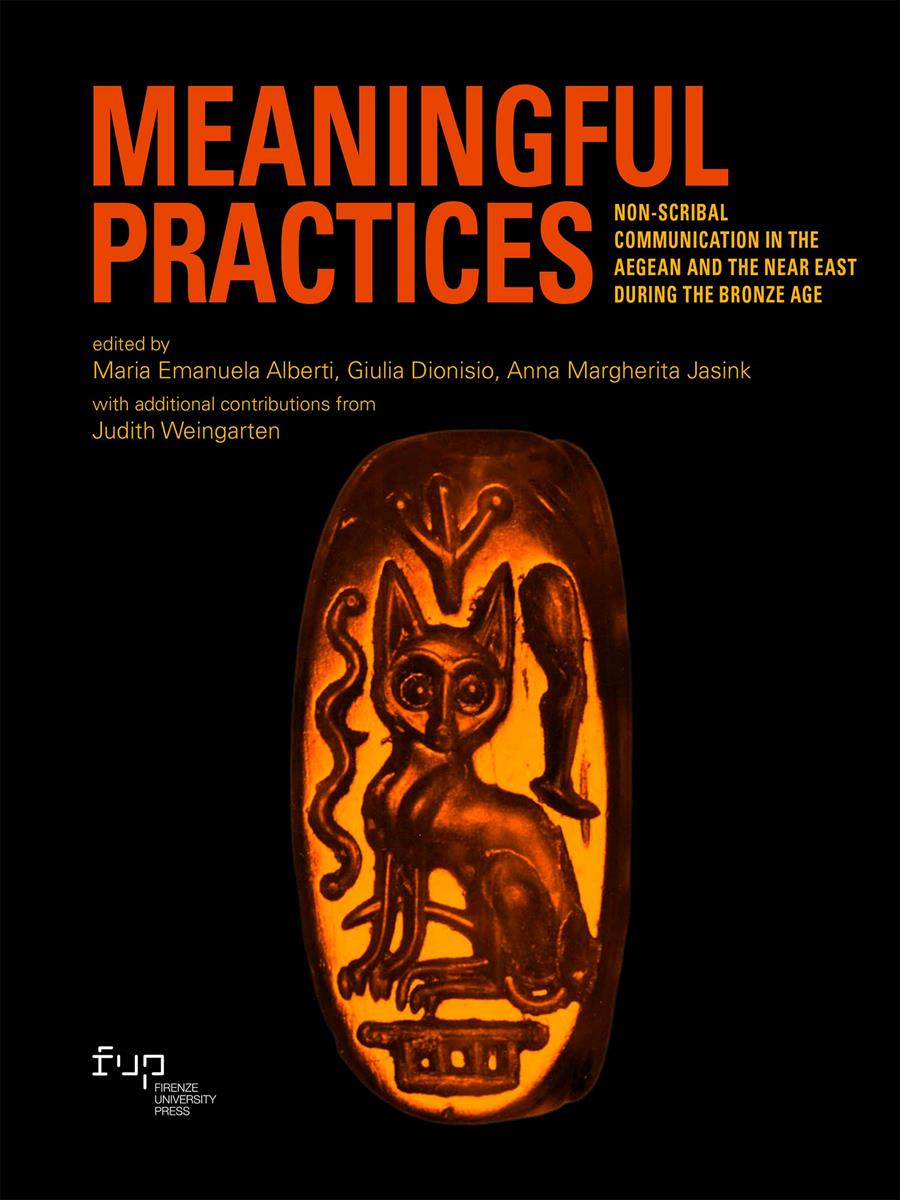
Meaningful Practices
Non-scribal Communication in the Aegean and the Near East during the Bronze Age
- A cura di:
- Maria Emanuela Alberti,
- Giulia Dionisio,
- Anna Margherita Jasink,
The volume explores some aspects of the nonscribal communication systems used by the Aegean and Eastern Mediterranean societies in the Bronze Age, ranging from seals, tokens, potter’s marks, weight and capacity systems, and marks on loom weights. The chronological span goes from the 4th millennium to the entire 2nd millennium BC, through the presentation of several case studies and methodological considerations. In these societies, writing is used, especially in official and administrative contexts, but nevertheless a wide range of other parallel communication codes is present. It is therefore necessary to investigate the semantic and social space occupied by these “other” codes and their importance also in a scribal context. This is a type of documentation that is rarely analysed as a whole and in a comparative way: and this is precisely the strength of the volume.
- Parole chiave:
- Bronze Age Mediterranean,
- Aegean,
- Levant,
- Communication,
- Codes,
- DOI: 10.36253/979-12-215-0765-2
- Collana: Strumenti per la didattica e la ricerca
- Comitato scientifico: Periploi – Studi Egei e Ciprioti
- Lingua: Inglese
- Argomento: Archeologia

University of Florence, Italy - ORCID: 0000-0002-5119-3581
University of Florence, Italy - ORCID: 0000-0003-1373-9173
University of Florence, Italy - ORCID: 0000-0001-5122-0482
Giulia Dionisio, with a PhD in Science for Cultural Heritage Conservation, is Curator of the University Museum System - University of Florence, for the collections of the Museum of Anthropology and Ethnology, dealing with issues related to the study, enhancement and dissemination of anthropological and ethnographic heritagemination of ethnographic heritage.
Anna Margherita Jasink was Associate Professor of Aegean Civilizations at the University of Florence and is the founder and co-director of Periploi. Series of Aegean and Cypriot Studies (FUP). Her interests span the entire Central-Eastern Mediterranean, in the context of an integrated use of textual and archaeological sources.
- Adawi Schreiber, L., Ortegal Izquierdo, A., Mejía Pérez, M., Rojas Leiva, A. 2011. Una aproximación al estudio de los quipus del MNAAHP. In: G. Urton, C. Arellano Hoffman (eds), Atando Cabos. Lima: Ministerio de Cultura: 239-263.
- Aimi, A. 2018. Scrittura. In: A. Aimi, A. Guarnotta (eds), Aztechi, Maya, Inca e le culture dell’antica America. Catalogo della mostra (Faenza, 11 novembre 2018-28 aprile 2019). Milano: SilvanaEditoriale: 146.
- Akkermans, P.M.M.G. 1996 (ed.). Tell Sabi Abyad. The Late Neolithic Settlement, II vols. Leiden: Nederlands Historisch-Archaeologisch Instituut te Istanbul.
- Akkermans, P.M.M.G., Duistermaat, K. 1996. Of storage and nomads. The sealings from the Late Neolithic Sabi Abyad, Paléorient 22 (2): 17-32.
- Alberti, G. 2005. The Earliest Contacts between Southeastern Sicily and Cyprus in the Late Bronze Age. In: R. Laffineur, E. Greco (eds), Emporia: Aegeans in the Central and Eastern Mediterranean. Proceedings of the 10th International Aegean Conference/10e Rencontre égéenne internationale, Athens, Italian School of Archaeology, 14-18 April 2004 (Aegaeum 25). Liège and Austin: Université de Liège, University of Texas at Austin: 343-351.
- Alberti, L. 2013. Middle Minoan III burial Customs at Knossos: a pianissimo intermezzo? In: C.F. Macdonald, C. Knappett (eds), Intermezzo. Intermediacy and Regeneration in Middle Minoan III Crete (British School at Athens Studies 21). London: British School at Athens: 47-55.
- Alberti, M.E. 2000. Les poids de Malia entre les premiers et les seconds palais : un essai de mise en contexte, Bulletin de Correspondence Hellenique 124/1: 57-73.
- Alberti, M.E. 2003. I sistemi ponderali dell’Egeo nell’età del Bronzo. Studi, storia, pratica e contatti, Annuario della Scuola Italiana di Atene 81, serie III,3, 2003/II (2005): 597-640.
- Alberti, M.E. 2006. Changing in Time: Some Aspects of the Aegean and Cypriot Balance Weights. In: M.E. Alberti, E. Ascalone and L. Peyronel (eds), Weights in Contexts. Bronze Age Weighing Systems of Eastern Mediterranean. Chronology, Typology, Material and Archaeological Contexts. Proceedings of the International Colloquium Rome 22nd-24th November 2004 (Studi e Materiali 13). Roma: Istituto Italiano di Numismatica: 315-340.
- Alberti, M.E. 2011. La levantinizzazione dei sistemi ponderali nell’Egeo dell’età del Bronzo. In: E. Ascalone and L. Peyronel (eds), Studi italiani di metrologia ed economia del Vicino Oriente Antico dedicati a Nicola Parise in occasione del Suo settantesimo compleanno (Studia Asiana 7). Roma: Herder: 1-42.
- Alberti, M.E. 2016a. Aegean Trade and Weighing Systems from EBA to EIA: How Changing Circuits Influenced Changing ‘Glocal’ Measures. In: B. Molloy (ed.), Of Odysseys and Oddities: Scales and Modes of Interaction between Prehistoric Aegean Societies and Their Neighbours (Sheffield Studies in Aegean Archaeology 10). Oxford: Oxbow Books: 277-322.
- Alberti, M.E. 2016b. I sistemi di misura micenei. In: M. Del Freo, M. Perna (a cura di), Manuale di epigrafia micenea. Introduzione allo studio dei testi in lineare B: 2. Padova: Libreria Universitaria: 691-724.
- Alberti, M.E. 2017. A Measured World? Measures in Minoan Daily Life. In: A.M. Jasink, J. Weingarten, S. Ferrara (eds.), Non Scribal Communication Media in the Bronze Age Aegean and Surrounding Areas. Periploi 9. Firenze: Firenze University Press: 3-40.
- Alberti, M.E. 2019a. Survival or Recycling? EH Balance Weights in Mycenaean Contexts. In: E. Borgna, I. Caloi, F. Carinci, R. Laffineur (eds), MNHMH/MNEME. Past and Memory in the Aegean Bronze Age. 17th International Aegean conference: Venezia-Udine 17-21 aprile 2018 (Aegaeum 43). Leuven-Liège: 659-662.
- Alberti, M.E. 2019b. Un probable poids du Bâtiment Dessenne et le pesage à Malia à l’Age du Bronze Moyen. In: M. Devolder, I. Caloi (eds), Le Bâtiment Dessenne et les abords Sud-Ouest du palais dans l’établissement pré- et protopalatial de Malia (Etudes crétoises 37). Athènes: 275-279.
- Alberti, M.E., Ascalone, E., Peyronel, L. 2006 (eds). Weights in Contexts. Bronze Age Weighing Systems of Eastern Mediterranean. Chronology, Typology, Material and Archaeological Contexts. Proceedings of the International Colloquium Rome 22nd-24th November 2004 (Studi e Materiali 13). Roma: Istituto Italiano di Numismatica.
- Alberti, M.E., Parise, N. 2005. Towards a Unification of Mass-Units between the Aegean and the Levant. In: R. Laffineur, E. Greco (eds), Emporia. Aegeans in the Central and Eastern Mediterranean, Proceedings of the 10th International Aegean Conference, Athens, Italian School of Archaeology, 14-18 April 2004 (Aegaeum 25). Liège and Austin: Université de Liège, and University of Texas at Austin: 383-390.
- Alberti. M.E., Aravantinos, V. 2006. The Balance Weights from the Kadmeia, Thebes. In: M.E. Alberti, E. Ascalone, L. Peyronel (eds), Weights in Contexts. Bronze Age Weighing Systems of Eastern Mediterranean. Chronology, Typology, Material and Archaeological Contexts. Proceedings of the International Colloquium Rome 22nd-24th November 2004 (Studi e Materiali 13). Roma: Istituto Italiano di Numismatica: 293-314.
- Alexiou, St. 1963. Ανασκαφή Κατσαμβά, Πρακτικά της εν Αθήναις Αρχαιολογική Εταιρεία: 189-200.
- Alexiou, St. 1967. Υστερομινωικοί τάφοι λιμένος Κνωσού (Κατσαμβά). Αθηνα: Η εν Αθήναις Αρχαιολογική Εταιρεία.
- Al-Radi, S.M.S. 1983. Phlamoudhi Vounari: A sanctuary site in Cyprus. Studies in Mediterranean Archaeology Vol. LXV. Paul Astroms Forlag.
- Alram-Stern, E. 2004. Die ägäische Frühzeit, 2. Serie, Forschungsbericht 1975-1993, 2. Band. Teil 1 und 2. Die Frühbronzezeit in Griechenland mit Ausnahme von Kreta, Veröffentlichungen der Mykenischen Kommission 21. Vienna: Austrian Academy of Sciences Press.
- Alram-Stern, E. 2014. Times of Change. Greece and the Aegean during the 4th millennium BC. In: Horejs and Mehofer 2014: 305-327.
- Alram-Stern, E., Horejs, B. 2018 (eds). Pottery Technologies and Sociocultural Connections Between the Aegean and Anatolia During the 3rd Millennium BC, Oriental and European Arc-haeology 10. Vienna: Austrian Academy of Sciences Press.
- Ameri, M., Kielt Costello, S., Jamison, G., Jarmer Scott, S. 2018. Seals and Sealing in the Ancient World. Cambridge: Cambridge university Press.
- Amiet, P. 1961. La glyptique Mésopotamienne archaique. Paris: Editions du CNRS (2nd ed. 1980).
- Amiet, P. 1972. Glyptique Susienne, des origins à l’époque des Perses Achéménides. Mémoires de la Délégation Archéologique en Iran XLIII. Paris: Paul Geuthner.
- Anastasiadou, M. 2010. Gruppen innerhalb der mittelminoischen dreiseitigen Prismen aus weichem Stein. In: W. Müller (ed.), Die Bedeutung der minoischen und mykenischen Glyptik: VI. Internationales Siegel-Symposium aus Anlass des 50 jährigen Bestehens des CMS, Marburg, 9.-12. Oktober 2008. CMS Beiheft 8. Mainz am Rhein: Verlag Philipp von Zabern: 57-72.
- Anastasiadou, M. 2011. The Middle Minoan Three-Sided Soft Stone Prism. A Study of Style and Iconography. CMS Beiheft 9. Darmstadt/Mainz: Verlag Philipp von Zabern.
- Anastasiadou, M. 2016. Drawing the Line: Seals, Scripts and Regionalism in Protopalatial Crete, American Journal of Archaeology 120: 159-193.
- Anastasiadou, M. 2016. Review of Dionisio, G., Jasink, A.M. Weingarten, J. 2014. Minoan Cushion Seals, Innovation in Form, Style and Use in Bronze Age Glyptic (Studia Archaeologica 215, Vicino Oriente 2). Roma: L'Erma di Bretschneider.
- Anastasiadou, M. 2019a. The seals from the Kamilari tholos in Grigori Koryphi and the Messarian tradition of seal engraving in Protopalatial and Neopalatial Crete. In: L. Girella, I. Caloi (eds), Kamilari: Una necropoli di tombe a tholos nella Messarà (Creta). Monografie della Scuola Archeologica di Atene e delle Missioni Italiane in Oriente 29. Athens: Scuola Archeologica Italiana di Atene: 485-520.
- Anastasiadou, M. 2019b. Étude des sceaux et empreintes de sceaux. In: M. Devolder, I. Caloi (eds), Le Bâtiment Dessene et les abords Sud-Ouest du palais dans l’établissement pré- et protopalatial de Malia. Études Crétoises 37. Athens: École française d’Athènes: 152-163.
- Anastasiadou, M. 2023. The Function and the Users of Protopalatial Seals: Seal Groups of East Central and East Crete. In: M.E. Alberti, A.M. Jasink, J. Weingarten (eds), Meaningful Practices (Periploi 12). Firenze: Firenze University Press.
- Anastasiadou, M. forthcoming. The seals and the seal impressions. In: C. Knappett (ed.), Palaikastro. British School at Athens Supplementary Volume.
- Anderson, E.S.K. 2016. Seals, Craft and Community in Bronze Age Crete. Cambridge: Cambridge University Press.
- Andersson Strand, E., Nosch, M.-L. (eds). 2015. Tools, Textiles and Contexts. Investigating Textile Production in the Aegean and Eastern Mediterranean Bronze Age. Ancient Textile Series (hereinafter ATS) 21. Oxford and Philadelphia: Oxbow Books.
- Andreadaki-Vlazaki, M. 1997. Craftsmanship at MM Khamalevri in Rethymnon. In R. Laffineur, P.P. Betancourt (eds), ΤΕΧΝΗ, Craftsmen, Craftswomen and Craftsmanship in the Aegean Bronze Age, Proceedings of the 6th International Aegean Conference Philadelphia, Temple University, 18-21 April 1996. Aegaeum 16. Liège and Austin: Universitéde Liège and University of Texas at Austin: 37-44.
- Angle, M., Dottarelli, R. 1990-91. Uslu Köy e la standardizzazione della ceramica, Origini XV: 375-400.
- Anson, D. 1974. The Rude Style (L.C. II-L.C. III pottery) and its affinities (unpublished M. Phil. thesis, The University of London).
- Anson, D. 1980a. Composition and provenance of Rude style and related wares, Report of the Department of Antiquities Cyprus: 109-127.
- Anson, D. 1980b. The Rude Style Late Cypriot IIC-III Pottery: an analytical typology, Opuscula Atheniensia 13: 1-18.
- Anson, D. 2017. Analysis and classification of variations in the shape of Mycenaean pictorial amphoroid kraters from Cyprus and the Levant, Mediterranean Archaeology 30: 1-18.
- Apostolakou, V., Brogan, T.M., Betancourt, P.P. 2020. Alatzomouri Pefka: A Middle Minoan IIB Workshop Making Organic Dyes. Prehistory Monographs 62. Philadelphia: INSTAP Academic Press.
- ARACHNE = arachne.uni-koeln.de. Website including the digitization of the Corpus of Minoan and Mycenaean seals. Heidelberg.
- Aravantinos, V. 2000. Νέα μυκηναϊκά ελεφαντουργήματα από τη Καδμεία (Θήβα). In: Α. Χριστοδούλου (ed.), Γ’ Συνέδριο Βοιωτικών Μελετών, Θήβα, 4-8 Σεπτεμβρίου 1996, Επετηρίς της Εταιρείας Βοιωτικών Μελετών: Γ’: α’. Αθήνα: Εταιρείας Βοιωτικών Μελετών: 31-120.
- Archi, A. 1987. Reflections On the System of Weights From Ebla. In: Eblaitica: Essays On the Ebla Archives and Eblaite Language, Vol. I: 47-89.
- Arellano Hoffmann, C. 2020. On Cords, Knots, Colors and Drawings. An Introduction. In: M. Setlak, V.R. Moscovich, S. Hyland, L. Milillo (eds), Quipus and Quipucamayoc. Encoding and administration in ancient Peru. Ernst & Young Consultores S. Civil de R.L.: 20-51.
- Asaro, F., Perlman, I. 1973. Provenience studies of Mycenaean pottery employing neutron activation analysis. In: Department of Antiquities, Cyprus (ed.), Acts of the International Archaeological Symposium « The Mycenaeans in the Eastern Mediterranean». Nicosia 27th March-2nd April 1972. Nicosia: Zavallis Press Ltd.: 213-224.
- Ascalone, E., Peyronel, L. 2006. I pesi da bilancia del Bronzo Antico e del Bronzo Medio (Materiali e Studi Archeologici di Ebla VII). Roma: Università degli Studi di Roma ‘La Sapienza’.
- Ascher, M. 1983. The Logico-Numerical System of the Inca Quipus, Annals of the History of Computing 5.3: 268-278.
- Åkerström, Å. 1987. Berbati: The Pictorial Pottery. Skrifter Utgivna av Svenska Institutet I Athen, 4°, 36:2. Stockholm: Paul Åströms Förlag.
- Åström, P. 1998. Hala Sultan Tekke 10. The Wells. Studies in Mediterranean Archaeology 45.10. Jonsered: Paul Åström Förlag.
- Åström, P., Bailey, D.M., Karageorghis, V. 1976. With contribution of several authors. Hala Sultan Tekke 1. Excavations 1897-1971. Göteborg: Paul Åströms Förlag.
- Aura Jorro, F., Adrados, F.R. 1985 and 1993. Diccionario micénico (vol. 1-2). Madrid: Consejo Superior de Investigaciones Científicas.
- Babbi, A., Bubenheimer-Erhart, F., Marìn-Aguilera, B., Muhl,S. 2015 (eds). The Mediterranean Mirror: Cultural Contacts in the Mediterranean Sea between 1200 and 750 B.C. International Post-doc and Young Researcher Conference, Heidelberg, 6th-8th October 2012 (Römisch- Germanisches Zentralmuseum Tagungen 20). Mainz: Verlag des Römisch-Germansichen Zentralmuseums. 360
- Baldacci, G. 2018. Low-Relief Potter’s Marks and the Phaistos Disc: A Not of the “Comb” Sign (N.21), Annuario (95): 65-79
- Balossi Restelli, F. 2006. The Development of «Cultural Regions» in the Neolithic of the Near East. The Dark Faced Burnished Ware Horizon. BAR International Series 1482. Oxford: Archaeopress.
- Balossi Restelli, F. 2019. Arslantepe Period VII. The Development of a Ceremonial/Political Centre in the first half of the 4th Millennium BC. Arslantepe Series vol. II. Roma: Arbor Sapientiae Editore.
- Banou, E., Hitchcock, L. 2013. The Lord of Vapheio: the social Identity of the Dead and its Implications for Laconia in the Late Helladic II-IIIA period. In: H. Cavanagh, W. Cavanagh, J. Roy (eds), Honouring the Dead in the Peloponnese (CPS Online Publication 2): 1-44.
- Barber, E. W. 1994. Women's Work: The First 20,000 Years. Women, Cloth, and Society in Early Times. New York, London: W.W. Norton & Company.
- Barnard, K.A., Brogan, T.M. 2003. Mochlos IB: Period III. The Neopalatial Settlement on the Coast: The Artisans’ Quarter and the Farmhouse at Chalinomouri. The Neopalatial Pottery (Prehistory Monographs 8). Philadelphia PA: INSTAP Academic Press.
- Bartelheim, M., Horejs, B., Krauß, R. 2016 (eds). Von Baden bis Troia. Ressourcennutzung, Metallurgie und Wissenstrasnfer. Eine Jubiläumsschrift für Ernst Pernicka. Oriental and European Archaeology 3. Vienna: Austrian Academy of Sciences Press.
- Bass, G.F., Throckmorton, P., Du Plat Taylor, J., Hennessy, J.B., Shulman, A.R., Buchholz, H.-G. 1967. Cape Gelidonya: A Bronze Age Shipwreck, Transactions of the American Philosophical Society 57(8): 1-177.
- Baxevani-Kouzioni, K., Markoulaki, S. 1996. Une tombe à chambre MR III à Pankalochori (nome de Réthymnon), Bulletin de Correspondence Hellenique 120: 641-703.
- Becker, M.J. 1976. Soft-stone sources on Crete, JFA 3:3: 361-374.
- Becker, N. 2015. Attribution Studies of golden Signet Rings: New Efforts in Tracing Aegean Goldsmiths and their Workshops, Aegean Archaeology 11: 73-88.
- Becker, N. 2018. Die goldenen Siegelringe der Ägäischen Bronzezeit. Heidelberg: Heidelberg University Publishing.
- Belanová Štolcová, T., Grömer, K. 2010. Loom-weights, spindles and textiles- textile production in central Europe from the Bronze Age to the Iron Age. In: E. Andersson Strand, M. Gleba, U. Mannering, Ch. Munkholt, M. Ringgaard (eds), North European Symposium for Archaeological Textiles X. ATS 5. Oxford and Oakville: Oxbow Books: 9-20.
- Beller, J.A. 2014. Discourse and Overview: A note on the Theory of Potmarks, UMASA 32: 1-11.
- Bender Jørgensen, L. 2012. Writing Craftsmanship? Vocabularies and Notation Systems in the Transmission of Craft Knowledge. In: W. Wendrich (ed.), Archaeology and Apprenticeship. Body Knowledge, Identity and Communities of Practice. Tucson: The University of Arizona Press: 240-254.
- Bennett, E.L. 1962. Names for Linear B Writing and for its Signs, Kadmos 2: 98-123.
- Bennett, E.L. 1950. Fractional Quantities in Minoan Bookkeeping, American Journal of Archaeology 54: 204-222.
- Bennett, E.L. 1980. Linear A Fractional Retractation, Kadmos 19: 12-23.
- Bennett, E.L. 1999. Minos and Minyas: Writing Aegean Measures. In: S. Deger-Jalkotzy, S. Hiller, O. Panagl (eds), Floreant Studia Mycenaea. Akten des X. Internationalen Mykenologischen Colloquiums in Salzburg vom 1.-5. Mai 1995. Band II. Wien: Verlag der Österreichischen Akademie der Wissenschaften: 159-175.
- Bennet, J. 1996. Marks on Bronze Age Pottery from Kommos. In: J.W. Shaw, M.C. Shaw (eds.), Kommos: an excavation on the south coast of Crete. 2, The Minoan hilltop and hillside houses; with contributions by John Bennet et al. Princeton: Princeton University Press: 313-321.
- Bennet, J. 2008. PalaceTM: Speculation on Palatial Production in Mycenaean Greece with (Some) Reference to Glass. In: C.M. Jackson, E.C. Wager (eds), Vitreous Materials in the Late Bronze Age Aegean. Oxford: Oxbow Books: 151-172.
- Bennison-Chapmann, L.E. 2018. Reconsidering «Tokens»: The Neolithic Origins of Accounting or Multifunctional, Utilitarian Tools?, Cambridge Archaeological Journal 29.2: 233-259.
- Bennison-Chapmann, L.E. 2019. Clay objects as «tokens»? Evidence for early counting and administration at Late Neolithic Tell Sabi Abyad, Mesopotamia, Levant 50.3: 305-337.
- Bentz Høgseth, H. 2012. Knowledge Transfer: The Craftsman’s Abstraction. In: W. Wendrich (ed.), Archaeology and Apprenticeship. Body Knowledge, Identity and Communities of Practice. Tucson: The University of Arizona Press: 61-78.
- Berg, I. 2015. Potting Skill and Learning Networks in Bronze Age Crete. In: W. Gauß, G. Klebinder- Gauß, C. Von Rüden (eds), The Transmission of Technical Knowledge in the Production of Ancient Mediterranean Pottery. Proceedings of the International Conference at the Austrian Archaeological Institute at Athens, 23rd-25th November 2012 Austria (Sonderschriften Band 54). Wien: Österreichisches Archäologisches Institut: 17-34.
- Berger, D., Pernicka, E., Nessel, B., Brügmann, G., Frank, C., Lockhoff, N. 2014. Neue Wege zur Herkunftsbestimmung des bronzezeitlichen Zinns, Blickpunkt Archäologie 4: 76-82.
- Bergner, M., Horejs, B., Pernicka, P. 2009. Zur Herkunft der Obsidianartefakte vom Çukuriçi Höyük, Studia Troica 18: 251-273.
- Bernabò Brea, L. 1958. I contrassegni sulle ceramiche eoliane ed il loro significato. Palermo: Meligunìs Lipari III.
- Bernabò-Brea, L. 1964. Poliochni. Città preistorica nell’isola di Lemnos I. Rome: «L'erma» di Bretschneider.
- Bernbeck, R. 2009. Class conflicts in ancient Mesopotamia, Anthropology of the Middle East 4(1): 33-64.
- Bernbeck, S., Burmeister, R. (eds.). 2017. The Interplay of People and Technologies. Archaeological Case Studies on Innovation. Berlin: Edition Topoi/Exzellenzcluster Topoi der Freien Universität Berlin und der Humboldt-Universität zu Berlin.
- Berriman, A.E. 1955. Some Marked Weights in the Petrie Collection, The Journal of Egyptian Archaeology 41: 48-50.
- Betancourt, P.P. (ed.). 2006. The Chryssokamino Metallurgy Workshop and its Territory. Hesperia Suppl. 36. Athens: American School of Classical Studies at Athens.
- Betancourt, P.P. 2003. Excavations at Hagios Charalambos, 2003, Kentro, The Newsletter of the INSTAP Study Center for East Crete 6 (Fall 2003): 8-9.
- Betancourt, P.P., Apostolakou, V., Brogan, T.M. 2012. The workshop for making dyes at Pefka, Crete. In: M.L. Nosch, R. Laffineur (eds), Kosmos: Jewellery, Adornment and Textiles in the Aegean Bronze Age. Proceedings of the 13th International Aegean Conference/13e Rencontre égéenne internationale, University of Copenhagen, Danish National Research Foundation's Centre for Textile Research, 21-26 April 2010. Aegaeum 33. Leuven and Liege: Peeters: 183-186.
- Betancourt, P.P., Davaras, C., Simpson, R.H. 2005. Pseira IX. The Archaeological Survey of Pseira Island, Part 2: The Intensive Survey, Philadelphia: INSTAP Academic Press.
- Betancourt, P.P., Davaras, C., Stravropodi, E. 2008. Excavations in the Hagios Charalambos cave: A preliminary report, Hesperia 77: 539-605.
- Bettelli, M., Cardarelli, A. 2010. La spada di bronzo e la grappa di stagno. In: M.C. Martinelli (ed.), Archeologia delle Isole Eolie. Il villaggio dell’età del Bronzo Medio di Portella di Salina. Ricerche 2006 e 2008. Muggio: Rebus Edizioni: 165-171.
- Bettelli, M., Martinelli, M.C. 2024. Le Eolie e la Grecia micenea. In: A. Crispino, R. Jung (eds), Il regno di Ahhijawa. I Micenei e la Sicilia. Roma - Bristol (CT): «L’Erma» di Bretschneider: 125-130.
- Betts, J.H. 1967. New Light on Minoan Bureaucracy. A Re-Examination of some Cretan Sealings, Kadmos 6: 15-40.
- Betts, J.H., 1989. Seals of Middle Minoan III: Chronology and technical revolution. In: I. Pini (ed.), Fragen und Probleme der bronzezeitlichen ägäischen Glyptik. Beiträge zum 3. Internationalen Marburger Siegel-Symposium, 5.-7. September 1985. CMS Beiheft 3. Berlin: Gebr. Mann Verlag: 1-17.
- Bevan, A., Bloxham, E. 2017. Stonemasons and Craft Mobility in the Bronze Age Eastern Mediterranean. In: E. Kiriatzi, C. Knappett (eds.), Human Mobility and Technological Transfer in the Prehistoric Mediterranean. British School at Athens Studies in Greek Antiquity. Cambridge: Cambridge University Press: 68-93.
- Bieliński, P. 2019. A small Ninevite 5 Period Shrine from Tell Arbid. In: P. Abrahami, L. Battini (eds), Ina dmarri u qan tuppi. Par la béche et le stylet! Cultures et sociétés syro-mesopotamiennes. Mélanges offerts à Olivier Rouault. Ancient Near Eastern Archaeology 5. Oxford: Archaeopress: 61-67.
- Bikaki, A.H. 1984. Keos Volume IV. Ayia Irini, the potters' marks. Mainz am Rhein: Verlag Philipp von Zabern.
- Biscione, R. 1982. La ceramica del III millennio. In: P.E. Pecorella, M. Salvini (eds), Tell Barri/Kaḫat 1. Relazione preliminare sulle campagne 1980 e 1981 a Tell Barri / Kaḫat, nel bacino del Habur. Consiglio Nazionale delle Ricerche, Istituto per gli Studi Micenei ed Egeo- Anatolici. Roma: 45-54.
- Biscione, R. 1998. La sequenza del III millennio a Tell Barri/ Kaḫat: l’area B. In: P.E. Pecorella (ed.), Tell Barri/Kaḫat 2. Documenta Asiana V, CNR/Università degli Studi di Firenze. Roma: 35-64.
- Blakolmer, F. 2010. Small is beautiful. The Significance of Aegean Glyptic for the Study of Wall Paintings, Relief Frescoes and Minor Relief Arts. In: W. Müller (ed.), Die Bedeutung der minoischen und mykenischen Glyptik VI. internationales Siegel-Symposium aus Anlass des 50 jährigen Bestehens des CMS, Marburg, 9.-12. Oktober 2008 (Corpus der minoischen und mykenischen Siegel Beiheft 8). Berlin: Mann: 91-108.
- Blakolmer, F. 2016. Il Buono, il Brutto, il Cattivo? Character, Symbolism and Hierarchy of Animals and supernatural Creatures in Minoan and Mycenaean Iconography, Creta Antica 17: 97-183.
- Blanton, R. 1998. Beyond Centralization: Steps Towards a Theory of Egalitarian Behavior in Archaic States. In: G.M. Feinmann, J. Marcus (eds), Archaic States. Santa Fe: School of American Research: 135-172.
- Blasingham, A.C. 1983. The Seals from the Tombs of the Mesara: inferences as to Kinship and social Organisation. In: O. Kryszkowska, L. Nixon, (eds), Minoan Society. Proceedings of the Cambridge Colloquium 1983. Bristol: Bristol Classical Press: 11-21.
- Blegen, C.W., Rawson, M. 1966. The Palace of Nestor at Pylos in Western Messenia. Vol I. The Buildings and their Contents. Princeton: Princeton University Press.
- Blegen, C.W., Rawson, M., Taylour, W., Donovan, W.P. 1973. The Palace of Nestor at Pylos in Western Messenia. Vol III. Acropolis and Lower Town: Tholoi, grave circle, and chamber tombs. Discoveries outside the citadel. Princeton: Princeton University Press.
- Blondel, N. 2001. Céramique: vocabulaire technique. Paris: Monum, Éditions du patrimoine.
- Blum, St.W.E., Riehl, S.B. 2015. Troy in the 23rd century BC – environmental dynamics and cultural change. In: Meller, H., Arz, H.W., Jung, R., Risch, R. 2015 (eds). 2200 BC –Ein Klimasturz als Ursache für den Zerfall der Alten Welt?/2200 BC – A climatic breakdown as a course for the collapse of the old world? 7. Mitteldeutscher Archäologentag vom 23. bis 26. Oktober 2014 in Halle (Saale)/7th Archaeological Conference of Central Germany, 23th-26th October 2014, Halle (Saale). Halle (Saale): Landesamt für Denkmalpflege und Archäologie Sachsen-Anhalt: 181-203.
- Boehmer, R.M. 1999. Uruk. Früheste Siegelabrollungen. Mainz: Philip von Zabern.
- Borchardt, L. 1937. Catalogue general des antiquites egyptiennes du musee du Caire, DENKMÄLER DES ALTENREICHES. Berlin.
- Bordreuil, E. 2006. Preliminary considerations for a typology of the weights of the Late Bronze Age discovered at Ras Shamra-Ugarit. Archaeological and textual data. In: M.E. Alberti, E. Ascalone, L. Peyronel (eds), Weights in Contexts. Bronze Age Weighing Systems of Eastern Mediterranean. Chronology, Typology, Material and Archaeological Contexts. Proceedings of the International Colloquium Rome 22nd-24th November 2004 (Studi e Materiali 13). Roma: Istituto Italiano di Numismatica: 203-232.
- Bordreuil, E. 2008. Les poids du palace royale d’Ougairt dans leur contexte archeologique et epigraphique. In: Le mobilier du Palais royal d’Ougarit, RSO XVII. Lyon: Maison de l’Orient et de la Méditerranée: 215-245.
- Bordreuil, E. 2023. The weights of Ras Shamra-Ugarit in the Late Bronze Age - Weight units in the texts, typology of the weights and statistical study. In: G. Chambon, A. Otto (eds), Weights and Measures as a Window on Ancient Near Eastern Societies (Münchener Abhandlungen zum Alten Orient 9). Gladbeck: PeWe Verlag: 61-72.
- Borg, G., Wolf, D. 2012. Systematic differences between prehistoric and modern metal provinces in Western Turkey as a result of supergene modification. Implications for archaeological provenance studies. In: C. Helvacı, Y. Yılmaz, Y. Ersoy, H. Brückner, Ş. Tül, Ö. Sümer (eds), IESCA 2012. Abstracts. International Earth Science Colloquium on the Aegean Region, IESCA-2012, 1st-5th October 2012, İzmir, Turkey. Izmir: Dokuz Eylül University Press: 167.
- Bosanquet, R.C. 1901/02. Excavations at Palaikastro I, BSA 8: 286-316.
- Bourogiannis, G. 2022 (ed.). Beyond Cyprus: Investigating Cypriot Connectivity in the Mediterranean from the Late Bronze Age to the End of the Classical Period. (AURA Supplement 9). Athens: National and Kapodistrian University of Athens, Faculty of History and Archaeology.
- Boyd-Hawes, H, Williams, B.E., Seager, R.B., Hall, E. 1908. Gournia, Vasiliki and other Prehistoric Sites on the Isthmus of Hierapetra Crete. Excavations of the Wells-Houston-Cramp Expeditions 1901, 1903, 1904. Philadelphia: INSTAP Academic Press.
- Bradfer-Burdet, I. 2005. Une kouloura dans le «Petit Palais» de Malia. In: I. Bradfer-Burdet, B. Detournay, R. Laffineur (eds), Κρης Τεχνίτης. L'artisan crétois: Recueil d'articles en l'honneur de Jean-Claude Poursat, publié à l'occasion des 40 ans de la découverte du Quartier Mu. Aegaeum 26. Liège and Austin: Université de Liège Histoire de l'art et archéologie de la Grèce antique and University of Texas at Austin: 39-49.
- Brandes, M.A. 1979. Siegelabrollungen aus den Archaischen Bauschichten in Uruk-Warka. Wiesbaden.
- Brandherm, D., Heymans, E., Hofmann, D. 2018 (eds). Gifts, Goods and Money. Comparing currency and circulation systems in past societies. Oxford: Archaeopress.
- Branigan, K. 1988. Social Security and the State in Middle Bronze Age Crete. In: R. Laffineur (ed.), Annales d’Archéologie Égéene de l’Université de Liѐge (Aegaeum 2). Liѐge: Université de l’ Etat à Liѐge: 11-16.
- Breglia, L. 1958. Questioni ponderali. In: Centennial publication of the American Numismatic Society. New York: The American Numismatic Society: 147-166.
- Breniquet, C. 1996. La disparition de la culture de Halaf. Paris: Editions Recherche sur les Civilisations.
- Brice, W.C. 1997. Notes on the Cretan Hieroglyphic Script VII, The «Seated Bird» Sign, Evans No. 80, Kadmos 36: 93-96.
- Britsch, Ch. in press. Early Textile Technologies in the Anatolian-Aegean World – From Neolithic to Early Bronze Age. Çukuriçi Höyük Series, Oriental and European Archaeology Series. Vienna: Austrian Academy of Sciences Press.
- Britsch, Ch., Horejs, B. 2014. The role of textile production and fishing in the EBA metallurgical centre of Çukuriçi Höyük, Egypt and the Levant 24: 229-242.
- Britsch, Ch., Horejs, B. 2020. Agencies of textile production in western Anatolian and Aegean prehistory. In: L. Quillien, K. Sarri (eds), Textile Workers. Skills, Labour and Status of Textile Craftspeople Between the Prehistoric Aegean and the Ancient Near East. Proceedings of the Workshop held at 10th ICAANE in Vienna, April 2016. Vienna: Austrian Academy of Sciences Press: 75-90.
- Brogan, T.M. 2006. Tipping the Scales: Evidence for Weight Measurement from the Wider Neopalatial Community at Mochlos. In: M.E. Alberti, E. Ascalone, L. Peyronel (eds), Weights in Contexts. Bronze Age Weighing Systems of Eastern Mediterranean. Chronology, Typology, Material and Archaeological Contexts. Proceedings of the International Colloquium Rome 22nd-24th November 2004 (Studi e Materiali 13). Roma: Istituto Italiano di Numismatica: 233-264.
- Brogan, T.M. 2008. Metalworking at Mochlos before the Appearance of the Artisans’ Quarter. In: I. Tzachili (ed.), Aegean Metallurgy in the Bronze Age. Proceedings of an International Symposium held at the University of Crete, Rehymnon, Greece, on November 19-21, 2004. Athens: Ta Pragmata: 157-168.
- Broodbank, C. 2013. The Making of the Middle Sea. A History of the Mediterranean from the Beginning to the Emergence of the Classical World. Oxford: Thames & Hudson Ltd.
- Brysbaert, A., Vetters, M. 2013. A moving story about exotica: objects’ long-distance production chains and associated identities at Tiryns, Greece, Opuscula 6: 175-210.
- Budja, M. 1998. Clay tokens - accounting before writing in Eurasia, Documenta Praehistorica 25: 219-235.
- Budka, J. Kammerzell, F., Rzepka, S. 2015. Non-textual Marking Systems in Ancient Egypt (and Elsewhere): An Introduction. In: J. Budka, F. Kammerzell, S. Rzepka (eds.), Non-Textual Marking Systems in Ancient Egypt (and Elsewhere). Lingua Aegyptica Studia Monographica Band 16. Hamburg: Widmaier Verlag: 1-8.
- Buell, D.M, McEnroe, J.C. 2017. Community Building/Building Community at Gournia. In: Q. Letesson, C. Knappett (eds), Minoan Architecture and Urbanism: New perspectives on an Ancient Built Environment. Oxford: Oxford University Press: 204-227.
- Burke, B. 2003. The spherical loom weights. In: P.A. Mountjoy (ed.), Knossos: The South House, The British School at Athens Supplementary Volume 34. London: The British School at Athens: 195-197.
- Burke, B. 2006. Textile Production at Petras: the Evidence from House 2. In: Pepragmena 9. Diethnus Krētologiku Synedriu. Tomos A1, Proïstorikē periodos-anaskafika dedomena. Heraklion: Hetairia Krētikōn Historikōn Meletōn: 280-295.
- Burke, B. 2010. From Minos to Midas. Ancient Cloth Production in the Aegean and in Anatolia (Ancient Textile Series vol. 7). Oxford and Oakville: Oxbow Books.
- Büyükkolancı, M. 2007a. Apaša, das alte Ephesos und Ayasoluk. In: J. Cobet, V. von Graeve, W.- D. Niemeierm, K. Zimmermann (eds), Frühes Ionien. Eine Bestandsaufnahme. Panionion- Symposion Güzelçamlı, 26. September-1. Oktober 1999. Milesische Forschungen 5. Mainz: Verlag Philipp von Zabern: 21-26.
- Büyükkolancı, P. 2007b. Ayasuluk Tepesi 2005 Yılı Kazısı, Müze Çalışmaları ve Kurtarma Kazıları Sempozyumu 15 (2006): 75-82.
- Cadogan, G. 1980. «Pyrgos, Crete, 1970-7.», AR 1977-1978: 70-84.
- Cadogan, G. 2011. Behind the Façade: What Social Realities and Political Realities are Behind the Cultural Regionalities of Middle Minoan Crete? In: M. Andreadaki-Vlazaki, E. Papadopoulou (eds), Pepragmena Ι’ Diethnous Kritologikou Synedriou/Proceedings of the 10th Cretological Conference, Hania, 1-8 October 2006, Volume A1. Chania: 127-139.
- Carter, E., Campbell S., Gauld, S. 2003. Elusive complexity: New data from Late Halaf Domuztepe in South Central Turkey, Paléorient 29 (2): 117-133.
- Carter, R.A., Philip, G. 2010 (eds). Beyond the Ubaid. Transformation and Interaction in the Late Prehistoric Societies of the Middle East. Studies in Ancient Oriental Civilization 63. The Oriental Institute. Chicago: The University of Chicago Press.
- Caskey, J.L. 1958. Excavations at Lerna 1957, Hesperia 27: 125-144.
- Catling, H.W. 1957. Chapter III. The Bronze Age Pottery. In: J. Du Plat. Taylor (ed.), Myrtou Pigadhes: A Late Bronze Age Sanctuary in Cyprus. Oxford: Ashmolean Museum: 26-59.
- Catling, H.W., Karageorghis, V. 1960. Minoika in Cyprus, The Annual of the British School at Athens 55: 108-127.
- Catling, H.W., Millett, A. 1965. A study in the composition patterns of Mycenaean pictorial pottery from Cyprus, The Annual of the British School at Athens 60: 212-224.
- Catling, H.W., Richards, E.E., Blin-Stoyle, A.E. 1963. Correlations between composition and provenance of Mycenaean and Minoan pottery, The Annual of the British School at Athens 58: 94-115.
- Chadwick, J. 1979. The Minoan Origin of the Classical Cypriote Script, Acts RCC: 139-143.
- Chambon, G. 2006. Weights in the documentation from Mari: the issue of the norm. In: M.E. Alberti, E. Ascalone, L. Peyronel (eds), Weights in Contexts. Bronze Age Weighing Systems of Eastern Mediterranean. Chronology, Typology, Material and Archaeological Contexts. Proceedings of the International Colloquium Rome 22nd-24th November 2004 (Studi e Materiali 13). Roma: Istituto Italiano di Numismatica: 185-202.
- Chambon, G. 2011. Normes et pratiques – L’homme, la mesure et l’écriture en Mésopotamie I (Berliner Beiträge zum Vorderen Orient vol. 21). Berlin: PeWe Verlag.
- Chambon, G., Otto, A. 2023 (eds). Weights and Measures as a Window on Ancient Near Eastern Societies (Münchener Abhandlungen zum Alten Orient 9). Gladbeck: PeWe Verlag.
- Cherry, J.F. 1986. Polities and Palaces: Some Problems in Minoan state Formation. In: C. Renfrew, J. F. Cherry (eds), Peer Polity Interaction and Socio-Political Change. Cambridge: Cambridge University Press: 19-45.
- CHIC Olivier, J.-P., Godart, L. 1996. Corpus Hieroglyphicarum Inscriptionum Cretae. Études Crétoises XXXI. Paris.
- Chmielewski, T.J. 2009. Po nitce do kłębka…O przędzalnictwie i tkactwie młodszej epoki kamienia w Europie środkowej. Warszawa: Semper.
- Christakis, K.S. 2014. The Sanctuary of Hermes and Aphrodite at Syme Vianou V: Σημεία Κεραμέων. Potters’ Marks from Syme and Other Sites of Bronze Age Crete (Library of the Archaeological Society at Athens 293). Athens: Archaeological Society at Athens.
- Christakis, K.S. 2016. From Potter’s Mark to the Potter who Marks. In: M. Mina, S. Triantaphyllou and Y. Papadatos (eds.), An Archaeology of Prehistoric Bodies and Embodied Identities in the Eastern Mediterranean. Oxford: Oxbow Books: 136-144.
- Cipriani, L. 1928. Su due «quipus» del Museo Nazionale di Antropologia e Etnologia di Firenze. In: Atti del XXII Congresso Internazionale degli Americanisti (Roma – Settembre 1926), Vol. I. Roma: Stabilimento Tipografico Riccardo Garroni: 471-480.
- Cipriano, S. 2018. Spinning and weaving at the sanctuary of Reitia in Este (Italy) during Roman Times. In: M.S. Busana, M. Gleba, F. Meo, A.R. Tricomi (eds), PURPUREAE VESTES VI. Textiles and Dyes in the Mediterranean Economy and Society, Proceedings of the VIth International Symposium on Textiles and Dyes in the Ancient Mediterranean World (Padova- Este-Altino, Italy 17-20 October 2016). Zaragoza: Libros Pórticos: 325-331.
- Civitillo, M. 2007. Alcune riflessioni intorno ad AB 80 e alla cosiddetta «cat mask» del geroglifico minoico, Rend. Mor. Att Lincei, s. 9, v.18: 621-660.
- Civitillo, M. 2016. La scrittura geroglifica minoica sui sigilli: Il messaggio della glittica protopalaziale. Biblioteca di «Pasiphae» 12. Pisa-Roma.
- Civitillo, M. 2021. R.E.A.D.I.N.G. Cretan Hieroglyphic inscriptions on seals, Pasiphae 15: 83-108. Civitillo, M. 2023. Sul sigillo prismatico CHIC #294: «Le premier sceau Hiérogliphique de la littérature crètoise» tra letterature ottocentesche e ipotesi alternative attuali. In: Atti del Convegno internazionale in onore di M.L. Chirico. Università della Campania «Luigi Vanvitelli», 10-12 novembre 2021: 53-74. Evans, A.J. 1909. Scripta Minoa I. The Hieroglyphic and Primitive Linear Classes. Oxford.
- Clancier, Ph., Joannès, F., Rouillard, P., Tenu, A. 2005 (eds). Autour de Polanyi : vocabulaires, théories et modalités des échanges. Nanterre, 12-14 juin 2004 (Colloques de la Maison René- Ginouvès archéologie et ethnologie 1). Paris: de Boccard.
- CMS – Corpus der minoischen und mykenischen Siegel volumes I-XIII and Beihefte 1-10, Berlin: Mann 1964-2000; Mainz: von Zabern 2002-2011; Heidelberg: Propylaeum 2018-; cf. https:// books.ub.uni-heidelberg.de/propylaeum/catalog/series/cms for open access copies, accessed on 10/02/2023.
- Cooper, A. 1918. The creation of the chinese script. London: China Society.
- Corazza, M., Ferrara, S., Montecchi, B., Tamburini, F., Valerio, M. 2021. The mathematical values of fraction signs in the Linear A script: A computational, statistical and typological approach, Journal of Archaeological Science 125: 1-14.
- Costello, S.A. 2000. Memory Tools in early Mesopotamia, Antiquity 74: 475-476.
- Courtois, J.-C. 1971. Le sanctuaire du dieu au lingot d’Enkomi-Alasia. Chypriote Fer I. XIIe - XIe siècles avant J.-C. Paris: Collège de France.
- Courtois, J.-C. 1984. Chapter VIII: pierre: poids. In: Alasia III. Les objets des niveaux stratifies d’Enkomi (fouilles C.F.-A. Schaeffer 1947-1970). Paris: éditions recherche sur les civilisations, memoire n. 33: 107-134.
- Crişan, I., Vidican, R., Morea, A., Simea, Ş. 2018. Dyeing potential of linen fabric with iris flower extracts, ProEnvironment 11: 223-227.
- Crispino, A. 2024. Thapsos. In: A. Crispino, R. Jung (eds), Il regno di Ahhijawa. I Micenei e la Sicilia. Roma - Bristol (CT): «L’Erma» di Bretschneider: 131-138.
- Crouwel, J. 1991. The Mycenaean Pictorial Pottery. Well Built Mycenae. The Helleno-British Excavations within the Citadel at Mycenae, 1959-1969. Fascicule 21. Oxford: Oxbow Books.
- Crouwel, J. 2006. Late Mycenaean pictorial pottery. A brief review. In: Rystedt, E., Wells, B. 2006 (eds). Pictorial Pursuits: Figurative Painting on Mycenaean and Geometric Pottery. Papers from two seminars at the Swedish Institute at Athens in 1999 and 2001. Skrifter Utgivna av Svenska Institutet i Athen, 4°, LIII. Stockholm: Paul Åströms Förlag: 15-22.
- Crouwel, J.H., Morris. C.E. 2015. The Minoan amphoroid krater: From production to consumption, The Annual of the British School at Athens 110: 147-201.
- Crumley, L.C. 1995. Heterarchy and the Analysis of the Complex Societies. In: R.M. Ehrenreich, C.L. Crumley, J.L. Levy (eds), Heterarchy and the Analysis of Complex Societies. Washington, DC: American Anthropological Association: 1-6.
- Cutler, J. 2016. Fashioning Identity: Weaving Technology, Dress and Cultural Change in the Middle and Late Bronze Age Southern Aegean. In: E. Gorogianni, P. Pavúk, L. Girella (eds), Beyond Thalassocracies. Understanding Processes of Minoanisation and Mycenaeanisation in the Aegean. Oxford and Philadelphia: Oxbow Books: 172-185.
- Cutler, J. 2019. Arachne’s web: women, weaving and networks of knowledge in the Bronze Age southern Aegean, The Annual of the British School of Athens 114: 79-92.
- Cutler, J. 2021.Crafting Minoanisation: Textiles, Crafts Production & Social Dynamics in the Bronze Age Southern Aegean. ATS 33. Oxford and Philadephia: Oxbow Books.
- Cutler, J., Andersson Strand, E. 2018. Textile production at three Middle Minoan centres. In: Πεπραγμένα του ΙΑ' Διεθνούς Κρητολογικού Συνεδρίου (Ρέθυμνο, 21-27 Οκτωβρίου 2011), A1.3. Ρέθυμνο: Ιστορική και Λαογραφική Εταιρεία Ρεθύμνης: 41-57.
- Cveček, S. 2022. Çukuriçi Höyük 4. Household Economies in the Early Bronze Age Aegean. Oriental and European Archaeology 25. Vienna: Austrian Academy of Sciences Press.
- Czichon, R.M., Werner, P. 1998. Tall Munbaqa-Ekalte: Die bronzezeitlichen Kleinfunde. Ausgrabungen in Tall Munbāqa-Ekalte 1, Wissenschaftliche Veröffentlichung der Deutschen Orient-Gesellschaft, Saarbrücker Druckerei und Verlag, Saarbrücke.
- D’Anna, MB., Guarino, P. 2010. Continuity and changes in the elite food management during the 4th millennium BC. Arslantepe Period VII and VIA: A comparison. In: M. Frangipane (ed.), Economic Centralisation in Formative States. The Archaeological reconstruction of the economic system in 4th millennium Arslantepe. Studi di Preistoria Orientale 3. Roma: Dip. Scienze dell’Antichità, Università Sapienza: 193-204.
- D’Anna, M.B., Guarino, P. 2012. Pottery production and use at Arslantepe between Periods VII and VIA. Evidence for social and economic change, Origini 34: 49-68.
- D’Onofrio, A.M. 2007a. A Preliminary Survey of Evidence for Counters and Tokens in the Aegean and Hellenic World. In: A.M. D’Onofrio (ed.), Tallies, Tokens & Counters. From the Mediterranean to India: A Cross-Cultural Approach. Napoli: Università degli Studi di Napoli «L’Orientale»: 85-103.
- D’Onofrio, A.M. 2007b. Tallies, Tokens & Counters: An Introduction. In: A.M. D’Onofrio (ed.), Tallies, Tokens & Counters. From the Mediterranean to India: A Cross-Cultural Approach. Napoli: Università degli Studi di Napoli «L’Orientale»: 7: 1-7.
- Dakouri-Hild, A. 2005. Breaking the Mould? Production and Economy in the Theban State. In: A. Dakouri-Hild, S. Sherratt (eds), Autochthon. Papers presented to O.T.P.K. Dickinson on the occasion of his retirement (British Archaeological Reports International Series 1432). Oxford: Archaeopress: 207-224.
- Dakouri-Hild, A. 2012. Making La Différence: The Production and Consumption of Adornments in Late Bronze Age Boeotia. In: M.L. Nosch, R. Laffineur (eds), Kosmos. Jewellery, Adornment and Textiles in the Aegean Bronze Age, 13th International Aegean Conference, University of Copenhagen, 19-22 April 2010 (Aegaeum 33). Leuven: Peeters: 471-482.
- Daux, G. 1965. Chronique des fouilles et découvertes archéologiques en Grèce en 1964, BCH 89: 683-1007.
- Daux, G. 1966. Chronique des fouilles et découvertes archéologiques en Grèce en 1965, BCH 90: 715-1019.
- Davidson, G.R. 1952. Corinth: Results of the Excavations Conducted by the American School of Archaeology at Athens. XII. The Minor Objects. Princeton: American School of Classical Studies at Athens.
- Davis, J.L. 1979. Minos and Dexithea. Crete and the Cyclades in the later Bronze Age. Paper in Cycladic Prehistory. University of California, Institute of Archaeology, Monograph 14.
- Davis, J.L., Stocker, S.R. 2016. The Lord of the Gold Rings: The Griffin Warrior of Pylos, Hesperia 85: 627-655.
- Dawkins, R.M., 1903/04. Excavations at Palaikastro. III, Annual of the British School Athens 10: 192-226.
- De Benedictis, E. (forthcoming). Weighing in Late Bronze Age Cyprus: equipment and practices. Ph.D. Thesis, University of Cyprus.
- De Benedictis, E., Meneghetti, F. 2024. Dealing with and Analyzing Legacy Data: An Interdisciplinary, GIS-based Approach to Study the French Excavations at Enkomi (Cyprus), Near Eastern Archaeology 87.4: 220-230.
- De Fidio, P. 2024. The absolute values of the symbols for weight. In: J. Killen (ed.), The New Documents in Mycenaean Greek. Cambridge: Cambridge University Press, vol. I: 137-168.
- De Garis Davies, N. 1943. The Metropolitan Museum of Art Egyptian expedition: the tomb of Rekh-Mi-Re’ at Thebes. Volume II. New York: Publications of the Metropolitan Museum of Art.
- Del Freo, M. 2021. Wool working at Hagia Triada: The HT 24 Tablet and the 45 Noduli from the Quartiere Sudovest. In: B. Davis, R. Laffineur (eds), Neôteros. Studies in Bronze Age Aegean Art and Archaeology in Honor of Professor John G. Younger (Aegaeum 44). Leuven: Peeters: 55-66.
- Demakopoulou, K. 2020. A Mycenaean pictorial vase from Midea, Opuscula. Annual of the Swedish Institutes at Athens and Rome 13: 113-121.
- Demakopoulou, K., Divari-Valakou, N., Maran, J., Mommsen, H., Prillwitz, S., Walberg, G. 2017. Clay paste characterization and provenance determination of Middle and Late Helladic vessels from Midea, Opuscula. Annual of the Swedish Institutes at Athens and Rome 10: 7-49.
- Derin, Z. 2020. İzmir – Yeşilova Höyüğü 2016-2018 Yılı Çalışmaları, Kazı Sonuçları Toplantısı 48 41/4 (2019): 525-547.
- Derin, Z., Erdem, M.A., Ҫelik, Ö., Mamikoğlu, M. 2020. Yassıtepe Höyüğü, İzmir Araştırmaları Dergisi 12: 61-74.
- Derin, Z., Eroğlu, G.S., Erden, A.G., Yurtsever, M., Kızıl, M., Yıldırım, Y, Öztürk, M. 2017. İzmir’in Prehistorik Yerleşim Alanı Yeşilova Höyüğü 2015 Yılı Çalışmaları, Kazı Sonuçları Toplantısı 38/2 (2015): 143-160.
- Detournay, B., Poursat, J.-C., Vandenabeele, F. 1980. Fouiles éxecutées a Mallia, le quartier Mu, II. Vases de pierre et de métal, vannerie, figurines et reliefs d'appliqué, éléments de parure et de décoration, armes, sceaux et empreintes (Etudes crétoises XXVI). Paris: Librairie Orientaliste Paul Geuthner.
- Devolder, M. 2017. The Functions of Masons’ Marks in the Bronze Age Palace at Malia (Crete), American Journal of Archaeology 122.3: 343-365.
- Devolder, M. 2020. The Masons’ Marks of Minoan Knossos. Review of S. Hood, L.M. Bendall: The Masons' Marks of Minoan Knossos. BSA supplementary volume 49. London: British School at Athens. Bryn Mawr Classical Review https://bmcr.brynmawr.edu/2020/2020.11.08/ (accessed 28.03.2020).
- Dikaios, P. 1969-1971. Enkomi. Excavations 1948-1958. Mainz am Rhein: Verlag Philipp von Zabern.
- Dikaios, P. 1971. Enkomi. Excavation 1948-1958. Mainz am Rhein: verlag Philipp von Zabern.
- Dimopoulou, N. 1988. Kritiki Hestia 2: 325-327.
- Dimopoulou, N. 1997. Workshops and Craftsmen in the Harbor-town of Knossos at Poros- Katsambas. In: R. Laffineur, P.P. Betancourt (eds), TEXNE. Craftsmen, Craftswomen and Crafsmenship in the Aegean Bronze Age (Aegaeum 16). Liège-Austin: Université de Liège, Histoire de l’art et archéologie de la Grèce antique and University of Texas at Austin: 433-438.
- Dimopoulou, N.1994. Poros Irakleiou, Archaiologikon Deltion 49.2: 707-710.
- Dimopoulou, N. 1999. The Neopalatial Cemetery of the Harbour Town of Poros: Mortuary Behaviour and Ranking. In: I. Kilian-Dirlmeier, M. Egg (eds), Eliten in der Bronzezeit: Ergebnisse zweier Colloquien in Mainz und Athen. Mainz: Philipp von Zabern: 27-36.
- Dimopoulou, N. 2000. Seals and Scarabs from the Minoan Port Settlement at Poros-Katsambas. In: W. Müller (ed.), Die Bedeutung der minoischen und mykenischen Glyptik VI. internationales Siegel-Symposium aus Anlass des 50 jährigen Bestehens des CMS, Marburg, 9.-12. Oktober 2008 (Corpus der minoischen und mykenischen Siegel Beiheft 6). Berlin: Mann: 27-38.
- Dimopoulou, N. 2004. To epineio tis Knosou ston Poro-Katsamba. In: G. Cadogan, E. Hatzaki, A. Vasilaki (eds), Knossos: Palace, City, State (British School at Athens Studies 12). London: The British School at Athens: 363-379.
- Dimopoulou, N. 2010. A Gold Discoid from Poros, Herakleion: the Guard Dog and the Garden. In: O. Krzyszkowska (ed.), Cretan Offerings: Studies in Honour of Peter Warren (British School at Athens Studies 18). London: British School at Athens: 89-100.
- Dimopoulou, N. 2012. Metallurgy and metalworking in the harbour town of Knossos at Poros- Katsambas. In: V. Kassianidou, G. Papasavvas (eds), Eastern Mediterranean Metallurgy and Metalwork in the Second Millennium BC: A conference in honour of James D. Muhly. Nicosia, 10th-11th October 2009. Oxford and Oakville: Oxbow Books: 135-141.
- Dimopolou N., Rethemiotakis, G. 2000. The «Sacred Conversation» Ring from Poros. In: W. Müller (ed.), Die Bedeutung der minoischen und mykenischen Glyptik VI. internationales Siegel-Symposium aus Anlass des 50 jährigen Bestehens des CMS, Marburg, 9.-12. Oktober 2008 (Corpus der minoischen und mykenischen Siegel Beiheft 6). Berlin: Mann: 39-56.
- Dionisio, G., Bigoni, F. 2021. Ernesto Mazzei, un medico italiano in Perù. Una rilettura storica e culturale, Archivio per l’Antropologia e la Etnologia CLI: 21-34.
- Dobres, M., Hoffman, C.R. 1994. Social agency and the dynamics of prehistoric technology, Journal of Archaeological Method and Theory 1: 211-258.
- Dobres, M.-A. 2010. Archaeologies of technology, Cambridge Journal of Economics 34(1): 103-114.
- Donnan, C.B. 1971. Ancient Peruvian Potters’ Marks and Their Interpretation through Ethnographic Analogy, American Antiquity 36(4): 460-466.
- Doudalis, G. 2018. An age of transition: ceramic innovations and social changes in the Mirabello gulf during the Middle Minoan period, Bulgarian e-Journal of Archaeology/Българско е-Списание за Археология 8(2): 163-178.
- Doudalis, G. 2019. Mochlos in the Protopalatial Period: Ceramic Analysis and Social Perspectives in the Middle Bronze Age. Heidelberg.
- Doudalis, G. 2022. Mochlos in the Protopalatial Period: Ceramic Analysis and Social Perspectives in the Middle Bronze Age. Propylaeum, Daidalos, Heidelberger Abschlussarbeiten zur klassichen Archäologie 12, Heidelberg.
- Drakaki, E. The Ownership of hard Stone seals with the Motif of a pair of recumbent Bovines from the Late Bronze Age Greek Mainland: A contextual Approach, Aegean Archaeology 8: 81-93.
- Duell, P. 1938. The Mastaba of Mereruka. Part I: chambers A 1-10. The University of Chicago press.
- Duistermaat, K. 1996. The seals and sealings. In: P.M.M.G. Akkermans (ed.), Tell Sabi Abyad: The Late Neolithic Settlement, Vol. II. Leiden: Nederlands Historisch-Archaeologisch Instituut te Istanbul: 339-401.
- Dunham, S. 2015. The Small Finds. In: G.M. Schwartz (ed.), Rural Archaeology in Early Urban Northern Mesopotamia: Excavations at Tell al-Raqa'i. Monumenta Archaeologica 36. Los Angeles: Cotsen Institute of Archaeology: 297-437.
- Düring, B.S. 2011. Fortifications and fabrications: reassessing the emergence of fortifications in prehistoric Asia Minor. In: B.S. Düring, A. Wossink, P.M., Akkermans, M.G. (eds), Correlates of Complexity. Essays in Archaeology and Assyriology dedicated to Diederik J.W. Meijer in Honour of his 65th Birthday, Publications de l'Institut historique-archéologique néerlandais de Stamboul 116. Leiden: Peeters Publishers: 69-85.
- Durkovič, E. 2015. Weaving-related finds from the Early Iron Age settlement at Győr-Ménfőcsanak (Hungary). In: I. Szathmári, G. Ilon (eds), An der Grenze der Bronze- und Eisenzeit. Festschrift für T. Kemenczei zum 75. Geburtstag. Budapest: Magyar Nemzeti Múzeum: 81-107.
- Easton, D., Weninger, B. 2018. A possible new Bronze Age period in Troy, Anatolian Studies 68: 33-73.
- Eccles, E. 1939-1940. The Seals and Sealings. In: R.W. Hutchinson, E. Eccles, S. Benton, Unpublished Objects from Palaikastro and Praisos. II, The Annual of the British School at Athens 40: 43-49.
- Eder, B., Pruzsinszky R. 2015 (eds). Policies of Exchange: Political Systems and Modes of Interaction in the Aegean and the Near East in the 2nd Millennium B.C.E. Proceedings of the International Symposium at the University of Freiburg Institute for Archaeological Studies, 30th May-2nd June 2012 (Oriental and European Archaeology 2). Vienna: Austrian Academy of Sciences Press.
- Edgar, C.C., Evans, A.J. 1904. The Pottery Marks. Excavations at Phylakopi in Melos. London: The Society for the Promotion of Hellenic Studies, Suppl. Paper 4: 177-185.
- Efe, T. 2002. The interaction between cultural/political entities and metalworking in Western Anatolia during the Chalcolithic and Early Bronze Ages. In: Ü. Yalçın (ed.), Anatolian Metal II, Der Anschnitt, Beiheft 15, Veröffentlichungen aus dem Deutschen Bergbau-Museum 109. Bochum: Deutsches Bergbau-Museum Bochum: 49-65.
- Efe, T. 2003. Küllüoba and the initial stages of urbanism in western Anatolia. In: M. Özdoğan, H. Hauptmann, N. Başgelen (eds), From Villages to Towns. Studies Presented to Ufuk Esin. Istanbul: Arkeoloji ve Sanat Yayinlari: 265-282.
- Efe, T. 2007. The theories of the «Great caravan route» between Cilicia and Troy: the Early Bronze Age III period in inland western Anatolia, Anatolian Studies 57: 47-64.
- Emberling, G., Cheng, J., Larsen, T.E., Pittman, H., Skuldboel, T.B.B., Weber, J., Wright, H.T. 1998. Excavations at Tell Brak 1998: Preliminary Report, Iraq LXI: 1-41.
- Emra, St., Galik, A., Forstenpointner, G. 2020. On the culling room floor: butchery waste from the Early Bronze Age site of Çukuriçi Höyük, Journal of Archaeological Science: Reports 30: 102253.
- Engels, L., Bavay, L., Tsingarida, A. 2009. Calculating vessel capacities: a new web-based solution. In: A. Tsingarida (ed.), Shapes and Uses of Greek Vases (7th-4th centuries B.C.). Bruxelles: CReA Patrimoine: 129-133.
- Englund, R.K. 2011. Accounting in proto-cuneiform. In: K. Radner, E. Robson (eds), The Oxford Handbook of Cuneiform Culture. Oxford: Oxford University Press: 32-50.
- Erdemgil, S., Büyükkolancı, M. 1992. 1990 Yılı Efes-Ayasuluk Tepesi Prehistorik Kazısı, Kazı Sonuçları Toplantısı 13/2(1991): 265-281.
- Erim-Özdoğan, A., Işın, M. 2002. Tekirdağ Menekşe Çatağı Kurtarma Kazıları, Kazı Sonuçları Toplantısı 23/1(2001): 313-326.
- Erkanal, H. 2008. Die neuen Forschungen in Bakla Tepe bei Izmir. In: H. Erkanal, H. Hauptmann, V. Şahoğlu, R. Tuncel (eds), The Aegean in the Neolithic, Chalcolithic and the Early Bronze Age. Proceedings of the International Symposium, 13-19 October 1997, Urla/ İzmir, Turkey. Ankara: Ankara University Press: 165-177.
- Erkanal, H., Özkan, T. 1997. 1995 Bakla Tepe Kazıları, Kazı Sonuçları Toplantısı 18/1(1996): 261-279.
- Erkanal, H., Özkan, T. 1999. Bakla Tepe Kazıları/Excavations at Bakla Tepe. In: H. Erkanal, T. Özkan (eds), Tahtalı Barajı Kurtarma Kazısı Projesi/Tahtalı Dam Salvage Excavations Project. Izmir: İzmir Arkeoloji Müzesi: 12-42, 108-138.
- Erkanal, H., Özkan, T. 2000. 1998 Bakla Tepe Kazıları, Kazı Sonuçları Toplantısı 21/1(1999): 263-278.
- Erkanal, H., Şahoğlu, V. 2016. Liman Tepe, an Early Bronze Age trade center in western Anatolia: recent investigations. In: Pernicka et al. 2016: 157-166.
- Esin, U. 1994. The functional evidence of seals and sealings of Değirmentepe. In: P. Ferioli, E. Fiandra, G.G. Fissore, M. Frangipane (eds), Archives before Writing. Roma: Ediz. CIRAAS: 59-81.
- Evans, A.J. 1906. Minoan Weights and Minoan Currency from Crete, Mycenae and Cyprus. In: G.F. Hill (ed.), Corolla Numismatica: Numismatic Essays in Honour of Barclay V. Head. Oxford: 336-367.
- Evans, A.J. 1909. Scripta Minoa: The Written Documents of Minoan Crete with Special Reference to the Archives of Knossos. Volume I, The Hieroglyphic and Primitive Linear Classes. Oxford: At the Clarendon Press.
- Evans, A. 1935. The Palace of Minos IV. London: Macmillan.
- Evely, R.D.G. 1993. Minoan Crafts: Tools and Techniques. An Introduction. Volume One. SIMA 92. Jonsered: Paul Åströms Förlag.
- Evely, R.D.G. 2000. Minoan Crafts: Tools and Techniques. An Introduction. Volume Two. SIMA 92. Jonsered: Paul Åströms Förlag.
- Ferioli, P., Fiandra, E., Fissore, G.G. 1996 (eds). Administration in Ancient Societies. In: Proceedings of the 13th International Congress of Anthropological and Ethnological Sciences, 27
- Ferioli, P., Fiandra, E., Fissore, G.G., Frangipane, M. 1994 (eds). Archives before Writing. Roma: Ediz. CIRAAS.
- Ferrara, S., Cristiani, D. 2016. Il geroglifico cretese: nuovi metodi di lettura (con una nuova proposta di interpretazione del segno 044), Kadmos 55: 17-36.
- Ferrara, S., Jasink, A.M. 2017, To have and to hold: Hieroglyphic seals as personal markers and objects of display. In: A.M. Jasink, J. Weingarten, S. Ferrara (eds), Non-scribal communication Media in the Bronze Age Aegean and Sourrondings Areas (Periploi 9). Firenze: Firenze University Press: 41-53.
- Ferrara, S., Montecchi, B., Valério, M. 2022. The Relationship Between Cretan Hieroglyphic and Linear A: A Palaeographic and Structural Approach, Pasiphae 26: 81-109.
- Ferrara, S., Weingarten, J. 2022. Cretan Hieroglyphic Seals and Script: A View from the East, Pasiphae XVI: 111-122.
- Ferrara, S., Weingarten, J., Cadogan, G. 2016. Cretan Hieroglyphic at Myrtos-Pyrgos, SMEA N.S. 2: 81-99.
- Fiandra, E. 1968. A che cosa servivano le cretule di Festos, Πεπραγεμένα του Β Διεθνής Κρητολογικού Συνεδρίου (2nd International Conference on Crete). Athens: 383-397.
- Fiandra, E. 1975. Ancora a proposito delle cretule di Festòs: connessione tra i sistemi amministrativi centralizzati e l’uso delle cretule nell’Età del Bronzo, Bollettino d’Arte 1-2: 1-25.
- Fiandra, E. 1981. The connection between clay sealings and tablets in administration. In: H. Härtel (ed.), South Asian Archaeology 1979: 29-43.
- Fiandra, E., Frangipane, M. 2007. Cretulae: The object, its use and functions. In M. Frangipane, P. Ferioli, E. Fiandra, R. Laurito, H. Pittman (M. Frangipane ed.), Arslantepe Cretulae. An Early Centralised Administrative System Before Writing. Arslantepe Series vol. V. Roma: Università di Roma La Sapienza: 15-23.
- Fidan, E. 2012. Küllüoba İlk Tunç Çağı Mimarisi, Mimarlar, Arkeologlar, Sanat Tarihçileri, Restoratörler Ortak Platformu 7: 1-44.
- Fidan, E. 2014. Küllüoba İlk Tunç Çağı Mimarlığında Taș Kullanımı ve Taș Yataklarının Araștırılması, Uluslararası Arkeometri Sonuçları Toplantısı 29: 18-28.
- Fidan, E., Sarı, D., Türkteki, M. 2015. An overview of the western Anatolian Early Bronze Age, European Journal of Archaeology 18/1: 60-89.
- Finlayson, S. 2020. The House Seal: examining seal use and sealing practices in Proto- and Neopalatial Crete in the light of Lévi-Strauss’ model of House Societies. In: M. Relaki, J. Driessen (eds), OIKOS. Archaeological Approaches to House Societies in Aegean Prehistory (Aegis 19). Louvain: Presses Universitaires de Louvain: 185-200.
- Finlayson, S. Bogacz, B., Mara, H., D. Panagiotopoulos 2021. Searching for ancient Aegean Administrators: computational Experiments on identical Seal Impression, Journal of Archaeological Science 136: 105490.
- Firth, R. 2015. Mathematical analysis of the spindle whorl and loom weight data in the CTR database. In: E. Andersson Strand, M.-L. Nosch (eds), Tools, Textiles and Contexts. Investigating Textile Production in the Aegean and Eastern Mediterranean Bronze Age. ATS 21. Oxford and Philadelphia: Oxbow Books: 153-190.
- Fischer, P.M., Bürge, T. 2017a. Tombs and offering pits at the Late Bronze Age Metropolis of Hala Sultan Tekke, Cyprus, Bulletin of the American Schools of Oriental Research 377: 161-128.
- Fischer, P.M., Bürge, T. 2017b. The New Swedish Cyprus Expedition 2016: Excavations at Hala Sultan Tekke (The Söderberg Expedition). Preliminary results. With contributions by L. Recht, D. Kofel, D. Kaniewski, N. Mariner, C. Morhange, Opuscula. Annual of the Swedish Institutes at Athens and Rome 10: 50-93.
- Fischer, P.M., Bürge, T. 2018. The New Swedish Cyprus Expedition 2017: Excavation at Hala Sultan Tekke (the Söderberg Expedition), Opuscula Athens-Rome II: 29-80.
- Fischer, P.M., Bürge, T. 2018. Two Late Cypriot City Quarters at Hala Sultan Tekke: The Söderberg Expedition 2010-2017. With special studies by many authors. Studies in Mediterranean Archaeology 147. Uppsala: Åström editions.
- Fischer, P.M., Burge, T. 2023. New Swedish Cyprus Expedition (The Söderberg Expedition): Excavations at Hala Sultan Tekke autumn 2021 and spring 2022. Preliminary results, Opuscola Athens-Rome 16: 7-59.
- Fisher S.M. 2007. The Mycenaean pictorial pottery. In: G. Walberg (ed.), Midea. The Megaron complex and shrine area. Excavation on the Lower Terraces 1994-1997. Prehistory Monographs 20. Philadelphia: INSTAP Academic Press: 106-111.
- Flouda, G. 2010. Agency matters: Seal-users in Pylian Administration, Oxford Journal of Archaeology 29.1: 495-526.
- Forest, J.D. 1996. Mesopotamie. L’apparition de l’etat. Paris: Editions Paris-Méditerranée.
- Forsythe, E.J. 1927. The Mavrospelio Cemetery at Knossos, Annual of the British School at Athens 28: 243-296.
- Fortin, M. 1990. Rapport préliminaire sur la second campagne des fouilles à Tell ‘Atij et la premiére à Tell Gudeda (Automne 1987), sur le Moyen Khabour, Syria LXVII: 219-256.
- Fortin, M. 1991. ʼAtij, American Journal of Archaeology 95: 698-700.
- Fortin, M. 2001. Mise en valeur des terres de la moyenne vallée du Khabour au troisiéme millenaire. In: B. Geyer (ed.), Conquête de la steppe et appropriation des terres sur les marges arides du Croissant fertile. Lyon: Maison de l'Orient et de la Méditerranée Jean Pouilloux: 27-54.
- Fotiadis, M., Laffineur, R., Lolos, Y., Vlachopoulos, A. 2017 (eds). Έσπερος/Hesperos: The Aegean Seen from the West. Proceedings of the 16th International Aegean Conference, University of Ioannina, Department of History and Archaeology, Unit of Archaeology and Art History, 18- 21 May 2016 (Aegaeum 41). Leuven-Liège: Peeters.
- Frangipane, M. 1993. Local components in the development of centralized societies in Syro- Anatolian regions. In: M. Frangipane, H. Hauptmann, M. Liverani, P. Matthiae, M. Mellink (eds), Between the Rivers and over the Mountains. Archaeologica Anatolica et Mesopotamica Alba Palmieri Dedicata. Roma: Univ. Sapienza di Roma: 133-161.
- Frangipane, M. 1996. La nascita dello Stato nel Vicino Oriente. Bari-Roma: Laterza ed.
- Frangipane, M. 2007 (ed.). Arslantepe Cretulae. An Early Centralised Administrative System Before Writing. Roma: Università di Roma «La Sapienza».
- Frangipane, M. 2007. Different types of egalitarian societies and the development of inequality in early Mesopotamia, World Archaeology 39(2): 151-176.
- Frangipane, M. 2013. Societies Without Boundaries. Interpreting Late Neolithic Patterns of Wide Interaction and Sharing of Cultural Traits: The Case of the Halaf Communities. In: O.P. Nieuwenhuyse, R. Bernbeck, P.M.M.G. Akkermans, J. Rogasch (eds), Interpreting the Late Neolithic of Upper Mesopotamia. Leiden Museum of Antiquities (PALMA), Brepols, Turnhout, Belgium: 89-99.
- Frangipane, M. 2016. The Origins of Administrative Practices and Their Developments in Greater Mesopotamia. The Evidence from Arslantepe, Archéo-Nil 26: 9-32.
- Frangipane, M. 2018a. From a subsistence economy to the production of wealth in ancient formative societies: a political economy perspective, Economia Politica 35(3): 677-689.
- Frangipane, M. 2018b. Different Trajectories in State Formation in Greater Mesopotamia: A view from Arslantepe (Turkey), Journal of Archaeological Research 26(1): 3-63.
- Frangipane, M. 2019a. The secularization of power: A precocious birth and collapse of a palatial system at Arslantepe (Malatya, Turkey) in the 4th millennium BC. Internationales Colloquium der Deutschen Orient-Gesellschaft, «Der Palast im antiken und islamischen Orient». Frankfurt: Harrassowitz: 57-75.
- Frangipane, M. 2019b. Assemblage of cretulae from the end of period VII: Administered redistribution in ceremonial contexts. Preliminary remarks. In: F. Balossi Restelli (ed.), Arslantepe Period VII. The Development of a Ceremonial/Politcal Centre in the first half of the 4th Millennium BC. Arslantepe Series vol. II. Roma: Arbor Sapientiae Editore: 193-218.
- Frangipane, M., Ferioli, P., Fiandra, E., Laurito, R., Pittman, H. 2007 (M. Frangipane ed.). Arslantepe Cretulae. An Early Centralised Administrative System Before Writing. Arslantepe Series, vol. V. Roma: Università di Roma La Sapienza.
- Frangipane, M., Pittman, H. 2007. The fourth millennium glyptics at Arslantepe. In: M. Frangipane, P. Ferioli, E. Fiandra, R. Laurito, H. Pittman (M. Frangipane ed.), Arslantepe Cretulae. An Early Centralised Administrative System Before Writing. Arslantepe Series, vol. V. Roma: Università di Roma La Sapienza: 175-354.
- Friberg, J. 1994. Preliterate counting and accounting in the Middle East. A constructively critical review of Schmandt-Besserat's «Before Writing», Orientalische Literaturzeitung 89.5/6: 477-502.
- Friberg, J. 2007. Remarkable Collection of Babylonian Mathematical Texts. Manuscripts in the Schøyen Collection Cuneiform Texts I. Springer.
- Furtwängler, A., Loeschcke, G. 1886. Mykenische Vasen: vorhellenische Thongefässe aus dem Gebiete des Mittelmeeres. Berlin: Verlag von A. Asher & Co.
- Furumark, A. 1972 (2nd edition). Mycenaean Pottery. I. Analysis and Classification. Skrifter Utgivna av Svenska Institutet i Athen, 4°, 20:1. Stockholm: Svenska Institutet i Athen.
- Furumark, A., Åström, P., Hägg, R., Walberg, G. 1992. Mycenaean Pottery. III. Plates. Skrifter Utgivna av Svenska Institutet i Athen, 4°, 20:3. Stockholm: Paul Åströms Förlag.
- Galik, A. 2014. Late Chalcolithic subsistence strategies on the basis of two examples. The Çukuriçi Höyük in Western Anatolia and the Barcın Höyük in Northwestern Anatolia. In: Horejs and Mehofer 2014: 385-394.
- Galik, A. 2019. Çukuriçi Höyük – Animal exploitation from early Ceramic Neolithic settling to early Bronze Age proto-urban life at the western coast of Anatolia. In: J. Peters, G. McGlynn, V. Goebel (eds), Animals. Cultural identifiers in ancient societies? Documenta Archaeobiologiae 15. Rahden/Westf.: Verlag Marie Leidorf: 99-121.
- Galik, A., Horejs, B. 2011. Çukuriçi Höyük – Various aspects of its earliest settlement phase. In: R. Krauß (ed.), Beginnings. New Approaches in Researching the Appearing of the Neolithic between Northwestern Anatolia and the Carpathian Basin. Workshop held at Istanbul Department of the German Archaeological Institute, 8th-9th April 2009, Istanbul, Menschen – Kulturen – Traditionen. Studien aus den Forschungsclustern des Deutschen Archäologischen Instituts 1. Rahden/Westf.: Verlag Marie Leidorf: 83-94.
- Galik, A., Horejs, B., Nessel, B. 2012. Der nächtliche Jäger als Beute. Studien zur prähistorischen Leopardenjagd, Prähistorische Zeitschrift 87/2: 261-307.
- Galili, E., Gale, N., Baruch, R. 2013. A Late Bronze Age Shipwreck with a Metal Cargo from Hishuley Carmel, Israel, The International Journal of Nautical Archaeology 42(1): 2-23.
- Gallay, A. 1970. La poterie en pays Sarakolé (Mali, Afrique Occidentale), étude de technologie traditionelle, Journal de la Société des Africanistes 40/1: 7-84.
- Gerritsen, F., Özbal, R., Thissen, L., Özbal, H., Galik, A. 2010. The Late Chalcolithic settlement of Barcın Höyük, Anatolica 36: 197-225.
- Gessel, G.C., Day, L.P., Coulson, W.D.E. 1988. Excavations at Kavousi, Crete, 1987, Hesperia 57: 279-301.
- Giglioli, E.H. 1884. Rendiconti della Società Italiana di Antropologia, Etnologia e Psicologia Comparata, Archivio per l’Antropologia e la Etnologia XIV: 409-410.
- Giokaridaki-Skandali, M. 2008. Σημεία Κεραμέως από το Ιερό Κορυφής του Βρύσινα (1972- 1973). MA thesis. University of Rethymnon.
- Gjerstad, E., Lindros, J., Sjöqvist, E., Westholm, A. 1934. The Swedish Cyprus Expedition. Finds and Results of the Excavations in Cyprus 1927-1931. Vol. 1. Stockholm: The Swedish Cyprus Expedition.
- Gleba, M. 2008. Textile Production in Pre-Roman Italy. ATS 4. Oxford: Oxbow Books.
- Godart, L. 1979. Le linéaire B et son environnement, SMEA 20: 27-42.
- Godart, L. 2024. Les dépôts hiéroglyphiques de Malia et Cnossos, Pasiphae 18: 133-147.
- Godart, L., Kanta, A., Tzigounaki, A. 1996. La bureaucratie palatiale: la naissance et évolution d’un système de pouvoir en Égée, In: E. De Miro, L. Godart, A. Sacconi (eds), Atti e Memorie del Secondo Congresso Internazionale di Micenologia, Roma-Napoli 14-20 settembre 1991. Incunabula Graeca XCVIII. Roma: Gruppo editoriale internazionale: 581-598.
- Godart, L., Olivier, J.-P. 1978. Fouilles exécutées à Mallia. Le Quartier Mu I. Introduction générale. Écriture hiéroglyphique crétoise. Études Crétoises 23. Athènes: École Française d'Athènes.
- Godart, L., Olivier, J.P. 1996. Corpus Hieroglyphicarum Inscriptionum Cretae. Études Crétoises 31. École Française d’Athènes.
- Goren, Y., Panagiotopoulos, D. 2009. Lords of the Rings, Bulletin of the Institute of Classical Studies 52.1: 257-258.
- GORILA Godart, L., Olivier, J.-P. 1976-1985. Receuil des Inscriptions en Linéaire A. Vol I-V. Etudes crétoises, XXI. Paris.
- Gorogianni, E., Cutler, J., Fitzsimons, R.D. 2015. Something old, something new: non-local brides as catalysts for cultural exchange at Ayia Irini, Kea. In: C. Stampolidis, Ç. Maner, K. Kopanias (eds), Nostoi: Indigenous Culture, Migration and Integration in the Aegean Islands and Western Anatolia during the Late Bronze Age and Early Iron Age. Istanbul: KoçUniversity Press: 889-921.
- Grasböck, St., Bratschi, T., Horejs, B., Schwall, Ch. 2023. Çukuriçi Höyük 5. Stratigraphie und Architektur der frühen Bronzezeit. Oriental and European Archaeology 26. Vienna: Austrian Academy of Sciences Press.
- Grieshofer, F. (ed.). 2004. Ur Ethnographie. Auf der Suche nach dem Elementaren in der Kultur. Die Sammlung Eugenie Goldstein. Kataloge des Österreichischen Museums für Volkskunde 85. Wien: Österreichischen Museums für Volkskunde.
- Grömer, K. 2016. The Art of Prehistoric Textile Making. The development of craft traditions and clothing in Central Europe. Veröffentlichungen der Prähistorischen Abteilung 5. Vienna: Natural History Museum Vienna.
- Gunter, A.C. 1991. The Gordion Excavations Final Reports, Volume III. The Bronze Age. University Museum Monograph 71. Philadelphia: University Museum Press.
- Güntner, W. 2000. Figürlich bemalte mykenische Keramik aus Tiryns. Tiryns. Forschungen und Berichte. Band XII. Mainz am Rhein: Verlag Philipp von Zabern.
- Haas-Lebegye, J., Renfrew, C. 2013. The spool from Dhaskalio. In: C. Renfrew, O. Philaniotou, N. Brodie, G. Gavalas, M.J. Boyd (eds), The settlement at Dhaskalio. The sanctuary on Keros and the origins of Aegean ritual practice: the excavations of 2006-2008. Vol. I. McDonald Institute for Archaeological Research: 491-504.
- Hafford, W.B. 2012. Weighing in Mesopotamia: The Balance Pan Weights from Ur, Akkadica 133.1: 21-65.
- Haggis, D. 1999. Staple Finance, Peak Sanctuaries and Economic complexity in Late Prepalatial Crete. In: A. Chaniotis (ed.), From Minoan Farmers to Roman Traders: Sidelights on the Economy of Ancient Crete. Stuttgart: Franz Steiner Verlag: 53-85.
- Haggis, D. 2005. Kavousi I: The Archaeological Survey of the Kavousi Region. Philadelphia: INSTAP Academic Press.
- Haggis, D. 2012. Neolithic and Bronze Age Pottery. In: L.V Watrous, D. Haggis., K. Nowicki, N.V. Brogan, M. Schultz, (eds), An Archaeological Survey of the Gournia Landscape: A regional History in the Mirabello Bay, Crete, in Antiquity. Philadelphia: INSTAP Academic Press: 135-154.
- Hahn, H.P. 2017. Innovation and Inertia: Questioning Paradigms of Consumerist Object Fetishism. In: S. Bernbeck, R. Burmeister (eds.), The Interplay of People and Technologies. Archaeological Case Studies on Innovation. Berlin: Edition Topoi/Exzellenzcluster Topoi der Freien Universität Berlin und der Humboldt-Universität zu Berlin: 43-60.
- Halbherr, F., Stefani, E., Banti, L. 1977. Haghia Triada nel period tardo palaziale. ASAtene 55, n.s. 39. Rome: L’Erma di Bretschneider.
- Halepa-Bikaki, A. 1984. Keos IV. Ayia Irini: The Potters’ Marks. Mainz on Rhine: Von Zabern.
- Hall, E. 1912. Excavations in Eastern Crete, Sphoungaras (The Museum Anthropological Publications III ii). Philadelphia: University of Pennsylvania.
- Hallager, E. 1996. The Minoan Roundel and Other Sealed Documents in the Neopalatial Linear A Administration (Aegaeum14). Liège-Austin: Université de Liège, Histoire de l’art et archéologie de la Grèce antique and University of Texas at Austin.
- Hankey, V. 1967. Mycenaean pottery in the Middle East: Notes on finds since 1951, The Annual of the British School at Athens 62: 107-147.
- Hankey, V., Hankey, H. 1985. A Mycenaean pictorial krater from Lachish, Level VI. In: J.N. Tubb (ed.), Palestine in the Bronze and Iron Ages. Papers in honour of Olga Tufnell. London: Institute of Archaeology: 88-99.
- Haring, B. 2017. Identity Marks in ancient Egypt: Scribal and non-scribal modes of visual communication. In: A.M. Jasink, J. Weingarten, S. Ferrara (eds.), Non Scribal Communication Media in the Bronze Age Aegean and Surrounding Areas. Periploi 9. Firenze: Firenze University Press: 233-246.
- Harush, O., Glauber, N., Zoran, A., Grosman, L. 2019. On quantifying and vizualizing the potter’s personal style, Journal of Archaeological Science 108: 104973.
- Harush, O., Grosman, L. 2021. Toward the identification of social signatures in ceramic production – An archaeological case study, PLoS ONE 16(7): e0254766.
- Hatzaki, E. 2018. Visible and invisible Death. Shifting Patterns in the burial Customs of Bronze Age Crete. In: M. Relaki, Y. Papadatos (eds), From the Foundations to the Legacy of Minoan Archaeology: Studies in Honour of Professor Keith Branigan (Sheffield Studies in Aegean Archaeology). Oxford: Oxbow: 190-209.
- Hayden, B.J. 2004. Reports on the Vrokastro Area, Eastern Crete, Vol. 2: The Settlement History of the Vrokastro Area Related Studies (University Museum Monograph 119). Philadelphia: University of Pennsylvania.
- Hayden, B.J. 2005. Reports on the Vrokastro Area, Eastern Crete, Vol. 3: The Vrokastro Regional Survey Project: Sites and Pottery (University Museum Monograph 123). Philadelphia: University of Pennsylvania.
- Hayes, W.C. 1959. The scepter of Egypt. A background for the study of Egyptian Antiquities in the Metropolitan Museum of Art. Part II: the Hyksos period and the New Kingdom (1675-1080 B.C.). Harvard University Press.
- Herbordt, S. 2006. Hittite Glyptic: A Reassessment in the Light of recent Discoveries. In: D. Mielke, J. Seeher, U. Schoop (eds), Strukturierung und Datierung in der hethitischen Archäologie. Voraussetzungen - Probleme - Neue Ansätze. BYZAS: 95-108.
- Herbordt, S. 2010. The Hittite King and his Court from the Perspective of the Sealed Bullae from Hattusa. In: W. Müller (ed.), Die Bedeutung der minoischen und mykenischen Glyptik, (Corpus der minoischen und mykenischen Siegel Beiheft 6). Berlin: Mann: 213-224.
- Hill Boone, E., Mignolo, W. 1994. Writing without Words: Alternative Literacies in Meso-America and the Andes. Durham: Duke University Press.
- Hirschfeld, N. 2006. Vases marked for exchange: the not-so-special case of pictorial pottery. In: Rystedt, E., Wells, B. 2006 (eds). Pictorial Pursuits: Figurative Painting on Mycenaean and Geometric Pottery. Papers from two seminars at the Swedish Institute at Athens in 1999 and 2001. Skrifter Utgivna av Svenska Institutet i Athen, 4°, LIII. Stockholm: Paul Åströms Förlag: 83-96.
- Hirschfeld, N. 2008. How and Why Potmarks Matter, Near Eastern Archaeology 71(1-2): 120-129.
- Hoffmann, S.M.A., Robinson, V.J., with Jones, R.E., French, E.B. 2013. The problem of the North East Peloponnese and progress to its solution: effects of measurement errors and element-element correlations in defining ceramic reference groups. In: E.B. French, J.E. Tomlison (eds), Technical Reports: The Results of Neutron Activation Analysis of Mycenaean Pottery. Well Built Mycenae. The Helleno-British Excavations Within the Citadel at Mycenae, 1959- 1969. Fascicule 34.1. Oxford: Oxbow Books: 5-22.
- Hogarth, D. 1900-1901. Excavations at Zakro, Crete, The Annual of the British School at Athens 7: 121-149.
- Holland, T.A. 1975. An Inscribed Weight from Tell Sweyhat, Syria, Iraq 37(1): 75-76.
- Hood, M.S.F., de Jong, P. 1952. Late Minoan Warrior-Graves, Annual of the British School at Athens 47, 243-277.
- Hood, S. 1987. Mason's marks in the palaces. In: R. Hägg, N. Marinatos (eds.), The Function of the Minoan Palaces. Proceedings of the Fourth International Symposium at the Swedish Institute in Athens, 10-16 June, 1984. Quarto Series 35. Stockholm: Swedish Institute in Athens: 205-212.88
- Hood, S. 2002. Minoan 'Masons' Marks, Cretan Studies 7: 97-110.
- Hood, S. 2010. The Middle Minoan Cemetery on Ailias at Knossos. In: O. Krzyszkowska (ed.), Cretan Offerings: Studies in honour of Peter Warren (British School at Athens Studies 18). London: British School at Athens: 161-168.
- Hood, S. 2020. The Masons’ Marks of Minoan Knossos. Volume I, The Text. Supplementary Volume 49. London: The British School at Athens.
- Horejs, B. 2009. Metalworkers at the Çukuriçi Höyük? An Early Bronze Age mould and a «Near Eastern weight» from Western Anatolia. In: T.L. Kienlin, B.W. Roberts (eds), Metals and Societies – Studies in honour of Barbara S. Ottaway, Universitätsforschungen zur prähistorischen Archäologie 169. Bonn: Verlag Dr. Rudolf Habelt: 358-368.
- Horejs, B. 2014. Proto-Urbanisation without urban centres? A model of transformation for the Izmir region in the 4th Millennium BC. In: Horejs, B., Mehofer, M. 2014 (eds). Western Anatolia Before Troy. Proto-Urbanisation in 4th Millennium BC? Proceedings of the International Symposium held at the Kusthistrorisches Museum Wien, Vienna, Austria, 21-24 November 2012. Oriental and European Archaeology 1. Vienna: Austrian Academy of Sciences Press: 15-41.
- Horejs, B. 2016. Neue Gewichtssysteme und metallurgischer Aufschwung im frühen 3. Jahrtausend – ein Zufall? In: Bartelheim, M., Horejs, B., Krauß, R. (eds). Von Baden bis Troia. Ressourcennutzung, Metallurgie und Wissenstrasnfer. Eine Jubiläumsschrift für Ernst Pernicka. Oriental and European Archaeology 3. Vienna: Austrian Academy of Sciences Press: 251-272.
- Horejs, B. 2017a. Çukuriçi Höyük 1. Anatolia and the Aegean from the 7th to the 3rd Millennium BC. Oriental and European Archaeology 5. Vienna: Austrian Academy of Sciences Press.
- Horejs, B. 2017b. The Çukuriçi Höyük research project. In: B. Horejs, 2017a. Çukuriçi Höyük 1. Anatolia and the Aegean from the 7th to the 3rd Millennium BC. Oriental and European Archaeology 5. Vienna: Austrian Academy of Sciences Press: 11-26.
- Horejs, B. 2019. Migrating and creating social memories: on the arrival and adaptation of the Neolithic in Aegean Anatolia. In: M. Brami, B. Horejs (eds), The Central/Western Anatolian Farming Frontier. Proceedings of the Neolithic Workshop held at 10th ICAANE in Vienna, April 2016. Oriental and European Archaeology 12. Vienna: Austrian Academy of Sciences Press: 159-179.
- Horejs, B., Galik, A. 2016. Hunting the beast. A reconstructed ritual in the EBA metal production centre in western Anatolia. In: E. Alram-Stern, F. Blakolmer, S. Deger-Jalkotzy, R. Laffineur, J. Weilhartner (eds), Metaphysis. Ritual, Myth and Symbolism in the Aegean Bronze Age. Proceedings of the 15th International Aegean Conference, Vienna, Institute for Oriental and European Archaeology, Aegean and Anatolia Department, Austrian Academy of Sciences and Institute of Classical Archaeology, University of Vienna, 22nd-25th April 2014. AEGAEUM 39. 50 Leuven: Peeters Publishing: 323-331.
- Horejs, B., Galik, A., Thanheiser, U., Wiesinger, S. 2011. Aktivitäten und Subsistenz in den Siedlungen des Çukuriçi Höyük. Der Forschungsstand nach den Ausgrabungen 2006-2009, Prähistorische Zeitschrift 86/1: 31-66.
- Horejs, B., Grasböck, St., Röcklinger, R. 2017. Continuity and change in an Early Bronze Age 1 metal workshop. In: B. Horjs 2017a (ed.), Çukuriçi Höyük 1. Anatolia and the Aegean from the 7th to the 3rd Millennium BC. Oriental and European Archaeology 5. Vienna: Austrian Academy of Sciences Press: 95-124.
- Horejs, B., Mehofer, M. 2014 (eds). Western Anatolia Before Troy. Proto-Urbanisation in 4th Millennium BC? Proceedings of the International Symposium held at the Kusthistrorisches Museum Wien, Vienna, Austria, 21-24 November 2012. Oriental and European Archaeology 1. Vienna: Austrian Academy of Sciences Press.
- Horejs, B., Mehofer, M. 2015. Early Bronze Age metal workshops at Çukuriçi Höyük. Production of arsenical copper at the beginning of the 3rd Millennium BC. In: A. Hauptmann, D. Modarressi-Tehrani (eds), Archaeometallurgy in Europe III. Proceedings of the 3rd International Conference. Deutsches Bergbau-Museum Bochum, 29 June-1 July, Der Anschnitt, Beiheft 26, Veröffentlichungen aus dem Deutschen Bergbau-Museum 202. Bochum: Deutsches Bergbau- Museum Bochum: 165-176.
- Horejs, B., Mehofer, M., Pernicka, E. 2010. Metallhandwerker im frühen 3. Jt. v. Chr. – Neue Ergebnisse vom Çukuriçi Höyük, Istanbuler Mitteilungen 60: 7-37.
- Horejs, B., Milić, B., Ostmann, F., Thanheiser, U., Weninger, B., Galik, A. 2015. The Aegean in the early 7th millennium BC: maritime networks and colonization, Journal of World Prehistory 28/4: 289-330.
- Horejs, B., Schwall, Ch. 2018. Interaction as a stimulus? Çukuriçi Höyük and the transition from the Late Chalcolithic period to the Early Bronze Age in Western Anatolia. In: S. Dietz, F. Mavridis, Ž. Tankosić, T. Takaoğlu (eds), Communities in Transition: The Circum-Aegean Area in the 5th and 4th Millennia BC. Oxford: Oxbow Books: 530-537.
- Horejs, B., Weninger, B. 2016. Early Troy and its significance for the Early Bronze Age in Western Anatolia. In: Pernicka et al. 2016: 123-146.
- Horowitz, M. 2007. Monumentality and Social Transformation at Late Bronze I Phlamoudhi- Vounari, Cyprus. PhD dissertation, Columbia University.
- Hyland, S. 2014. Ply, Markedness and Redundancy: New Evidence for How Andean Khipus Encoded Information, American Anthropologist 116(3): 643-648.
- Hyland, S. 2017. Writing with Twisted Cords. The Inscriptive Capacity of Andean Khipus, Current Anthropology 58.3: 412-419.
- Hyland, S. 2020. The meaning of seriation and colour-banding on quipus: A decipherment based on the labour accounting quipus of Huarochirí. In: M. Setlak, V.R. Moscovich, S. Hyland, L. Milillo (eds), Quipus and Quipucamayoc. Encoding and administration in ancient Peru. Ernst & Young Consultores S. Civil de R.L.: 217-251.
- Hyland, S., Bennison, S., Hyland, W.P. 2021. Khipus, Khipu Boards, and Sacred Texts: Toward a Philology of Andean Knotted Cords, Latin American Research Review 56(2): 400-416.
- Hyland, S., Lee, C. 2021. Indigenous Record Keeping and Hacienda Culture in the Andes: Modern Khipu Accounting on the Island of the Sun, Bolivia, Hispanic American Historical Review 101.3: 409-432.
- Iacovou, M. 2006. À contretemps. The Late Helladic IIIC syntax and context of Early Iron Age pictorial pottery in Cyprus. In: E. Rystedt, B. Wells, 2006 (eds). Pictorial Pursuits: Figurative Painting on Mycenaean and Geometric Pottery. Papers from two seminars at the Swedish Institute at Athens in 1999 and 2001. Skrifter Utgivna av Svenska Institutet i Athen, 4°, LIII. Stockholm: Paul Åströms Förlag: 191-203.
- Iacovou, M. 2012 (ed.). Cyprus and the Aegean in the Early Iron Age: The Legacy of Nicolas Coldstream. Nicosia: Bank of Cyprus Cultural Foundation.
- Ialongo, N. 2019. The earliest balance weights in the West: Towards an independent metrology for bronze Age Europe, Cambridge Archaeological Journal 29.1: 103-124.
- Ialongo, N., Hermann, R., Rahmstorf, L. 2021. Bronze Age weight systems as a measure of market integration in Western Eurasia, Proceedings of the National Academy of Sciences 118 n. 27: 1-9, e2105873118. DOI: 10.1073/pnas.2105873118.
- Ialongo, N., Rahmstorf, R. 2019. The identification of balance weights in pre-literate Bronze Age Europe: Typology, chronology, distribution and metrology. In: L. Rahmstorf, E. Stratford (eds), Weights and Marketplaces from the Bronze Age to the Early Modern Period. Proceedings of Two Workshops Funded by the European Research Council (ERC). Kiel/Hamburg: Wachholtz Verlag: 106-126.
- Ialongo, N., Vacca, A., Peyronel, L. 2018. Breaking down the bullion. The compliance of bullion-currencies with official weight-systems in a case-study from the ancient Near East, Journal of Archaeological Science 91: 20-32.
- Ialongo, N., Vacca, A., Vanzetti, A. 2018. Indeterminacy and approximation in Mediterranean weight systems in the third and second millennia BC. In: D. Brandherm, E. Heymans, D. Hofmann (eds), Gifts, Goods and Money. Comparing currency and circulation systems in past societies. Oxford: Archaeopress: 9-44.
- Imhausen, A. 2016. Mathematics in Ancient Egypt. A Contextual History. Princeton University Press.
- Immerwahr, S.A. 1990. Aegean Painting in the Bronze Age. University Park and London: The Pennsylvania State University Press.
- Ingold, T. 2000. The Perception of the Environment. Essays on livelihood, dwelling and skill. London and New York: Routledge.
- Ivanova, M. 2008. Befestigte Siedlungen auf dem Balkan, in der Ägäis und in Westanatolien, ca. 5000-2000 v. Chr., Tübinger Schriften zur ur- und frühgeschichtlichen Archäologie 8. Münster: Waxmann Verlag.
- Ivanova, M. 2013. Domestic architecture in the Early Bronze Age of Western Anatolia: the row-houses of Troy I, Anatolian Studies 63: 17-33.
- Ivanova, M. 2016. Stratigraphy and architecture of Troy I: the excavations in ‘Schliemann’s Trench’. In: Pernicka, E., Ünlüsöy, S., Blum, St.W.E. 2016 (eds). Early Bronze Age Troy: chronology, cultural development, and interregional contacts. Proceedings of an international conference held at the University of Tübingen, 8-10 May 2009. Studia Troica Monorgraphien 8. Bonn: Verlag Dr. Rudolf Habelt: 39-48.
- Jackson, C.M., Wager, E.C. 2008 (eds). Vitreous Materials in the Late Bronze Age Aegean. Oxford: Oxbow Books.
- Jasim, S.A., Oates, J. 1986. Early Tokens and Tablets in Mesopotamia: New Information from Tell Abada and Tell Brak, World Archaeology 17.3: 348-362.
- Jasink, A.M. 2002. I sigilli in geroglifico minoico e il loro rapporto con i documenti amministrativi: alcune osservazioni, Studi Micenei ed Egeo-Anatolici 44, 2: 199-219.
- Jasink, A.M. 2005. The so-called Klasmatograms on Cretan Hieroglyphic seals, Kadmos 44: 23-39.
- Jasink, A.M. 2007. Some remarks on Neapolis seal CHIC 314, DO-SO-MO 7. Fascicula Mycenologica Polona 7: 93-100.
- Jasink, A.M. 2009. Cretan Hieroglyphic Seals. A New Classification of Symbols and Ornamental/ Filling Motifs (with contributions by Judith Weingarten and Luca Bombardieri). Biblioteca di «Pasiphae» 8. Pisa-Roma.
- Jasink, A.M, Bombardieri, L.,Gonzato, F. 2007. New research tools for the Aegean Studies. The DBAS project on-line, DO-SO-MO 7. Fascicula Mycenologica Polona 7: 81-92.
- Jasink, A.M., Ferrara, S. 2017. To Have and to Hold: Hieroglyphic Seals as Personal Markers and Objects of Display. In: A-M. Jasink, S. Ferrara, J. Weingarten (eds.), Non-Scribal Communication Media in the Bronze Age Aegean and Surrounding Areas: The semantics of a-literate and proto-literate media. Florence: Florence University Press: 41-53.
- Jasink, A.M., Weingarten, J. 2024. Macro view: uses, social practices and ideological implications of Hieroglyphic texts. In: M. Civitillo, S. Ferrara, T. Meissner (eds), The Cretan Hieroglyphic Script in context. Framing the Earliest European Writing. Cambridge Classical Studies: chapter 4.
- Jones, R., Levi, S.T., Bettelli, M. 2014. Italo-Mycenaean pottery: the archaeological and archaeometric dimensions. Roma: CNR – Istituto di Studi sul Mediterraneo Antico.
- Joy, J. 2009. Reinvigorating object biography: reproducing the drama of object lives, World Archaeology 41(4): 540-556.
- Jung, R. 2021 (ed.). Punta di Zambrone I: 1200 BCE – A Time of Breakdown, a Time of Progress in Southern Italy and Greece (Oriental and European Archaeology 17). Vienna: Austrian Academy of Sciences.
- Jung, R., Weninger, B. 2015. Archaeological and environmental impact of the 4.2 ka cal BP event in the central and eastern Mediterranean. In: Meller, H., Arz, H.W., Jung, R., Risch, R. 2015 (eds). 2200 BC –Ein Klimasturz als Ursache für den Zerfall der Alten Welt?/2200 BC – A climatic breakdown as a course for the collapse of the old world? 7. Mitteldeutscher Archäologentag vom 23. bis 26. Oktober 2014 in Halle (Saale)/7th Archaeological Conference of Central Germany, 23th-26th October 2014, Halle (Saale). Halle (Saale): Landesamt für Denkmalpflege und Archäologie Sachsen-Anhalt: 205-234.
- Kanta, A. 1999. Monastiraki and Phaistos, elements of Protopalatial history. In: P.P. Betancourt, V. Karageorghis, R. Laffineur, W.-D. Niemeier (eds), MELETEMATA: Studies in Aegean Archaeology Presented to Malcolm H. Wiener as He Enters His 65th Year. Aegaeum 20. Liège and Austin: Universitéde Liège and University of Texas at Austin: 387-394.
- Kanta, A., Tzigounaki, A. 2000. The protopalatial multiple sealing system. The new evidence from Monastiraki. In M. Perna (ed.), Administrative Documents in the Aegean and their Neat Eastern Counterparts. Proceedings of the International Colloquium Naples, February 29-March 2, 1966. Ministero per i beni culturali e ambientali. Ufficio centrale per i beni archivistici: 184-205.
- Karageorghis, V. 1965. Nouveaux documents pour l'étude du Bronze Récent à Chypre: Recueil critique et commenté. École française d’Athènes. Études Chypriote 3. Paris: E. de Boccard.
- Karageorghis, V. 1977. Chronique des fouilles et découvertes archéologiques à Chypre en 1976, Bulletin de Correspondance Hellénique 101.2: 707-779.
- Karageorghis, V. 1982. A Late Mycenaean IIIB chariot crater from Cyprus, Report of the Department of Antiquities Cyprus: 77-82.
- Karageorghis, V. 1983. Two Mycenaean amphoroid craters from Cyprus, Report of the Department of Antiquities Cyprus: 163-167.
- Karageorghis, V. 2003. The Cyprus Collections in the Medelhavsmuseet. Nicosia.
- Karageorghis, V., Coldstream, J.N., Bikai, P.M., Johnston, A.W., Robertson, M., Jehasse, L. 1981. Excavations at Kition IV. The Non-Cypriote Pottery. Nicosia: Dept. of Antiquities.
- Karageorghis, V., Demas, M. 1984. Pyla-Kokkinokremos: A Late 13th-Century B.C. Fortified Settlement in Cyprus. Nicosia: the Department of Antiquities, Cyprus.
- Karageorghis, V., Kanta, A. 2014. In association with A. Georgiou. Pyla-Kokkinokremos: A Late 13th century B.C. Fortified Settlement in Cyprus. Excavations 2010-2011. Uppsala: Åström Förlag.
- Karagioga, Th.G. 1972. Ἀνασκαφὴ περιοχῆς ἀρχαίου Δωρίου, Αρχαιολογική Εφημερίς: 12-20.
- Karasik, A. 2008. Applications of 3D technology as a research tool in archaeological ceramic analysis. In: B. Frischer, A. Dakouri-Hild (eds), Beyond Illustration: 2D and 3D Digital Technologies as Tools for Discovery in Archaeology. BAR International Series 1805. Oxford: Archaeopress: 111-124.
- Karasik, A., Smilansky, U. 2011. Computerized morphological classification of ceramics, Journal of Archaeological Science 38 (10): 2644-2657.
- Karnava, A. 2001. Fractions and Measurements Units in the Cretan Hieroglyphic Script. In: A. Michailidou (ed.), Manufacture and Measurement. Counting, Measuring and Recording Craft Items in Early Aegean Societies (ΜΕΛΕΤΗΜΑΤΑ 33). Aθήνα: Κέντρον Ελληνηκής και Ρωμαικής Αρχαιοτήτος: 45-51.
- Karnava, A. 2002. The Cretan Hieroglyphic Script of the Second Millennium BC: Description, Analysis, Function and Decipherment Perspectives. Unpublished Ph.D. diss. Université Libre de Bruxelles.
- Karnava, A. 2018. Seals, Sealings and Seal Impressions from Akrotiri in Thera (Corpus der minoischen und mykenischen Siegel, Beiheft 10, CMS Heidelberg -Propylaeum) (https://e-book.fwf.ac.at/ detail/o:1267#?q=karnava&page=1&pagesize=10).
- Karnava, A. 2019. Minoan Archives: a case for the Preservation of institutional Memory. In: E. Borgna, I. Caloi, F. M. Carinci, R. Laffineur (eds), MΝΗΜΗ/ΜΝΕΜΕ. Past and Memory in the Aegean Bronze Age, Proceedings of the 17th International Aegean Conference, University of Udine, Department of Humanities and Cultural Heritage, Ca’ Foscari University of Venice, Department of Humanities, 17-21 April 2018 (Aegaeum 43). Leuven-Liège:Université de Liège, Histoire de l’art et archéologie de la Grèce antique and University of Texas at Austin: 579-589.
- Karnava, A. 2019. The inscribed loomweight. In I. Nikolakopoulou (ed.), Akrotiri, Thera. Middle Bronze Age: Pottery and Stratigraphy, vol. I. Stratigraphy, Ceramic Typology and Technology, Weaving Equipment. The Archaeological Society at Athens Library Series 318. Athens: The Archaeological Society of Athens: 501-504.
- Karytinos, A. 2000. The stylistic Development of Seals from Archanes-Phourni throughout the Prepalatial Period – Style and social Meaning. In: W. Müller (ed.), Die Bedeutung der minoischen und mykenischen Glyptik VI. internationales Siegel-Symposium aus Anlass des 50 jährigen Bestehens des CMS, Marburg, 9.-12. Oktober 2008 (Corpus der minoischen und mykenischen Siegel Beiheft 6). Berlin: Mann: 123-134.
- Kassianidou, V. 2007. Chapter seven: ground stone tools from Apliki Karamallos. In: Joan du Plat Taylor’s excavation at the Late Bronze Age mining settlement at Apliki Karamallos, Cyprus. Studies in Mediterranean Achaeology, Vol. CXXXIV:1. Paul Åströms förlag: 277-306.
- Kayan, İ. 2014. Palaeogeography of the coastal regions of Turkey during the Neolithic period, in: M. Özdoğan, N. Başgelen, P. Kuniholm (eds), The Neolithic in Turkey 6. 10500-5200 BC: Environment, Settlement. Flora, Fauna, Dating, Symbols, of Belief, with Views from North, South, East and West. Istanbul: Archaeology & Art Publications: 95-123.
- Kenna, V.E.G. 1960. Cretan Seals, with a Catalogue of the Minoan Gems in the Ashmolean Museum. Oxford.
- Keramopoullos, A. 1930. Αἱ βιομηχανίαι καί τό ἐμπόριον τοῦ Κάδμου. Ἀρχαιολογική Ἐφημερίς 1930: 29-58.
- Keswani, P. 1989. Mortuary Ritual and Social Hierarchy in Bronze Age Cyprus (PhD, The University of Michigan).
- Keswani, P. 2004. Mortuary Ritual and Society in Bronze Age Cyprus. Monographs in Mediterranean Archaeology. London, Oakville: Equinox Publishing Ltd.
- Kilian-Dirlmeier, I. 1988. Jewelry in Minoan and Mycenaean Warrior Graves. In: E. French, K. Wardle (eds), Problems in Greek Prehistory. Bristol: Bristol Classical Press: 161-171.
- Kling, B. 1989. Mycenaean IIIC:1b and Related Pottery in Cyprus. Studies in Mediterranean Archaeology LXXXVII. Göteborg: Paul Åström Förlag.
- Knappett, C. 1999. Assessing a Polity in Protopalatial Crete. The Malia Lasithi State, AJA 103: 615-639.
- Knappett, C. 2012. A Regional Network Approach to Protopalatial Complexity. In: I. Schoep, P. Tomkins, J. Driessen (eds), Back to the Beginning: Reassessing Social and Political Complexity on Crete During the Early and Middle Bronze Age. Oxford: Oxbow books: 384-402.
- Knappett, C. 2020. Aegean Bronze Age Art: Meaning in the Making. Cambridge: Cambridge University Press.
- Knappett, C., Cunningham, T.F. 2003. Three Neopalatial Deposits from Palaikastro, East Crete, Annual of the British School at Athens 90: 107-187.
- Knappett, C., Pomadère, M., Gardeisen, A., Gomrée, T., Theodoropoulou, T., Westlake, P. 2017. Deux dépôts MM IIA dans le secteur Pi de Malia, BCH 141.2: 485-552.
- Knappett, C., van der Leeuw, S. 2014. A developmental approach to ancient innovation. The potter’s wheel in the Bronze Age east Mediterranean, Pragmatics and Cognition 22.1: 64-92.
- Kober, A.E. 1948. The Minoan Scripts: Fact and Theory, American Journal of Archaeology 52(1): 82-103.
- Koliński, R. 1995. Early Dynastic Potter's Marks From Polish Excavations In Northern Syria, Berytus XLI: 5-27.
- Koliński, R. 2003. Pottery marks − Evidence for Early Writing Practices in Thinite Egypt and Early Dynastic Mesopotamia. In: J. Popielska-Grzybowska (ed.), Proceedings of the 2nd Central European Conference of Young Egyptologists, Warsaw, March 5-7, 2001. Warsaw: Instytut Archeologii UW: 85-90.
- Koliński, R., Lawecka, D. 1990. Report of Polish Excavations at Tell Abū Hafūr, North Syria 1988-1989. Area A, Damaszener Mitteilungen 6: 177-246.
- Korfmann, M. 1983. Demircihüyük I. Architektur, Stratigraphie und Befunde. Mainz: Verlag Phillip von Zabern.
- Korfmann, M. 1988. Beşik-Tepe. Vorbericht über die Ergebnisse der Grabungen von 1985 und 1986. Grabungen am Beşik-Yassıtepe und im Beşik-Gräberfeld, Archäologischer Anzeiger 1988: 391-404.
- Korfmann, M. 1989a. Ausgrabungen am Beşik-Tepe 1982-1987. In: K. Emre, B. Hrouda, M. Mellink, N. Özgüç (eds), Anatolia and the Ancient Near East. Studies in Honor of Tashin Özgüç. Ankara: Türk Tarih Kurumu Basımevi: 271-278.
- Korfmann, M. 1989b. Zu Troias ältester «Verteidigungsmauer», Istanbuler Mitteilungen 39: 307-313.
- Kostopoulou, I. 2021. The appearance of the Pastoral Style in relation to the Mycenaean Pictorial Style with reference to the case of some kraters from Pyla-Kokkinokremos, Egypt and the Levant 31: 233-292.
- Kouka, O. 2002. Siedlungsorganisation in der Nord- und Ostägäis während der Frühbronzezeit (3. Jt. v. Chr.). Internationale Archäologie 58. Rahden/Westf.: Verlag Marie Leidorf.
- Kouka, O. 2016. The built environment and cultural connectivity in the Aegean Early Bronze Age. In: B.P.C. Molloy (ed.), Of Odysseys and Oddities. Scales and modes of interaction between prehistoric Aegean societies and their neighbours. Oxford: Oxbow Books: 203-224.
- Kritzas, CH. 1973-4. Οδός 25ης Μαρτίου (έργα ΔΕΗ), Aρχαιολογικόν Δελτίον 29 B2: 247-248.
- Krzyszkowska, O. 2005. Aegean Seals. An Introduction. Bulletin of the Institute of Classical Studies Supplement 85. London: Institute of Classical Studies, School of Advanced Study, University of London.
- Krzyszkowska, O. 2011. Seals and Society in Late Bronze Age Society. Proceedings of the 10th International Cretological Congress (Khania 2006). Khania: Historical Society: 437-448.
- Krzyszkowska, O. 2012. Seals from the Petras Cemetery: A Preliminary Overview. In: M. Tsipopoulou (ed.), Petras, Siteia - 25 Years of Excavation and Studies. Monographs of the Danish Institute at Athens Volume 16. Athens: The Danish Institute at Athens: 145-160.
- Krzyszkowska, O. 2015. Why were cats different? Script and Imagery in MM II Glyptic. In: C. Macdonald, E. Hatzaki, S. Andreou (eds.), The Great Islands: studies of Crete and Cyprus presented to Gerald Cadogan. Athens: Kapon Editions: 100-106.
- Krzyszkowska, O. 2016. Materials, Motifs and Mobility in Minoan Crete. Proceedings of the 12th Cretological Congress of Cretan Studies. Heraklion: Historical Society: 1-17.
- Krzyszkowska, O. 2016. Warding off evil: apotropaic Practices and Imagery in Minoan Crete. In: E. Alram-Stern, F. Blakolmer, S. Deger-Jalkotzy, R. Laffineur, J. Weilhartner (eds), METAPHYSIS: Ritual, Myth and Symbolism in the Aegean Bronze Age (Aegaeum 39). Université de Liège, Histoire de l’art et archéologie de la Grèce antique and University of Texas at Austin: 115-122.
- Krzyszkowska, O. 2017. Further seals from the cemetery at Petras. In: M. Tsipopoulou (ed.), Petras, Siteia: The Pre- and Proto-palatial cemetery in context. Acts of a two-day conference held at the Danish Institute at Athens, 14-15 February 2015. Monographs of the Danish Institute at Athens 21. Aarhus: The Danish Institute at Athens and Aarhus University Press: 143-157.
- Krzyszkowska, O. 2018. Materials, motifs and mobility in Minoan glyptic. In: K. Mitsotaki, L. Tzedaki-Apostolaki (eds), Πεπραγμένα ΙΒ΄ Διεθνούς Κρητολογικού Συνεδρίου, Ηράκλειο, 21-25 Σεπτεμβρίου 2016. Heraklion: Εταιρία Κρητικών Ιστορικών Μελετών - Ιστορικό Μουσείο Κρήτης.
- Krzyszkowska, O. 2022. On the Wings of Birds: Reflections on the Cut Style in Minoan Glyptic. In: J.M.A. Murphy, J.E. Morrison (eds), Kleronomia: Legacy and Inheritance. Studies on the Aegean Bronze Age in Honor of Jeffrey S. Soles. Philadelphia: INSTAP Academic Press: 85-94.
- Krzyszkowska, O. 2022. Seals and Clay Sealing. In: J. Soles (ed.), Mochlos IVA: Period III. The House of the Metal Merchant and Other Buildings in the Neopalatial Town (Prehistory Monographs 68). Philadelphia/ INSTASP Academic Press: 277-290.
- Kula, W. 1970. Measures and Men (translation by R. Szreter). Princeton: Princeton University Press 1986.
- Kulmar, T. 2008. On the writing systems of Ancient Peru: the possibility of the quellqa and the quipu as an instrument of power of the Incas, Folklore (Estonia) 38: 135-144.
- Kuraszkiewicz, K.O. 2015. Marks on the Faience Tiles from the «Blue Chambers» of Netjerykhet’s Funerary Complex’. In: J. Budka, F. Kammerzell, S. Rzepka (eds.), Non-Textual Marking Systems in Ancient Egypt (and Elsewhere). Lingua Aegyptica Studia Monographica Band 16. Hamburg: Widmaier Verlag: 41-48.
- La Rosa, V. 2004 (a cura di). Le presenze micenee nel territorio siracusano: I Simposio siracusano di preistoria siciliana in memoria di Paolo Orsi, Siracusa, 15-16 dicembre 2003, Palazzo Impellizzeri, Museo archeologico regionale «Paolo Orsi». Padova: Bottega d'Erasmo.
- Laffineur, R. 1995. Craftsmen and Craftsmanship, Mycenaean Greece: For a Multimedia Approach. In: R. Laffineur, W.D. Niemeier (eds), Politeia. Society and State in the Aegean Bronze Age. Proceedings of the 5th International Aegean Conference, University of Heidelberg, Archäologisches Institut 10-13 April 1994 (Aegaeum 12). Bruxelles: Universitéde Liège; Austin, University of Texas at Austin: 189-199.363
- Laffineur, R., Greco, E. 2005 (eds). Emporia. Aegeans in the Central and Eastern Mediterranean. Proceedings of the 10th International Aegean Conference, Athens, Italian School of Archaeology, 14-18 April 2004 (Aegaeum 25). Liège: Université de Liège; Austin: University of Texas at Austin.
- Lamb, W. 1936. Excavations at Thermi in Lesbos. Cambridge: Cambridge University Press.
- Lane, M.F. 2012: Landholding at Pa-ki-ja-na: Toward Spatial Modeling of Mycenaean Agricultural Estates, Pasiphae VI: 59-115.
- Laurencich Minelli, L. 2004. Ulteriori prospettive per la lettura dei quipu. Il quipu di Firenze n. 3887, Archivio per l’Antropologia e la Etnologia CXXXIV: 101-125.
- Lawall, M.L. 2014. Transport amphoras and loomweights: integrating elements of ancient Greek economies? In: M. Harlow, M.-L. Nosch (eds), Greek and Roman Textiles and Dress. An Interdisciplinary Anthology. ATS 18. Oxford and Philadelphia: Oxbow Books: 150-189.
- Le Brun, A. 1978. La Glyptique du niveau 17B de l’Acropole (champagne 1972), Cahiers de la Délégation Archéologique Française en Iran (DAFI): 61-79.
- Le Brun, A., Vallat, F. 1978. L’origine de l’écriture à Suse, Cahiers de la Délégation Archéologique Française en Iran (DAFI): 11-59.
- Legarra-Herrero, B.J. 2016. Primary State Formation Processes on Bronze Age Crete: A Social Approach to Change in Early Complex Societies, Cambridge Archaeological Journal 26(2): 349-367.
- Levi, S.T., Bettelli, M., Cannavò, V., Di Renzoni, A., Ferranti, F., Martinelli, M.C., Ollà, A., Tigano, G. 2017. Stromboli: gateway for early Mycenaean connections through the Strait of Messina. In: M. Fotiadis, R. Laffineur, Y. Lolos, A. Vlachopoulos (eds), Έσπερος/Hesperos: The Aegean Seen from the West. Proceedings of the 16th International Aegean Conference, University of Ioannina, Department of History and Archaeology, Unit of Archaeology and Art History, 18-21 May 2016 (Aegaeum 41). Leuven-Liège: Peeters: 147-154.
- Levi-Strauss, C., Belmont, N. 1963. Marques de propriété dans deux tribus sud-américaines, L’Homme. Revue française d’anthropologie 3: 102-108.
- Lindblom, M. 2001. Marks and Makers. Appearance, Distribution and Function of Middle and Late Helladic Manufacturers' Marks on Aeginetan Pottery. Studies in Mediterranean Archaeology volume CXXVII. Jonsered: Paul Åströms Förlag.
- Littauer, M.A., Crouwel, J.H. 1990. Ceremonial threshing in the Ancient Near East, Archaeological evidence, Iraq 52: 15-23.
- Liverani, M. 1983. Fragments of Possible Counting and Recording Devices, Origini 12: 511-521.
- Liverani, M. 2014. Dal testo alla storia nell’Antico Oriente. Memorie dell’Accademia Nazionale dei Lincei, Serie IX, vol. XXXIV, Fasc. 2. Roma: Scienze e Lettere Editore.
- Locke, L. 1923. The Ancient Quipu or Peruvian Knot Record. New York: American Museum of Natural History.
- Longhitano, G. 2022. Weaving Traditions in Archaic Sicily: The Case Study of Portella Sant’Anna at Monte Polizo. In: A. Ulanowska, K. Grömer, I. Vanden Berghe, M. Öhrman (eds), Ancient Textile Production from an Interdisciplinary Perspective Humanities and Natural Sciences Interwoven for our Understanding of Textiles. Interdisciplinary Contributions to Archaeology Series. Cham: Springer: 105-119.
- Maiuri, A. 1923-1924. Scavi della Missione Archeologica Italiana a Rodi, Annuario della Scuola Archeologica di Atene e delle Missioni Italiane in Oriente 6-7: 83-341.
- Malafouris, L. 2013. How Things Shape the Mind, A Theory of Material Engagement. Cambridge Mass./London: Massachusetts Institute of Technology.
- Manning, S.W. 2010. Chronology and terminology. In: E.H. Cline (ed.), The Oxford Handbook of the Bronze Age Aegean. Oxford: Oxford University Press: 11-28.
- Mantegazza, P. 1884. Sulle antichità peruviane donate dal Comm. Prof. Ernesto Mazzei al Museo Nazionale d’Antropologia, Archivio per l’Antropologia e la Etnologia XIV: 405-410.
- Maran, J. 2004. The Spreading of Objectds and Ideas in the Late Bronze Age Eastern Mediterranean: two Case Examples from the Argolid of the 13th and 12th century BC, Bulletin of the American Society of Overseas Research: 11-30.
- Marangou, C. 2001. Evidence for counting and recording in the Neolithic? Artefacts as signs and signs on artefacts. In: A. Michailidou (ed.), Manufacture and Measurement: Counting, Measuring and Recording Craft Items in Early Aegean Societies. Athens: De Boccard: 9-43.
- Marchesini, S., Migliavacca, M. 2018. The inscribed loom weights from Monte Loffa, Monti Lessini (VR, Italy): can we crack the code? In: M.S. Busana, M. Gleba, F. Meo, A.R. Tricomi (eds), PURPUREAE VESTES VI. Textiles and Dyes in the Mediterranean Economy and Society, Proceedings of the VIth International Symposium on Textiles and Dyes in the Ancient Mediterranean World (Padova-Este-Altino, Italy 17-20 October 2016). Zaragoza: Libros Pórticos 231-240.
- Marthari, M. 2018. Architecture, seals and aspects of social organisation in the peak period of the Early Bronze Age Cyclades: the evidence from the major settlement at Skarkos on the island of Ios. In: H. Meller, D. Gronenborn, R. Risch (eds), Überschuss ohne Staat-Politische Formen in der Vorgeschichte/Surplus without the State - Political Forms in Prehistory,10. Mitteldeutscher Archäologentag vom 19. bis 21. Oktober 2017 in Halle. Tagungen des Landesmuseum für Vorgeschichte Halle 18. Halle: Landesmuseum für Vorgeschichte Halle (Saale): 167-198.
- Marti, L., Chambon, G. 2019. Identifying weights in cuneiform texts from Mari and Assyria: Management and circulation of silver. In: L. Rahmstorf, E. Stratford (eds), Weights and Marketplaces from the Bronze Age to the Early Modern Period. Proceedings of Two Workshops Funded by the European Research Council. Kiel: Wachholz Verlag and Murmann Publishers: 51-66.
- Martinelli, M.C. 2005. Il Villaggio dell’Età del Bronzo Medio di Portella a Salina nelle Isole Eolie. Firenze: Istituto Italiano di Preistoria e Protostoria.
- Masson, E. 1984. L’ «écriture» dans les civilisations danubiennes, Kadmos 23: 89-123.
- Matthews, R.J. 1995. Excavations at Tell Brak, Iraq 57: 87-111.
- Matthews, R.J. 2002. Seven Shrines of Subartu. In: L. Al-Gailani Werr, J. Curtis, H. Martin, A. McMahon, J. Oates, J. Reade (eds), Of Pots and Plans: Papers on the Archaeology and History of Mesopotamia and Syria presented to David Oates. London: Nabu Publications: 186-190.
- Matthews, R.J. 2003. A Chiefdom on the Northern Plains. Early Third-millennium Investigations: the Ninevite 5 Period. In: R. Matthews (ed.), Excavations at Tell Brak 4: Exploring an Upper Mesopotamian Regional Centre, 1994-1996. Cambridge: McDonald Institute for Archaeological Research: 97-191.
- Matthews, R.J., Richardson, A. 2019. Cultic resilience and intercity engagement at the dawn of urban history: protohistoric Mesopotamia and the «city seals», 3200-2750 BC, World Archaeology, published online 2019: 1-25. DOI: 10.1080/00438243.2019.1592018.
- McDonald, H. 2001. Third-Millennium Clay Objects. In: D. Oates, J. Oates, H. McDonald (eds), Excavations at Tell Brak 2: Nagar in the third millennium BC. Cambridge: McDonald Institute for Archaeological Research: 269-279.
- McMahon, A. 2009. Once There Was a Place. Settlement Archaeology at Chagar Bazar, 1999- 2002. Exeter: British Institute For the Study.
- McMahon, A. 2009. The Lion, the King and the Cage: Late Chalcolithic iconography and ideology in Northern Mesopotamia, Iraq 71: 115-124.
- McMahon, A. 2013. North Mesopotamia in the 3rd millennium BC. In: H. Crawford (ed.), The Sumerian World. Routledge: Abingdon/Oxon: 462-477.
- McMahon, A. 2016. The Encultured Culture: Late Chalcolithic Sealing Images and the Challenges of Urbanism in 4th Millennium BC Northern Mesopotamia, Paléorient 42.1: 169-183.
- McMahon, A. 2020. Experiments in recording practices in 4th millennium BC Northern Mesopotamia. In: F. Balossi Restelli, A. Cardarelli, G.M. Di Nocera, L. Manzanilla, L. Mori, G. Palumbi, H. Pittman (eds), Pathways through Arslantepe. Essays in Honour of Marcella Frangipane. Roma-Viterbo, Sapienza Università di Roma and Ediz. Sette Città.
- Mehofer, M. 2014. Metallury during the Chalcolithic and the beginning of the Early Bronze Age in Western Anatolia. In: Horejs and Mehofer 2014: 43-63.
- Mehofer, M. 2016. Çukuriçi Höyük – Ein Metallurgiezentrum des frühen 3. Jts. v. Chr. in der Westtürkei. In: Bartelheim et al. 2016: 359-373.51
- Mehofer, M. 2022. Çukuriçi Höyük 3. Ein frühbronzezeitliches Metallhandwerkerzent-rum in Westanatolien. Oriental and European Archaeology 22. Vienna: Austrian Academy of Sciences Press.
- Melena, J.L. 1987. On the Linear B Ideogrammatic Syllabogram ZE. Studies Presented to J. Chadwick. Salamanca: 389-457.
- Meller, H., Arz, H.W., Jung, R., Risch, R. 2015 (eds). 2200 BC –Ein Klimasturz als Ursache für den Zerfall der Alten Welt?/2200 BC – A climatic breakdown as a course for the collapse of the old world? 7. Mitteldeutscher Archäologentag vom 23. bis 26. Oktober 2014 in Halle (Saale)/7th Archaeological Conference of Central Germany, 23th-26th October 2014, Halle (Saale). Halle (Saale): Landesamt für Denkmalpflege und Archäologie Sachsen-Anhalt.
- Mellink, M.J. 1974. Excavations at Karataş-Semayük and Elmali, Lycia, 1973, American Journal of Archaeology 78/4: 351-359.
- Merpert, N.Y., Munchaev, M. 1993. Yarim Tepe II: The Halaf levels. In: N. Yoffee, J.J. Clark (eds), Early Stages in the Evolution of Mesopotamian Civilization. Tucson and London: The University of Arizona Press.
- Michailidou, A. 1990. The Lead Weights from Akrotiri: The Archaeological Record. In: D.A. Hardy, C.G. Doumas, J.A. Sakellarakis, P.M. Warren (eds), Thera and the Aegean World III. Proceedings of the Third International Congress, Santorini, Greece, 3-9 September 1989: I. London, The Thera Foundation: 407-419.
- Michailidou, A. 1992-1993. «Ostrakon» with Linear A Script from Akrotiri (Thera). A Non-bureaucratic Activity?, Minos 27-28: 7-24.
- Michailidou, A. 1995. «Ostrakon» with Linear A Script from Akrotiri (Thera). A non-Bureaucratic Activity?, Minos 27/28: 7-24.
- Michailidou, A. 2000. Ο ζυγός στη ζωή των κατοίκων του Αιγαίου και της Αιγύπτου. In: A. Karetsou (ed.), Κρήτη/Αίγυπτος. Πολιτιστικοί δεσμοί τριών χιλιετιών. Αθήνα: Υπουργίο Πολιτισμού: 128-149.
- Michailidou, A. 2001. Script and Metrology: Practical Processes and Cognitive Inventions. In: A. Michailidou (ed.), Manufacture and Measurement. Counting, Measuring and Recording Craft Items in Early Aegean Societies (ΜΕΛΕΤΗΜΑΤΑ 33). Aθήνα: Κέντρον Ελληνηκής και Ρωμαικής Αρχαιοτήτος: 53-82.
- Michailidou, A. 2004. On the Minoan Economy: a Tribute to ‘Minoan Weights and Mediums of Currency’ by Arthur Evans. In: G. Cadogan, E. Hatzaki, A. Vasilakis (eds), Knossos: Palace, City, State (Proceedings of the Conference in Herakleion organised by the British School at Athens and the 23rd Ephoreia of Prehistoric and Classical Antiquities of Herakleion, in November 2000, for the Centenary of sir Arthur Evans’s Excavations at Knossos), (British School at Athens Studies 12). London-Notthingham: The British School at Athens: 311-321.
- Michailidou, A. 2006. Stone Balance Weights? The Evidence from Akrotiri on Thera. In: M.E. Alberti, E. Ascalone, L. Peyronel (eds), Weights in Contexts. Bronze Age Weighing Systems of Eastern Mediterranean. Chronology, Typology, Material and Archaeological Contexts. Proceedings of the International Colloquium Rome 22nd-24th November 2004 (Studi e Materiali 13). Roma: Istituto Italiano di Numismatica: 233-263.
- Michailidou, A. 2007. Σταθμὰ. In: Χρ.Γ. Ντούμα (επιμ.), Ακρωτήρι Θήρας. Δυτική Οικία. Τράπεζες – Λίθινα – Μετάλλινα – Ποικίλα ( Βιβλιοθήκη τ ης ε ν Α θήναις Α ρχαιολογικής Ε ταιρείας 246). Αθήναι, Η εν Αθήναις Αρχαιολογική Εταιρεία: 200- 230.
- Michailidou, A. 2008. Weight and Value in Pre-Coinage Societies II. Sidelights on Measurement from the Aegean and the Orient (ΜΕΛEΤΗΜΑΤΑ 61). Aθήνα: Κέντρον Ελληνηκής και Ρωμαικής Αρχαιοτήτος.
- Milano, L. 2004. Weight stones from Tell Beydar, Kaskal 1(7): 1-7.
- Milano, L., Parise, N.F. 2003 (eds). Il regolamento degli scambi nell'antichità : III-I millennio a.C. Roma: GLF editori Laterza.
- Milić, M. 2014. PXRF characterisation of obsidian from central Anatolia, the Aegean and central Europe, Journal of Archaeological Science 41: 285-296.
- Milillo, L., Hacke, M., Norrehed, S., Degano, I., Gherardi, F., Gunnarsson, E. 2023. Heritage Science Contribution to the Understanding of Meaningful Khipu Colours, Heritage 6(3): 2355-2378.
- Militello, P. 2000. L’archivio di cretule del vano 25 e un nuovo sigillo da Festòs. In: M. Perna (ed.), Administrative Documents in the Aegean and their Near Eastern Counterparts. Proceedings of the International Colloquium Naples, February 29-March 2, 1996 (Pubblicazioni del centro Internazionale di Ricerche Archeologiche Antropologiche e Storiche I). Torino: Paravia Scriptorium: 221-243.
- Militello, P. 2002. Amministrazione e contabilità a Festós II. Il contesto archeologico dei documenti palatini, Creta antica 3: 51-91.
- Militello, P. 2005. Mycenaean Palaces and Western Trade: A Problematic Relationship. In: R. Laffineur, E. Greco (eds), Emporia: Aegeans in the Central and Eastern Mediterranean. Proceedings of the 10th International Aegean Conference/10e Rencontre égéenne internationale, Athens, Italian School of Archaeology, 14-18 April 2004 (Aegaeum 25). Liège: Université de Liège ; Austin: University of Texas at Austin: 2, 585-597.
- Militello, P. 2007. Textile industry and Minoan palaces. In: C. Gillis, M.-L.B. Nosch (eds), Ancient Textiles, Production, Craft and Society, Proceedings of the First International Conference on Ancient Textiles, held at Lund Sweden and Copenhagen, Denmark, on March 19-23, 2003. ATS 1. Oxford: Oxbow Books: 36-45.
- Militello, P. 2014. Wool economy in Minoan Crete before Linear B: A minimalist position. In: C. Breniquet, C. Michel (eds), Wool Economy in the Ancient Near East and the Aegean. ATS 17. Oxford and Philadelphia: Oxbow Books: 264-282.
- Militello, P. 2017. Management, Power and Non-Literate Communication in Prepalatial and Palatial Mesara. In: A.M. Jasink, J. Weingarten, S. Ferrara (eds.), Non Scribal Communication Media in the Bronze Age Aegean and Surrounding Areas. Periploi 9. Firenze: Firenze University Press: 55-72.
- Militello, P., Andersson Strand, E., Nosch, M.-L., Cutler, J. 2015. Textile tools from Phaistos, Crete, Greece. In: E. Andersson Strand, M.-L. Nosch (eds), Tools, Textiles and Contexts. Investigating Textile Production in the Aegean and Eastern Mediterranean Bronze Age. ATS 21. Oxford and Philadelphia: Oxbow Books: 215-228.
- Minar, C.J., Crown, P.L. 2001. Learning and Craft Production: an Introduction, Journal of Anthropological Research 57.4: 369-380.
- Mommsen, H., Maran, J. 2000-2001. Production places of some Mycenaean pictorial vessels: the contribution of chemical pottery analysis, Opuscula Atheniensia 25-26: 95-106.
- Montecchi, B. 2009. Le frazioni, gli errori di calcolo e le unità di misura nella documentazione in Lineare A, Annali dell'Istituto Italiano di Numismatica 55: 29-52.
- Montecchi, B. 2013. An updating note on Minoan fractions, measures, and weights, Annali dell’Istituto Italiano di Numismatica 59 N.S. 19: 9-26.
- Montecchi, B. 2017. The conceptualisation of Measuring and counting in the Bronze Age Aegean, Annali dell’Istituto Italiano di Numismatica 63: 9-34.
- Montecchi, B. 2019. Contare a Haghia Triada. Le tavolette in lineare A, i documenti sigillati e il sistema economico-amministrativo nel TM IB (Incunabulae Graeca CVII). Rome: CNR-Istituto di Studi sul Mediterraneo Antico.
- Moortgat-Correns, U. 1988. Tell Chuēra in Nordost-Syrien. Vorlufige Berichte über die neunte und zehnte Grabungskampagne 1982 und 1983. Mann, Berlin.
- Moroni Lanfredini, A., Benvenuti, M. 2010. Alta Valtiberina toscana. Preistoria e protostoria di un territtorio le ricerche, gli aspetti culturali, il paleoambiente, IpoTESI di Preistoria 3(1): 1-26.
- Morricone, L. 1972-1973. Coo. Scavi e scoperte nel «Serraglio» e in località minori (1935– 1943), Annuario della Scuola archeologica di Atene e delle Missioni italiane in Oriente 50- 51: 139-396.
- Morris, C.E. 1989. The Mycenaean Amphoroid Krater: A Study in Form, Design and Function Amphoroid krater (unpublished Ph.D. University College, London).
- Moscovich, V.R. 2020. Quipu, yupana and a universal inca decimal system: yananin, that which is never alone. In: M. Setlak, V.R. Moscovich, S. Hyland, L. Milillo (eds), Quipus and Quipucamayoc. Encoding and administration in ancient Peru. Ernst & Young Consultores S. Civil de R.L.: 121-215.
- Mountjoy, P.A. 1986. Mycenaean Decorated Pottery: A Guide to Identification. Studies in Mediterranean Archaeology 73. Göteborg: Paul Åströms Förlag.
- Mountjoy, P.A. 1999. Regional Mycenaean Decorated Pottery. Rahden/Westf.: Verlag Marie Leidorf GmbH.
- Mountjoy, P.A. 2018. Decorated Pottery in Cyprus and Philistia in the 12th Century BC: Cypriot IIIC and Philistine IIIC. Vienna: Verlag der österreichischen Akademie der Wissenschaften.
- Muhly, P. 1992. Minoïkos laxeutos taphos ston Poro Herakleiou, anaskaphes 1967. Athens: Vivliotheke tes en Athenais Archaiologikes Hetaireias.
- Müller, W. 1999. Die Tomplomben und andere gestempelte Tonobjekte. In: W. Müller, I. Pini, Iraklion Archäologisches Museum. Die Siegelabdrücke von Aj. Triada und anderen zentral und ostkretischen Fundorten. CMS II.6, Berlin: Gebr. Mann Verlag: 339-399.
- Müller, W. 2000. Experimentelle Versuche mit zwei vom Fiedelbogen angetriebenen Geräten zur Bearbeitung von Siegelsteinen. In: I. Pini (ed.), Minoisch-Mykenische Glyptik. Stil, Ikonographie, Funktion. CMS Beiheft 6. Berlin: Gebr. Mann Verlag: 195-202.
- Müller, W. 2012. Concepts of Value in the Aegean Bronze Age: Some Remarks on the Use of Precious Materials for Seals and Finger Rings. In: M.-L. Nosch, R. Laffineur (eds), Kosmos: Jewellery, Adornment and Textiles in the Aegean Bronze Age. Proceedings of the 13th International Aegean Conference/13e Rencontre égéenne internationale, University of Copenhagen, Danish National Research Foundation's Centre for Textile Research, April 2010 (Aegaeum 33). Leuven and Liège: Peeters: 21-26.
- Müller-Karpe, A. 2015. Archäologische Beiträge zur Kenntnis hethitischer Maße und Gewichte. In: A. Müller-Karpe, E. Rieken, W. Sommerfeld (eds), Saeculum: Gedenkschrift Für Heinrich Otten Anlässlich Seines 100. Geburtstags. Harrassowitz Verlag: 147-160.
- Murock Hussein, A. 2018. The Magic and the Mundane: the Function of «Talismanic-class» Stones on Crete. In: M. Ameri, S. Kielt Costello, G. Jamison, S. Jarmer Scott (eds), Seals and Sealing in the Ancient World. Cambridge: Cambridge University Press: 387-400.
- Murúa, M. 1987. Historia general del Perù. Madrid: Manuel Ballesteros ed. Historia 16.
- Museyibli, N. 2016. Potter’s marks on Leilatepe culture pottery: Eastern Anatolian Chalcolithic traditions in the Caucasus, Mediterranean Archaeology and Archaeometry 16, 1: 283-294.
- Myres, J.L. 1949. An eight-sided Minoan sealstone in the Ashmolean Museum, Annual of the 122 British School at Athens 44, 2: 326-327.
- Nakassis, D. 2013. Individuals and Society in Mycenaean Pylos. Leiden and Boston: Brill.
- Nicolaou K. 1972. A Late Cypriote Necropolis at Ankastina in the Mesaoria, Report of the Department of Antiquities Cyprus: 58-105.
- Nieuwenhuyse, O. 2007. Plain and Painted Pottery. The Rise of Neolithic Ceramic Styles on the Syrian and Northern Mesopotamian Plains. Turnhout: Brepols.
- Nieuwenhuyse, O. 2013. The social use of decorated ceramics in Late Neolithic Upper Mesopotamia. In: O. Nieuwenhuyse, R. Bernbeck, P.M.M.G Akkermans, J. Rogasch (eds), Interpreting the Late Neolithic of Upper Mesopotamia. Turnhout: Brepols: 135-159.
- Nieuwenhuyse, O., Bernbeck, R., Akkermans, P.M.M.G., Rogasch, J. 2013 (eds). Interpreting the Late Neolithic of Upper Mesopotamia. Leiden Museum of Antiquities. Turnhout: Brepols.
- Nissen, H.J. 1986. The archaic texts from Uruk, World Archaeology 17/3: 317-333.
- Nissen, H.J. 2015. Urbanization and the technique of communication: the Mesopotamian city of Uruk during the fourth millennium BCE. In: N. Yoffee (ed.), Early Cities in Comparative Perspective. 4000 BCE-1200 CE. The Cambridge World History. Cambridge: Cambridge University Press: 113-130.
- Nissen, H.J., Damerow, P., Englund, R.K. 1993. Archaic Bookkeeping: Early Writing and Techniques of Economic Administration in the Ancient Near East. Chicago: The University of Chicago Press.
- Nodarou, E. 2010. Chapter 1: Petrographic analysis of the LM III Pottery Assemblage. In: R.A.K. Smith (ed.), Mochlos IIB. Period IV. The Mycenaean Settlement and Cemetery. The Pottery. Philadelphia: INSTAP Academic Press: 3-14.
- Nosch, M.-L., Ulanowska, A. 2021. The Materiality of the Cretan Hieroglyphic Script: Textile Production-Related Referents to Hieroglyphic Signs on Seals and Sealings from Middle Bronze Age Crete. In: Ph.J. Boyes, P.M. Steele, N.E. Astoreca (eds), The Social and Cultural Contexts of Historic Writing Practices. Oxford and Philadelphia: Oxbow Books: 73-100.
- Nosch, M-L., Del Freo, M. 2013. The Terminology of Textiles in the Linear B Tablets, including Some Considerations on Linear A Logograms and Abbreviations. In: C. Michel, M-L. Nosch (eds.), Textile Terminologies in the ancient Near East and Mediterranean from the Third to the First Millennia BC. Oxbow Books: 338-373.
- Nougayrol, J., Laroche, E., Virolleaud, C., Schaeffer, C.F.A., Herdner, A., Yoyote, J., Aynard, J.-M., Courtois, L., De Chalon-Schaeffer, I., Sznycer, M., Courtois j.-C. 1968. Ugaritica V. Nouveaux textes accadiens, hourrites et ugaritiques des archives et bibliothèques privées d'Ugarit, commentaires des textes historiques (première partie). Mission de Ras Shamra XVI. Paris: Imprimerie Nationale et Ļibrairie Orientaliste Paul Geuthner.
- Oates, D., Oates, J. 1993. Excavations at Tell Brak 1992-93, Iraq 55: 155-199.
- Oates, D., Oates, J. 1997. An Open Gate. Cities of the Fourth Millennium B.C. (Tell Brak 1997), Cambridge Archaeological Journal 7:2: 287-307.
- Oates, J. 1996. A Prehistoric Communication Revolution, Cambridge Archaeological Journal 6:1: 165-176.
- Oates, J. 2001. The Evidence of the Sealings. In: D. Oates, J. Oates, H. McDonald (eds), Excavations at Tell Brak 2: Nagar in the third millennium BC. Cambridge: McDonald Institute for Archaeological Research: 121-140.
- Öhrman M. 2022. From Use Wear to User: Working with Literary Sources on Worn Textile Tools. In: A. Ulanowska, K. Grömer, I. Vanden Berghe, M. Öhrman (eds), Ancient Textile Production from an Interdisciplinary Perspective. Humanities and Natural Sciences Interwoven for our Understanding of Textiles. Interdisciplinary Contributions to Archaeology Series. Cham: Springer: 163-184.
- Olivier, J.-P. 1968. Mallia: Sondages au sud-ouest du Palais. Paris: Études Crétoises 20: 135-156.
- Olivier, J.-P. 1981. Les sceaux avec des signes hiéroglyphiques – que lire ? Une question de définition. In: I. Pini (ed.), Studien zur Minoischen und Helladischen Glyptik. Beiträge zum 2. Marburger Siegel-Symposium 26.-30. September 1978. CMS Beiheft 1. Berlin: Gebr. Mann Verlag: 105-115.
- Olivier, J.P. 1986. Cretan Writing System in the Second Millennium B.C., World Archaeology 17: 383-387.
- Olivier, J.-P. 1990. The relationship between inscriptions on Hieroglyphic seals and those written on archival documents. In: T. Palaima (ed.), Aegean Seals, Sealings and Administration. Proceedings of the NEH-Dickson Conference of the Program in Aegean Scripts and Prehistory of the Department of Classics, University of Texas at Austin, January 11-13, 1989. Aegaeum 5. Université de Liège: Université de Liège, Histoire de l'art et archéologie de la Grèce antique: 11-24.
- Olivier, J.-P. 1996. Les sceaux avec des inscriptions hiéroglyphiques. Comment comprendre?, International Round Table on Sphragistic Studies in the Aegean and their Near Eastern Counterparts, Naples, February 29 - March 2, résumé perspectif: 1-4.
- Olivier, J.-P., Del Freo, M. 2020. The Pylos Tablets Transcribed. Deuxième edition. Limena (PD): libreriauniversitaria.it.
- Olivier, J.-P., Godart, L. 1996. Corpus Hieroglyphicarum Inscriptionum Cretae. Études Crétioses XXXI. Paris: École Française d'Athènes and École Française de Rome.
- Olofsson, L., Andersson Strand, E., Nosch, M.-L. 2015. Experimental testing of Bronze Age textile tools. In: E. Andersson Strand, M.-L. Nosch (eds), Tools, Textiles and Contexts. Investigating Textile Production in the Aegean and Eastern Mediterranean Bronze Age. ATS 21. Oxford and Philadelphia: Oxbow Books: 75-100.
- Onassoglou, A. 1985. Die «talismanischen» Siegel (Corpus der minoischen und mykenischen Siegel Beiheft 2). Berlin: Mann.
- Orton, C., Tyers, P., Vince, A. 1993. Pottery in Archaeology. Cambridge Manuals in Archaeology. Cambridge, New York, Oakleigh: Cambridge University Press.
- Otto, A. 2019. Glyptic. In: A.C. Gunter (ed.), A Companion to the Art of the Ancient Near East (Blackwell Companions to the Ancient World). Chichester: Wiley-Blackwell: 411-432.
- Overbeck, J., Swiny, S. 1972. Two Cypriot Bronze Age Sites at Kafkallia (Dhali). Studies in Mediterranean Archaeology 33. Göteborg: P. Åströms Förlag.
- Overmann, K. 2016. Beyond Writing: The Development of Literacy in the Ancient Near East, Cambridge Archaeological Journal 26.2: 285-303.
- Özdoğan, M. 2011. Mezraa Teleilat. In: M. Özdoğan, N. Başgelen, P. Kuniholm (eds), The Neolithic in Turkey. New excavations and New Researches - The Euphrates Basin. Istanbul: Arkeoloji ve Sanat Yayınları: 203-260.
- Pakkanen, J. 2011. Aegean Bronze Age weights, Chaînes Opératoires and the Detecting of Patterns through Statistical Analyses. In: A. Brysbaert (ed.), Tracing Prehistoric Social Networks through Technology: A Diachronic Perspective on the Aegean. Routledge: 143-166.
- Palaima, T.G. 1987. Mycenaean Seals and Sealings in their economic and administrative Contexts. In: P.H. Ilievski, L. Crepajac (eds), Tractata Mycenaea. Proceedings of the 8th International Colloquium on Mycenaean Studies. Skopje: University of Belgrade: 249-266.
- Palaima, T.G. 1994. Seal-Users and Script-Users: Nodules and Tablets at LM IB Hagia Triada. In: P. Ferioli, E. Fiandra, G.-G. Fissore (eds), Archives Before Writing (Pubblicazioni del centro Internazionale di Richerche Archeologiche Antropologiche e Storiche I). Torino: Paravia Scriptorium: 307-337.
- Palaima, T.G. 2004. Sacrificial feasting in the Linear B Tablets. In: J. Wright (ed.), The Mycenaean Feast (Hesperia 73.2). Princeton: American School of Classical Studies at Athens: 217-246.
- Palka, J.W. 2021. Not Just Counters: Clay Tokens and Ritual Materiality in the Ancient Near East, Journal of Archaeological Theory and Method 28: 414-445.
- Palmieri, A. 1985. Eastern Anatolian and early Mesopotamian urbanization: Remarks on changing relations. In: M. Liverani, A. Palmieri, R. Peroni (eds), Studi in onore di S.M. Puglisi. Roma: Università La Sapienza: 191-213.
- Panagiotopoulos, D. 2001. Tholos Tomb E at Archanes Phourni and its Implications for the Study of Prepalatial and Protopalatial Crete, BICS 45: 173-174.
- Panagiotopoulos, D. 2010. A Systemic Approach to the Myceanean Sealing System. In: W. Müller (ed.), Die Bedeutung der minoischen und mykenischen Glyptik VI. internationales Siegel- Symposium aus Anlass des 50 jährigen Bestehens des CMS, Marburg, 9.-12. Oktober 2008 (Corpus der minoischen und mykenischen Siegel Beiheft 6). Berlin: Mann: 259-269.
- Panagiotopoulos, D. 2015. Sealing and Exchange in the Late Bronze Age Aegean and Beyond. In: B. Eder, R. Pruzsinszky (eds), Policies of Exchange. Political Systems and Modes of Interaction in the Aegean and the Near East in the 2nd Millennium B.C.E. Proceedings of the International Symposium at the University of Freiburg Institute for Archaeological Studies, 30th May-2nd June 2012. Budapest: Prime Rate kft.: 277-292.
- Papadatos, Y., Tomkins, P. 2013. Trading, the longboat, and cultural interaction in the Aegean during the late fourth millennium B.C.E.: The view from Kephala Petras, East Crete, American Journal of Archaeology 117/3: 353-381.
- Papadopoulos, A. 2018. The iconography of Late Helladic IIIA-B pictorial kraters and wall-paintings: A view from the Aegean and the Eastern Mediterranean. In: A. Vlachopoulos (ed.), ΧΡΩΣΤΗΡΕΣ/Paintbrushes: Wall-painting and vase-painting of the second millennium BC in dialogue. Athens: University of Ioannina / Hellenic Ministry of Culture and Sports- Archaeological Receipts Fund: 523-531.
- Papastamatiou, J., Ventoulis, D., Tataris, A., Bornovas, J., Christodoulou, G., Katsikatsos, G. 1959. Geological Map of Greece 1:50000, Ierapetra Sheet. Athens: Institute of Geology and Subsurface Research.
- Parise, N. 1970-1971. Per uno studio del Sistema ponderale ugaritico, Dialoghi di Archeologia IV-V: 3-36.243
- Parise, N. 1971. Un' unità’ ponderale egea a Capo Gelidonya, Studi Micenei ed Egeo-Anatolici 14: 163-170.
- Parise, N. 1977. Appendice III: la documentazione ponderale. In: P.E. Pecorella (ed.), Le tombe dell’età del Bronzo Tardo della necropolis a mare di Ayia Irini «Paleokastro». Roma: CNR-ISMEA: 293-296.
- Parise, N. 2009. Per uno studio del sistema ponderale ugaritico. In: N. Parise, Pesi e misure nel Mediterraneo orientale prima della moneta. Roma: Edizioni Nuova Cultura: 17-52.
- Parise, N.F. 1984. Unità ponderali e rapporti di cambio nella Siria del Nord. In: A. Archi (ed.), Circulation of Goods in Non-Platial Context in the Ancient Near East (Incunabola Graeca 82). Roma: Edizione dell’Ateneo: 125-138.
- Parise, N.F. 1986. Unità ponderali egee. In: M. Marazzi, S. Tusa, L. Vagnetti (eds), Traffici micenei nel Mediterraneo. Problemi storici e documentazione archeologica, Atti del Convegno di Palermo (11-12 maggio e 3-6 dicembre 1984) (Magna Graecia 3). Taranto: Istituto per la storia e l'archeologia della Magna Grecia: 303-314.
- Parise, N.F. 1994. Ricerche ponderali, Annali dell’Istituto Italiano di Numismatica 38-41: 13-21.
- Parise, N.F. 1996. Fondamenti «minoici» delle misure «micenee». In: E. De Miro, L. Godart, A. Sacconi (a cura di), Atti e Memorie del Secondo Congresso Internazionale di Micenologia, Roma-Napoli, 14-20 ottobre 1991 (Incunabola Graeca XCVIII). Roma: Centro Nazionale delle ricerche: III, 1269-1271.
- Parkinson, W.A., Galaty, M.L. 2007. Secondary States in Perspective: An Integrated Approach to State Formation in the Prehistoric Aegean, American Anthropologist 109: 113-129.
- Parkinson, W.A., Galaty, M.L. 2010. Interaction and Ancient Societies. In: W.A. Parkinson, M.L. Galaty, (eds), Archaic State Interaction: The Eastern Mediterranean in the Bronze Age. Santa Fe: School of American Research: 3-28.
- Pecorella, P.E. 1977. Le tombe dell’età del Bronzo Tardo della necropolis a mare di Ayia Irini «Paleokastro». Roma: CNR-ISMEA
- Pecorella, P.E. 1982, I dati archeologici. In: P.E. Pecorella, M. Salvini (eds), Tell Barri/Kaḫat 1. Relazione preliminare sulle campagne 1980 e 1981 a Tell Barri / Kaḫat, nel bacino del Habur. Consiglio Nazionale delle Ricerche. Roma: Istituto per gli Studi Micenei ed Egeo-Anatolici: 29-43.
- Pecorella, P.E. 1998, L’area G di Tell Barri/Kaḫat: 1983-1993. In: P.E. Pecorella (ed.), Tell Barri/Kaḫat 2. Documenta Asiana V, CNR/Università degli Studi di Firenze. Roma: 65-134.
- Pecorella, P.E., Benoit Pierobon, R. 2008a. Tell Barri/Kaḫat. La campagna del 2003. Relazione Preliminare. Firenze: Firenze University Press.
- Pecorella, P.E., Benoit Pierobon, R. 2008b. Tell Barri/Kaḫat. La campagna del 2004. Relazione Preliminare. Firenze: Firenze University Press.
- Pelon, O. 1970. Fouilles exécutées a Mallia. Exploration des maisons et quartiers d'habitation (1963-1966), III (Le Quartier E). Études Crétoises XVI. Paris: Librairie Orientaliste Paul Geuthner.
- Pelon, O. 1984. Rapports sur les travaux de l’école française en Grèce en 1983, Malia 2, Le palais, BCH 108 : 881-887.
- Peloschek, L. 2016a. Archaeometric analyses of ceramic household inventories. Current research in Ephesos and at Cukurici Höyük, Arkeometri Sonuçları Toplantısı 31(2015): 253-260.
- Peloschek, L. 2016b. Verarbeitungsprozesse von Tonrohstoffen im prähistorischen und frühkaiserzeitlichen Ephesos. In: K. Piesker (ed.), Wirtschaft als Machtbasis. Beiträge zur Rekosntruktion vormoderner Wirtschaftssysteme in Anatolien, Byzas 22. Istanbul: Ege Yayınları: 187-205.
- Peloschek, L. 2017. Social dynamics and the development of new pottery signatures at Cukurici Höyük, 7th to 3rd millennium BC. In: Horejs 2017a: 125-137.
- Pendlebury, H.W., Pendlebury, J.D.S., Money Coutts, M.B., 1935/36 (1939). Excavations in the plain of Lasithi. I. The cave of Trapeza, BSA 36: 5-131.
- Peperaki, O. 2016. The Value of Sharing: Seal Use, Food Politics, and the Negotiation of Labor in Early Bronze II Mainland Greece, American Journal of Archaeology 120.1: 3-25.
- Perello, B. 2011. L'architecture domestique de l'Anatolie au IIIe millénaire. Varia Anatolica 24. Paris: De Boccard Édition.
- Perna, M. 1990. Segni di frazione semplici e composti. In: B. Νινιού-Κινδελή (επ.), Πεπραγμένα του ΣΤ΄ Διεθνούς Κρητολογικού Συνεδρίου (Χανιά, 24-30 Αυγύστου 1986). Χανιά, Φιλολογικός Σύλλογος «Ο Χρυσόστομος»: A2': 93-98.
- Perna, M. 2003. Ideograms of Vases and Fractions in Linear A Script. In: K. Polinger Foster, R. Laffineur (eds), Metron: Measuring the Aegean Bronze Age. Proceedings of the 9th International Aegean Conference/9e Rencontre égéenne internationale, New Haven, Yale University, 18-21 April 2002 (Aegaeum 24). Liège: Université de Liège; Austin: University of Texas at Austin: 343-347.
- Perna, M. 2019. A seal in the British Museum with a Cretan Hieroglyphic inscription (CR (?) S (1/1) 07), Kadmos 58 (1/2): 49-59.
- Pernicka, E. 1998. Die Ausbreitung der Zinnbronze im 3. Jahrtausend. In: B. Hänsel (ed.), Mensch und Umwelt in der Bronzezeit Europas. Kiel: Oetker-Voges Verlag: 135-147.
- Pernicka, E. 2014. Preface. In: E. Pernicka, Ch.B. Rose, P. Jablonka (eds), Troia 1987-2012: Grabungen und Forschungen I. Forschungsgeschichte, Methoden und Landschaft. Studia Troica Monographs 5. Bonn: Verlag Dr. Rudolf Habelt: 10-16.
- Pernicka, E., Ünlüsöy, S., Blum, St.W.E. 2016 (eds). Early Bronze Age Troy: chronology, cultural development, and interregional contacts. Proceedings of an international conference held at the University of Tübingen, 8-10 May 2009. Studia Troica Monorgraphien 8. Bonn: Verlag Dr. Rudolf Habelt.
- Perra, M., Lo Schiavo, F. 2021 (eds). Contatti culturali e scambi commerciali della Sardegna nuragica: la rotta meridionale (Sardegna, Sicilia, Creta, Cipro). Atti del IV Festival della Civiltà nuragica (Orroli, Cagliari)/Cultural contacts and trade in nuragic Sardinia: The southern route (Sardinia, Sicily, Crete and Cyprus). Proceedings of the fourth Festival of the nuragic civilization (Orroli, Cagliari). Cagliari: Arkadia.
- Peterson Murray, S. 2015. Patterned Textiles as Costume in Aegean Art. In: M.P. Shaw, A.P. Chapin (eds), Woven Threads. Patterned Textiles of the Aegean Bronze Age. Oxford: Oxbow: 43-104.
- Petrie, W.M.F. 1926. Ancient weights and measures. Vol. 39. Department of Egyptology, University College.
- Petruso, K.M. 1978. Marks on some Minoan balance weights and their interpretation, Kadmos 17(1): 26-42.
- Petruso, K.M. 1978. Systems of Weight in the Bronze Age Aegean. PhD dissertation. Indiana University.
- Petruso, K.M. 1981. Early Weights and Weighing in Egypt and the lndus Valley, Bulletin (Museum of Fine Arts, Boston) 79: 44-51.
- Petruso, K.M. 1992. Keos VIII. Ayia Irini: The Balance Weights. Mainz on Rhine: Philip von Zabern.
- Petruso, K.M. 2003. Quantal Analysis of Some Mycenaean Balance Weights. In: K. Polinger Foster, R. Laffineur (eds), Metron: Measuring the Aegean Bronze Age. Proceedings of the 9th International Aegean Conference/9e Rencontre égéenne internationale, New Haven, Yale University, 18-21 April 2002 (Aegaeum 24). Liège: Université de Liège; Austin: University of Texas at Austin: 285-291.
- Pfälzner, P. 1990. Tell Bderi − The Development of an Early Bronze Age Town. In: S. Kerner (ed.), The Near East in Antiquity. German contributions to the archaeology of Jordan, Palestine, Syria, Lebanon and Egypt. Amman: Goethe-Institut/Al Kutba: 63-79.
- Pfälzner, P. 1992-1993. Wohnen vor 4500 Jahren. Ergebnisse der Ausgrabungen auf dem Tall Bdēri (1992-1993), Nürnberger Blätter für Archäologie 9: 49-62.
- Pfälzner, P. 2002. Modes of Storage and the Development of Economic Systems in the Early Jezireh-Period. In: L. al-Ghailani-Werr, J. Curtis, H. Martin, A. McMahon, J. Oates, J. Reade (eds), Of Pots and Plans. Papers on the archaeology and history of Mesopotamia and Syria presented to David Oates in honour of his 75th Birthday. London: Nabu Publications: 259-286.
- Pfälzner, P. 2011. Architecture. In M. Lebeau (ed.), Associated Regional Chronologies for the Ancient Near East and the Eastern Mediterranean, Vol. I. Jezirah. Brepols, Turnhout: 137-200.
- Phialon, L. 2020. Thoughts on the Capacities of Goblets and Consumption Practices in Middle Helladic and Early Mycenaean Settlements, Archaeologia Austriaca 104: 195-229.
- Pini, I. 1990. The Hieroglyphic Deposit and the Temple Repositories at Knossos. In: T.G. Palaima (ed.), Aegean Seals, Sealings and Administration. Proceedings of the NEH-Dickson Conference of the Program in Aegean Scripts and Prehistory of the Department of Classics, University of Texas at Austin, January 11-13, 1989. Annales d'archéologie égéenne de l'Université de Liège. Université de Liège, Histoire de l'art et archéologie de la Grèce antique. Aegaeum 5. Liège: Université de Liège: 33-60.
- Pini, I. 1996. Die minoisch-mykenische Glyptik: Ergebnisse und offene Fragen. In: E. De Miro, L. Godart, A. Sacconi (eds), Atti e memorie del secondo congresso internazionale di micenologia, Roma-Napoli, 14-20 ottobre 1991, 3: Archeologia. Incunabula Graeca 98. Rome: Gruppo editoriale internazionale: 1091-1100.
- Pini, I. 1999 (ed.). Die Siegelabdrücke von AJ. Triada und anderen Zentral- und Ostkretischen Fundorten (Corpus der minoischen und mykenischen Siegel Band 2.6). Berlin: Mann.
- Pini, I. 2010. Aegean and Cypro-Aegean Non-sphragistic Decorated Gold Finger Rings of the Bronze Age (Aegaeum 31). Liège-Austin: Université de Liège, Histoire de l’art et archéologie de la Grèce antique and University of Texas at Austin.
- Pipes, M.-L., Kruk, J., Milisauskas, S. 2019. Textile Production and the Social Importance of Women in the Neolithic. Kraków: Institute of Archaeology and Ethnology, Polish Academy of Sciences.
- Piteros, Ch. 2015. Mycenaean Nauplio. In: A.-L. Schallin, I. Tournavitou (eds), Mycenaeans up to date: The archaeology of the north-eastern Peloponnese (Skrifter utgivna av Svenska Institutet i Athen, 4°, vol. 56). Stockholm: Svenska Institutet i Athen: 241- 260.
- Pittman, H. 1994. Towards an understanding of the role of glyphic imagery in the administrative systems of Proto-Literate Greater Mesopotamia. In: P. Ferioli, E. Fiandra, G.G. Fissore, M. Frangipane (eds), Archives before Writing. Roma: Edizioni CIRAAS: 177-203.
- Pittman, H. 2003. Seals and Seal Impressions from fourth-millennium Brak: 2001-2002 seasons. In: G. Emberling, H. McDonald (eds), Excavations at Tell Brak 2001-2002: Preliminary Report, Iraq 65: 14-22.29
- Pittman, H. 2007. The glyptic art from Arslantepe period VIA: A consideration of intraregional relations as seen through style and iconography. In: M. Frangipane, P. Ferioli, E. Fiandra, R. Laurito, H. Pittman (M. Frangipane ed.), Arslantepe Cretulae. An Early Centralised Administrative System before Writing. Arslantepe vol. V. Roma: Università di Roma La Sapienza: 284-334.
- Pliatsika, V. 2021. The «Flirting Bovines» Krater. The extraordinary tales of a Mycenaean pictorial krater in the National Archaeological Museum. In: E. Karantzali (ed.), 3rd International Interdisciplinary Colloquium: The Periphery of the Mycenaean World. Recent discoveries and research results. 18-21 May, Lamia 2018. Proceedings. Athens: Ministry of Culture and Sports: 59-71.
- Pomadère, M., Papayiannis, K. 2020. The Cat: an Exotic Animal in the Minoan World? In: B. Davis, R. Laffineur, (eds.), NEΩTEΡOΣ. Studies in Bronze Age Aegean Art and Archaeology in Honor of Professor John G. Younger on the Occasion of his Retirement. Aegeum 44. Leuven: Peeters Publishers: 237-248.
- Porter, A. 2012. Mobile Pastoralism and the Formation of Near Eastern Civilizations. Weaving Together Society. Cambridge: Cambridge University Press.
- Poursat, J.-C, Oberweiler, C. 2011. Metalworking at Malia, Quartier MU: High or Low Technology? In: Ph.P. Betancourt, S.C. Ferrence (eds), Metallurgy: Understanding How, Learning Why. Studies in Honor of James D. Muhly. Philadelphia, Pennsylvania: INSTAP Academic Press: 125-131.
- Poursat, J.C. 1978. Fouilles Exécutées à Mallia. Le Quartier Mu I. Études Cretoises 23. Paris.
- Poursat, J.-C. 1989. Fonction et usage des sceaux en Crète à l’époque des premiers palais: Quelques remarques. In: I. Pini (ed.), Fragen und Probleme der bronzezeitlichen ägäischen Glyptik. 3. Internationalen Marburger Siegel- Symposium 5.-7. September 1985. CMS Beiheft 3. Berlin: Gebr. Mann Verlag: 219-224.
- Poursat, J.-C. 1992. Guide de Malia au Temps des Premiers Palais, Le Quartier Mu. Paris: De Boccard.
- Poursat, J.-C. 1996. Fouilles exécutées à Malia: Le quartier Mu III. Artisans minoens: Les maisons- ateliers du quartier Mu (Études crétoises 32). Paris-Athènes: École française d'Athènes.
- Poursat, J.-C. 2000. Les sceaux hiéroglyphiques dans l’administration minoenne: usage et fonction. In: M. Perna (ed.), Administrative Documents in the Aegean and Their Near Eastern Counterparts: Proceedings of the International Colloquium, Naples, February 29-March 2, 1996. Torino: Centro internazionale di ricerche archeologiche antropologiche e storiche: 187-191.
- Poursat, J.-C. 2001. «Marques de potier» et contrôle économique à Malia à l’époque des premiers palais crétois. In: KTEMA. Civilisations de l’ Orient, de la Grèce et de Rome antiques. Strasbourg: Université Marc Bloch de Strasbourg and Centre de recherches sur le Proche- Orient et la Grèce antique: 25-30.
- Poursat, J.-C. 2012. The Emergence of Elite Groups at Protopalatial Malia. A Biography of Quartier Mu. In: I. Schoep, P. Tomkins, J. Driessen (eds.), Back to the Beginning. Reassessing Social and Political Complexity during the Early and Middle Bronze Age. Oxford: Oxbow Books: 177-183.
- Poursat, J.C., Godart, L., Olivier, J.P. 1978. Introduction Générale, Écriture Hiéroglyphique Crétoise, Fouilles Exécutées à Mallia. Le Quartier Mu XXIII (Études Crétoise 23). Paris: Librairie Orientaliste Paul Geuthner.
- Poursat, J.-C., Knappett. C. 2005. Fouilles exécutées à Malia: Le Quartier Mu IV. La poterie du Minoen Moyen II: Production et utilisation. Études Crétoises XXXIII. Athènes: École Française d'Athènes.
- Poursat, J.-C., Loubet, M. 2005. Métallurgie et contacts extérieurs à Malia (Crète) au minoen moyen II: Remarques sur une série d’analyses isotopiques du plomb. In: R. Laffineur, E. Greco (eds), Emporia: Aegeans in the Central and Eastern Mediterranean. Proceedings of the 10th International Aegean Conference/10e Rencontre égéenne internationale, Athens, Italian School of Archaeology, 14-18 April 2004 (Aegaeum 25). Liège: Université de Liège; Austin: University of Texas at Austin: 117-121.
- Poursat, J.-C., Papatsarouha. E. 2000. Les sceaux de l’Atelier de Malia: Questions de style. In: I. Pini (ed.), Minoisch-Mykenische Glyptik. Stil, Ikonographie, Funktion. CMS Beiheft 6. Berlin: Gebr. Mann Verlag: 257-268.
- Powell, M.A. 1973. Sumerian numeration and metrology. PhD dissertation. University of Minnesota.
- Powell, M.A. 1979. Ancient Mesopotamian weight metrology: Methods, problems and perspectives. In: M.A. Powell, R.H. Sack (eds), Studies in Honor of Tom B. Jones (Alter Orient und Altes Testament 203). Kevelaer: Butzon+Bercker: 71-109.
- Powell, M.A. 1987-1990. Masse und Gewichte, Reallexikon der Assyriologie 7: 457-517.
- Prell, S., Rahmstorf, L. 2021. Implications for Trade-Weights from Tell el-Dabʿa as Indicators of Eastern Mediterranean Influence on Egypt. In: A. Kilian, M. Zöller-Engelhardt (eds), Excavating the Extra-Ordinary: Challenges and Merits of Working with Small Finds. Proceedings of the International Egyptological Workshop at Johannes Gutenberg-University Mainz, 8-9 April 2019. Heidelberg: Propylaeum: 133-153.
- Preston, L. 2007. The Isopata cemetery at Knossos, Annual of the British School at Athens 102: 257-314.
- Przymorska-Sztuczka, M. 2020. Gospodarka włókiennicza późnej epoki brązu i wczesnej epoki żelaza Wielkopolsce, Kujawach i na ziemi chełmińskiej. Unpublished PhD thesis. Nicolaus Copernicus University of Toruń.
- Puglisi, D. 2004. Haghia Triada nel periodo Tardo Minoico I, Creta Antica 4: 145-198.
- Pulak, C. 1996. Analysis of the weight assemblages from the Late Bronze Age shipwrecks at Uluburun and Cape Gelydonia, Turkey. Doctoral dissertation. Texas A&M University.
- Pulak, C. 2001. The Cargo of the Uluburun Ship and Evidence for Trade with the Aegean and Beyond. In: L. Bonfante, V. Karageorghis (eds), Italy and Cyprus in Antiquity: 1500-450 BC. Proceedings of an International Symposium held at the Italian Academy for Advanced Studies in America at Columbia University, November 16-18, 2000. Nicosia: The Costakis and Leto Severis Foundation: 13-60.
- Pulak, C. 2011. Three copper oxhide ingots in the Şanliurfa archaeology museum, Turkey. In: Metallurgy: Understanding How, Learning Why, Studies in Honor of James D. Muhly. Philadelphia: INSTAP Academic Press: 295-304.
- Quercia, A., Foxhall, L. 2014a. Temporality, materiality and women’s networks: The production and manufacture of loom weights in the Greek and indigenous communities of southern Italy. In: K. Rebay-Salisbury, A. Brysbaert, L. Foxhall (eds), Knowledge Networks and Craft Traditions in Ancient World. Material Crossovers. New York and London: Routledge: 62-82.
- Quercia, A., Foxhall, L. 2014b. Weaving relationships in areas of cultural contacts: production, use and consumption of loom weights in pre-Roman Sicily. In: S. Lipkin, K. Vaianto (eds), Focus on Archaeological Textiles: Multidisclipinary Approaches. Monographs of the Archaeological Society of Finland 3. Archaeological Society of Finland: 88-101.
- Radicati di Primeglio, C. 1964. La seriación como posible clave para descifrar los quipus. Lima: Universidad Nacional Mayor de San Marcos (UNMSM).
- Radicati di Primeglio, C. 2006. Estudios sobre los quipus. Lima: Universidad Nacional Mayor de San Marcos (UNMSM).
- Rahmstorf, L. 2006. In search of the earliest balance weights, scales and weighing systems from the East Mediterranean, the Near and Middle East. In: M.E. Alberti, E. Ascalone, L. Peyronel (eds), Weights in Contexts. Bronze Age Weighing Systems of Eastern Mediterranean. Chronology, Typology, Material and Archaeological Contexts. Proceedings of the International Colloquium Rome 22nd-24th November 2004 (Studi e Materiali 13). Roma: Istituto Italiano di Numismatica: 9-45.
- Rahmstorf, L. 2006. Zur Ausbreitung vorderasiatischer Innovationen in die frühbronzezeitliche Ägäis, Prähistorische Zeitschrift 81/2: 49-96.
- Rahmstorf, L. 2008. Kleinfunde aus Tiryns. Terrakotta, Stein, Bein und Glas/Fayence vornehmlich aus der Spätbronzezeit (Tiryns XVI). Wiesbaden: Reichert.
- Rahmstorf, L. 2010. The Concept of Weighing during the Bronze Age in the Aegean, the Near East and Europe. In: I. Morley, C. Renfrew (eds), The Archaeology of Measurement: Comprehending Heaven, Earth and Time in Ancient Societies. Cambridge: Cambridge University Press: 88-105.
- Rahmstorf, L. 2011. Maß für Maß. Indikatoren für Kulturkontakte im 3. Jahrtausend. In: Badisches Landesmuseum Karlsruhe (eds), Kykladen. Lebenswelten einer frühgriechischen Kultur. Darmstadt: Primus Verlag: 144-153.
- Rahmstorf, L. 2012. Control mechanisms in Mesopotamia, the Indus valley, the Aegean and central Europe, c. 2600-2000 BC, and the question of social power in early complex societies. In: T.L. Kienlin, A. Zimmermann (eds), Beyond Elites. Alternatives to Hierarchical Systems in Modelling Social Formations, Universitätsforschungen zur Prähistorischen Archäologie 215. Bonn: Verlag Dr. Rudolf Habelt: 311-326.
- Rahmstorf, L. 2016. Emerging Economic Complexity in the Aegean and Western Anatolia during Earlier Third Millennium BC. In: B. Molloy (ed.), Of Odysseys and Oddities: Scales and Modes of Interaction between Prehistoric Aegean Societies and Their Neighbours (Sheffield Studies in Aegean Archaeology 10). Oxford: Oxbow Books: 225-276.
- Rahmstorf, L. 2016. From «value ascription» to coinage: a sketch of monetary developments in Western Eurasia from Stone to the Iron Age. In: C. Haselgrove, St. Krmnicek (eds), The Archaeology of Money. Proceedings of the workshop «Archaeology of Money», University of Tübingen, October 2013. Leicester Archaeology Monograph 24. Leicester: Leicester Archaeology Monographs, School of Archaeology & Ancient History, University of Leicester: 19-42.52
- Rahmstorf, L. 2017. The use of bronze objects in the 3rd millennium BC: a survey between Atlantic and Indus. In: J. Maran, Ph. W. Stockhammer (eds), Appropriating Innovations. Entangled Knowledge in Eurasia 5000-1500 BCE. Oxford: Oxbow Books: 184-210.
- Rahmstorf, L. 2020. Weight metrology in the Harappan civilisation. In: E. Myrdal-Runebjer (ed.), South Asian Archaeology and Art 2014. Papers presented at the Twenty-second International Conference of the European Association for South Asian Archaeology and Art held at the Museum of Far Eastern Antiquities/National Museums of World Culture, Stockholm, Sweden, 30th of June to 4th of July 2014. New Delhi: Dev Publishers & Distributors: 77-96.
- Raison, J., Pope, M. 1977. Index transuméré du Lineaire A. BCILL 11. Louvain.
- Ramos, M. 2015. Un hallazgo singular de un grupo de quipus inca en Huaycán de Cieneguilla. In: 55th Annual Meeting of the Institute of Andean Studies (9-10 January 2015). Berkeley: 1-10.
- Recht, L., Morris, C.E. 2021. Chariot kraters and horse-human relations in Late Bronze Age Greece and Cyprus, The Annual of the British School at Athens 116: 95-132.
- Rehak, P. 1994. The Aegean Priest on CMS I, 223, Kadmos 33.1: 76-84.
- Reichel, C. 2002. Administrative complexity in Syria during the 4th millennium B.C. The seals and sealings from Tell Hamoukar, Akkadica 123: 35-56.
- Reingruber, A., Toufexis, G., Kyparissi-Apostolika, N., Anetakis, M., Maniatis, Y., Facorellis, Y. 2017. Neolithic Thessaly: radiocarbon dated periods and phases, Documenta Praehistorica 44: 339-361.
- Relaki, M. 2012. The Social Arenas of Tradition. Investigating corporate and individual social Strategies in Prepalatial and Protopalatial Mesara. In: I. Schoep, P. Tomkins, J. Driessen (eds), Back to the Beginning: Reassessing social, economic and political complexity in the Early and Middle Bronze Age on Crete. Proceedings of the International Conference Held at Leuven, 1-2 February 2008. Oxford: Oxbow Books: 290-324.
- Renfrew, C. 1972. The Emergence of Civilisation. The Cyclades and the Aegean in the Third Millennium B.C. London: Methuen Publishing Ltd.
- Renfrew, C. 1986. Introduction: Peer Polity Interaction and Socio-political Change. In: C. Renfrew, J.F. Cherry (eds), Peer Polity Interaction and Socio-Political Change. Cambridge: Cambridge University Press: 1-18.
- Renfrew, C. 1986. The excavated areas. In: C. Renfrew, M. Gimbutas, E.S. Elster (eds), Excavations at Sitagroi. A Prehistoric Village in Northeast Greece. Volume I, Monumenta Archaeologica 13. Los Angeles: University of California, Los Angeles. Institute of Archaeology: 175-222.
- Rethemiotakis, G. 2003. The "Sacred Mansion" Ring from Poros Herakleion. Mitteilungen des Deutschen Archäologischen Instituts. Athenische Abteilung 118: 1-22.
- Rethemiotakis, G. 2016-2017. The «Divine Couple Ring» from Poros and the origins of the Minoan Calendar, Mitteilungen des Deutschen Archäologischen Instituts. Athenische Abteilung 131/132: 1-30.
- Richards, J.D. 1987. The Significance of Form and Decoration of Anglo-Saxon Cremation Urns. British Archaeological Reports, British Series 166. Oxford: BAR.
- Rittig, D., Strommenger, E. 2010. Altorientalische Kleinfunde, Ausgrabungen in Tall Bi’a/Tuttul V, Wissenschaftliche Veröffentlichung der Deutschen Orient-Gesellschaft 126, Harrassowitz, Wiesbaden.
- Robertson, J.S. 2004. The possibility and actuality of writing. In: S.D. Houston (ed.), The First Writing. Script Invention as History and Process. Cambridge: Cambridge University Press: 16-38.
- Röcklinger, M., Horejs, B. 2018. Function and technology. A pottery assemblage from an Early Bronze Age house at Çukuriçi Höyük. In: E. Alram-Stern, B. Horejs (eds). Pottery Technologies and Sociocultural Connections Between the Aegean and Anatolia During the 3rd Millennium BC, Oriental and European Archaeology 10. Vienna: Austrian Academy of Sciences Press: 77-104.
- Roscio, M., Delor, J.-P., Muller, F. 2011. Late Bronze Age graves with weighing equipment from eastern France. The example of Migennes «Le Petit Moulin» (Dép. Yonne), Burial no. 298, Archäologisches Korrespondenzblatt 41(2): 173-186.
- Rothman, M. 2002. Tepe Gawra: The Evolution of a Small Prehistoric Center in Northern Iraq. Monograph 112. Philadelphia: University of Pennsylvania Museum.
- Roux, V., Karasik, A. 2018. Standardized vessels and number of potters: Looking for individual production. In: I. Miloglav, J. Vukovic (eds), Artisans Rule: Product Standardization and Craft Specialization in Prehistoric Society. Cambridge: Cambridge Scholars Publishing: 20-39.
- Rova, E. 2013. The Ninevite 5 Period in Northeast Syria. In: W. Orthmann, J.-W. Meyer (eds), Archéologie et Histoire de la Syrie I. Schriften zur Vorderasiatischen Archäologie 1.1, Harrassowitz, Wiesbaden: 107-118.
- Rupp, D.W., Tsipopoulou, M. 2012. Priestess? at work: A LM IA chlorite schist lentoid Seal from the Neopalatial settlement of Petras. In: M. Tsipopoulou (ed.), Petras, Siteia - 25 years of excavations and studies (Monographs of the Danish Institute at Athens 16). Athens: Aarhus University Press: 305-314.
- Rupp, D.W., Tsipopoulou, M. 2022. Reinventing persistent memory landscapes. The Late Minoan III interventions in the Pre- and Proto-palatial Cemetery at Petras – Kephala (Siteia, Crete). In: S. Manning (ed.), Critical Approaches to Mediterranean. Monographs in Mediterranean Archaeology. Sheffield: Equinox Publishing: 177-196.
- Rutter, J.B. 1974. The Late Helladic IIIB and IIIC periods at Korakou and Gonia in the Corinthia (PhD, University of Pennsylvania).
- Rystedt, E., Wells, B. 2006 (eds). Pictorial Pursuits: Figurative Painting on Mycenaean and Geometric Pottery. Papers from two seminars at the Swedish Institute at Athens in 1999 and 2001. Skrifter Utgivna av Svenska Institutet i Athen, 4°, LIII. Stockholm: Paul Åströms Förlag.
- Sabatini, S., Alberti, M.E. 2021. Contrasting Bronze Age textile production in the Terramare region, Mycenaean Greece and in Cyprus: reflections and ideas/La produzione tessile nelle Terramare, in ambito miceneo e a Cipro a confronto: riflessioni e spunti. In: M. Perra, F. Lo Schiavo (eds), Contatti culturali e scambi commerciali della Sardegna nuragica: la rotta meridionale (Sardegna, Sicilia, Creta, Cipro). Atti del IV Festival della Civiltà nuragica (Orroli, Cagliari)/Cultural contacts and trade in nuragic Sardinia: The southern route (Sardinia, Sicily, Crete and Cyprus). Proceedings of the fourth Festival of the nuragic civilization (Orroli, Cagliari). Cagliari: Arkadia: 151-174.
- Sacconi, A. 1974. Le marche di vasaio. Corpus delle iscrizioni vascolari in lineare B. Roma: 207-212.
- Şahoğlu, V. 2005. The Anatolian trade network and the Izmir region during the Early Bronze Age, Oxford Journal of Archaeology 24/4: 339-361.
- Sakellarakis, J. 1967. Mason's Marks from Arkhanes. In: W.C. Brice (ed.), Europa. Studien Zur Geschichte und Epigraphik Der Frühen Aegaeis. Festschrift für Ernst Grumach. Berlin: Walter de Gruyter: 277-288.
- Sakellarakis, J.A. 1992. The Mycenaean Pictorial Style in the National Archaeological Museum of Athens. Athens: Kapon editions.
- Sakellarakis, Y., Sakellaraki, E. 1997. Archanes: Minoan Crete in a New Light. Athens: University of Athens.
- Salgarella, E. 2020: Aegean Linear Scripts: Rethinking the Relationship Between Linear A and Linear B. Cambridge University Press.
- Salichou, A. 2011-2012. Towards an Identification of residential and economic Zones in the Neopalatial Settlement of Kato Zakros, East Crete: the Archaeological Evidence from the Ayios Antonios Hill, Aegean Archaeology 12: 2013-2015.
- Salomon, F. 2004. The Cord Keepers: Khipus and Cultural Life in a Peruvian Village. Durham, NC: Duke University Press.
- Salomon, F. 2008. Late Khipu Use. In: J. Baines, J. Cooper, S. Houston (eds), The Disappearance of Writing Systems. London: Equinox Press: 285-310.
- Salomon, F. 2013. The Twisting Paths of Recall: Khipu (Andean cord notation) as artifact. In: K.E. Piquette, R.D. Whitehouse (eds), Writing as Material Practice: Substance, surface and medium. London: Ubiquity Press: 15-43.
- Sampson, A. 1985. La destruction d'un atelier palatial mycénien à Thèbes, Bulletin de correspondance hellénique 109: 21-29.
- Sbonias, K. 1999. Social Development, Management of Production, and symbolic Representation in Prepalatial Crete. In: A. Chaniotis (ed.), From Minoan Farmers to Roman Traders. Sidelights on the Economy of Ancient Crete. Stuttgart: Franz Steiner Verlag: 25-52.
- Schaeffer, C. F.-A. 1936-1937. Sur un cratère mycénien de Ras Shamra, The Annual of the British School at Athens 37: 212-235.
- Schaeffer, C.F.-A. 1949. Ugaritica II: Nouvelles études relatives aux découvertes de Ras Shamra. Mission de Ras Shamra. Tome V. Paris: Librairie orientaliste Paul Geuthner.
- Schaeffer, C.F.-A. 1978. Avec la collaboration de nombreux ugaritologues. Ugaritica VII. Mission de Ras Shamra. Tome XVIII. Paris: Librairie orientaliste Paul Geuthner, Leiden: E.J. Brill.
- Schmandt-Besserat, D. 1992. Before Writing. From Counting to Cuneiform. Austin: University of Texas Press.
- Schmandt-Besserat, D. 1996. How Writing came About. Austin: The University of Texas Press.
- Schmandt-Besserat, D. 2007. When Writing Met Art. Austin: The University of Texas Press.
- Schmandt-Besserat, D. 2014. Symbole aus Ton und Stein (calculi). In: E. Strommenger, D. Sürenhagen, D. Rittig (eds), Die Kleinfunde von Habuba Kabira-Süd, Ausgrabungen in Habuba Kabira II, Wissenschaftliche Veröffentlichung der Deutschen Orient-Gesellschaft 141, Harrassowitz, Wiesbaden: 309-325.
- Schmidt, P., dos Santos, J.L. 2017. The application of Inca khipu as an accountability and managerial control tool, Review of Business Management 19.66: 613-626.
- Schoep, I. 1995. Context and chronology of Linear A administrative documents, Aegean Archaeology 2 (1997): 29-65.
- Schoep, I. 1999. Tablets and territories. Reconstructing the LM IB political geography through undeciphered Documents, American Journal of Archaeology 103.2: 201-221.
- Schoep, I. 2001. Some notes on the «Hieroglyphic» Deposit from Knossos, SMEA 43.1: 143-158.
- Schoep, I. 2002. Social and political organization on Crete in the Proto-Palatial Period: The case of Middle Minoan II Malia, JMA 15.1: 101-132.
- Schoep, I. 2002. The Administration of Neopalatial Crete. A critical Assessment of the Linear A Tablets and their Role in the Administrative Process. Salamanca: Ediciones Universidad de Salamanca.
- Schoep, I. 2002a. The State of Minoan Palaces or the Minoan Palace State? In: J. Driessen,I. Schoep, R. Laffineur (eds), Monuments of Minos: Rethinking the Minoan Palaces. Proceedings of the International Workshop «Crete of the Hundred Palaces?» held at the Université Catholique de Louvain, Louvain-la-Neuve, 14-15 December 2001. Aegeum 23. Liѐge: Université de Liѐge, Austin: University of Texas at Austin, Program in Aegean Scripts and Prehistory: 15-34.
- Schoep, I. 2004. Assessing the role of architecture in conspicuous consumption in the Middle Minoan I-II periods, OJA 23.2: 243-269.
- Schoep, I. 2006. Looking Beyond the First Palaces: Elites and Agency of Power in EM III-MM II Crete, AJA 110: 37-64.
- Schoep, I. 2010. Making elites: political economy and elite culture(s) in Middle Minoan Crete. In: D.J. Pullen (ed.), Political Economies of the Aegean Bronze Age: Papers from the Langford Conference, Florida State University, Tallahassee, 22-24 February 2007. Oxford and Oakville: Oxbow Books: 66-85.
- Schoep, I. 2017. The role of non-written Communication in Minoan administrative Practices. In: A.M. Jasink, J. Weingarten, S. Ferrara (eds), Non-scribal Communication Media in the Bronze Age Aegean and Surrounding Areas. The semantics of a-literate and proto-literate media (Periploi 9). Firenze: Firenze University Press: 81-97.
- Schoep, I. Tomkins, P., Driessen, J. 2012. Back to the Beginning. Reassessing Social and Political Complexity during the Early and Middle Bronze Age. Oxford: Oxbow Books.
- Schwall, Ch. 2018. Çukuriçi Höyük 2. Das 5. und 4. Jahrtausend v. Chr. in Westanatolien und der Ostagäis. Oriental and European Archaeology 7. Vienna: Austrian Academy of Sciences Press.
- Schwall, Ch., Brandl, M., Gluhak, T.M., Milić, B., Betina, L., Sørensen, L., Wolf, D., Horejs, B. 2020. From near and far. Stone procurement and exchange at Çukuriçi Höyük in Western Anatolia, Journal of Lithic Studies 7/3: 1-25.
- Schwall, Ch., Horejs, B. 2020. Social dynamics in Western Anatolia between 3000 and 2500 BC. In: St.W.E. Blum, T. Efe, T.L. Kienlin, E. Pernicka (eds), From Past to Present: Studies in Memory of Manfred O. Korfmann. Studia Troica Monographien 11. Bonn: Verlag Dr. Rudolf Habelt: 109-119.
- Sconzo, P. 2013. Pottery and Potmarks at an Early Urban Settlement of the Middle Euphrates River Valley, Syria. Final Reports of the Syrian-German Excavations at Tell el-‘Abd III, U. Finkbeiner, (ed.), Altertumskunde des Vorderen Orients 16/2, Ugarit Verlag, Münster.
- Seager, R.B. 1916. The Cemetery of Pachyammos, Crete. Philadelphia: University Museum.
- Sergi, O., Karasik, A., Gadot, Y., Lipschits, O. 2012. The Royal Judahite Storage Jar: A computer-generated typology and its archaeological and historical implications, Tel Aviv 39:1: 64-92.
- Session 218, Mexico City. Roma: Ediz. CIRAAS.
- Setlak, M. 2020. Managing the strings of power: funcions of the quipu in the Inca empire. In: M. Setlak, V.R. Moscovich, S. Hyland, L. Milillo (eds), Quipus and Quipucamayoc. Encoding and administration in ancient Peru. Ernst & Young Consultores S. Civil de R.L.: 54-119.
- Setlak, M., Moscovich, V.R, Hyland, S. Milillo, L. (eds). 2020. Quipus and Quipucamayoc. Encoding and administration in ancient Peru. Ernst & Young Consultores S. Civil de R.L.
- Shaw, J.W. 1973. Minoan Architecture: Materials and Techniques. Annuario della Scuola Archeologica di Atene e delle Missioni Italiane in Oriente. Volume XLIX. Rome: Instituto Poligrafico dello Stato.
- Sherratt, S. 1999. E pur si muove: pots, markets and values in the second millennium Mediterranean. In: J.P. Crielaard, V. Stissi, G.J. van Wijngaarden (eds), The Complex Past of Pottery: Production, Circulation and Consumption of Mycenaean and Greek Pottery (sixteenth to early fifth centuries BC). Proceedings of the ARCHON international conference, held in Amsterdam, 8-9 November 1996. Amsterdam: J.C. Gieben: 163-211.
- Siennicka, M. 2020. Craftspeople, craftsmanship and Textile Production in Bronze Age Greece. In: L. Quillien, K. Sarri (eds), Textile Workers. Skills, Labour and Status of Textile Craftspeople Between the Prehistoric Aegean and the Ancient Near East. Oriental and European Archaeology 13. Vienna: Austrian Academy of Sciences Press: 27-44.
- Slenczka, E. 1974. Figürlich bemalte mykenische Keramik aus Tiryns. Tiryns. Forschungen und Berichte. Band VII. Mainz am Rhein: Verlag Philipp von Zabern.
- SM = Scripta Minoa, Evans 1909
- SMEA Studi Micenei ed Egeo-Anatolici.
- Smith, A.H. 1925. Corpus Vasorum Antiquorum. Great Britain-Fascicule 1. British Museum (Department of Greek and Roman Antiquities)-Fascicule 1. London: The Trustees of the British Museum.
- Smith, J.S. 2002. Changes in the workplace: women and textile production on Late Bronze Age Cyprus. In: D. Bolger and N. Serwint (eds), Engendering Aphrodite: Women and Society in Ancient Cyprus. CAARI Monographs 3. Boston: American Schools of Oriental Research: 281-311.
- Smith, J.S. 2005. Guide to Phlamoudi. New York: Columbia University.
- Smith, N.G., Karasik, A., Narayanan, T., Olson, E.S., Smilansky, U., Levy, Th.E. 2012. The Pottery Informatics Query Database: A new method for mathematic and quantitative analyses of large regional ceramic datasets, Journal of Archaeological Method and Theory: DOI: 10.1007/s10816-012-9148-1
- Sofaer, J. Stig Sørensen, M.L., Bender Jørgensen, L. 2018. Conclusion. In: L. Bender Jørgensen, J. Sofaer, M.L. Stig Sørensen (eds.), Creativity in the Bronze Age. Understanding Innovation in Pottery, Textile and Metalwork Production. Cambridge: Cambridge University Press: 289-300.
- Sofianou, C., Brogan, T. 2010. Μινωικός οικισμός Παπαδιόκαμπου Σητείας. Η ανασκαφή της Οικίας Β.1 κατά το 2008. In: M. Andrianakis, I. Tzachili (eds), AEK 1, Πρακτικά της 1ης Συνάντησης Ρέθυμνο, 28-30 Νοεμβρίου 2008. Rethymnon: Εκδόσεις Φιλοσοφικής Σχολής Πανεπιστημίου Κρήτης: 134-42.
- Soles, J.S. 1992. The Prepalatial Cemeteries at Mochlos and Gournia and the House Tombs of Bronze Age Crete (Hesperia Supplement 2). Princeton: American School of Classical Studies at Athens.
- Soles, J.S. 2005. From Ugarit to Mochlos-Remnants of an Ancient Voyage. In: R. Laffineur, E. Greco (eds), Emporia: Aegeans in the Central and Eastern Mediterranean. Proceedings of the 10th International Aegean Conference/10e Rencontre égéenne internationale, Athens, Italian School of Archaeology, 14-18 April 2004 (Aegaeum 25). Liège: Université de Liège; Austin: University of Texas at Austin: 429-439.
- Soles, J.S. 2008. Metal Hoards from LMIB Mochlos, Crete. In: I. Tzachili (ed.), Aegean Metallurgy in the Bronze Age. Proceedings of an International Symposium held at the University of Crete, Rehymnon, Greece, on November 19-21, 2004. Αθήνα: Τα πράγματα: 143-156.
- Soles, J.S. 2022. Mochlos IVA: Period III. The House of the Metal Merchant and Other Buildings in the Neopalatial Town. Volumes 1 and 2. Prehistory Monographs 68. Philadelphia: INSTAP Academic Press.
- Soles, J.S., Davaras, C. 1996. Excavations at Mochlos, 1992-1993, Hesperia 65: 175-432. Smith, R.A.K. 2010. Mochlos IIB: Period IV the Mycenaean Settlement and Cemetery. The Pottery. Philadephia: INSTAP Academic Press.
- Sorda, S., Camilli, L. 2003 (eds). Per una storia del denaro nel vicino Oriente antico: atti dell'incontro di studio, Roma 13 giugno 2001 (Studi e materiali 10). Roma: Istituto Italiano di Numismatica.
- Sørensen, L., Pétrequin, P., Pétrequin, A.-M., Errera, M., Horejs, B., Herbaut, F. 2017. Les limites sud-orientales des jades alpins (Grèce et Turquie). In: P. Pétrequin, E. Gauthier, A.-M. Pétrequin (eds), Jade. Objets-signes et interprétations sociales des jades alpins dans l’Europe néolithique. Cahiers de la MSHE Ledoux 27, Dynamiques territoriales 10. Besançon: Presses universitaires de Franche-Comté, and Centre de Recherche archéologique de la Vallée de l'Ain.
- Sourvinou-Inwood, C. 1973. On the lost «Boat» Ring from Mochlos, Kadmos 12: 149-158.
- South, A. 2006. Mycenaean pictorial pottery in context at Kalavasos-Ayios Dhimitrios. In: E. Rystedt, B. Wells (eds). Pictorial Pursuits: Figurative Painting on Mycenaean and Geometric Pottery. Papers from two seminars at the Swedish Institute at Athens in 1999 and 2001. Skrifter Utgivna av Svenska Institutet i Athen, 4°, LIII. Stockholm: Paul Åströms Förlag: 131-146.
- Steele, L. 2004. A Goodly Feast… A Cup of Mellow Wine: Feasting in Bronze Age Cyprus. In: J.C. Wright (ed.), Hesperia 73, no. 2, Special Issue: The Mycenaean Feast (Apr.-Jun., 2004): 281-300.
- Stig Sørensen, M.L., Sofaer, J., Bender Jørgensen, L. 2018. Introduction. In: L. Bender Jørgensen, J. Sofaer, M.L. Stig Sørensen (eds.), Creativity in the Bronze Age. Understanding Innovation in Pottery, Textile and Metalwork Production. Cambridge: Cambridge University Press: 1-18.89
- Stock, F. 2015. Ephesus and the Ephesia. Palaeogeographical and Geoarchaeological Research about a Famous City in Western Anatolia (Dissertation, University of Cologne). Cologne.
- Stock, F., Ehlers, L., Horejs, B., Knipping, M., Ladstätter, S., Seren, S., Brückner, H. 2015. Neolithic settlement sites in Western Turkey – palaeogeographic studies at Çukuriçi Höyük and Arvalya Höyük, Journal of Archaeological Science: Reports 4: 565-577.
- Stock, F., Pint, A., Horejs, B., Ladstätter, S., Brückner, H. 2013. In search of the harbours: new evidence of Late Roman and Byzantine harbours of Ephesus, Quaternary International 312: 57-69.
- Stocker, S.R., Davis, J.L. 2017. The Combat Agate from the Grave of the Griffin Warrior at Pylos, Hesperia 86.4: 583-605.
- Stocker, S.R., Davis, J.L. 2020. An Early Mycenaean Wanax at Pylos? On Genii and Sun-Disks from the Grave. In: F. Blakolmer (ed.), Current Approaches and New Perspectives in Aegean Iconography (Aegis 18). Louvain-la-Neuve: Presses Universitaires: 293-300.
- Stos-Gale, Z.A., Gale N.H. 1990. The Role of Thera in the Bronze Age Trade in Metals. In: D.A. Hardy, C.G. Doumas, J.A. Sakellarakis, P.M. Warren (eds), Thera and the Aegean World III. Vol. 1: Archaeology. Proceedings of the Third International Congress. Santorini, Greece, 3-9 September 1989. London: The Thera Foundation: 72-92.
- Stos Gale, Z.A., Gale, N.H. 2006. The origin of metal used for the lead weights in Minoan Crete, In: M.E. Alberti, E. Ascalone, L. Peyronel (eds), Weights in Contexts. Bronze Age Weighing Systems of Eastern Mediterranean. Chronology, Typology, Material and Archaeological Contexts. Proceedings of the International Colloquium Rome 22nd-24th November 2004 (Studi e Materiali 13). Roma: Istituto Italiano di Numismatica: 290-292.
- Stos-Gale, Z.A., Gale, N.H. 2008. Changing Patterns in Prehistoric Cycladic Metallurgy. In: N. Brodie, J. Doole, G. Gavalas, C. Renfrew (eds), Horizon. Ορίζων: A colloquium on the prehistory of the Cyclades. Cambridge: McDonald Institute for Archaeological Research: 387-408.
- Stram, C. 2017. The Talismanic Seal Stone of Crete: A Reevaluation. University of Nebraska - Lincoln (DigitalCommons@University of Nebraska – Lincoln The Talismanic Seal Stone of Crete: A Re-evaluation. (unl.edu))
- Strasser, T.F., Panagopoulou, E., Runnels, C.N., Murray, P.M., Thompson, N., Karkanas, P., McCoy, F.W., Wegmann, K.W. 2010. Stone Age seafaring in the Mediterranean: evidence from the Plakias region for Lower Palaeolithic and Mesolithic habitation of Crete, Hesperia 79: 145-190.
- Strathern, M. 1988. The Gender of the Gift : Problems With Women and Problems With Society (Melanesia Studies in Melanesian Anthropology). University of California Press.
- Sürenhhagen, D. 1985. Einige kulturelle Kontakte zwischen Arslantepe VIA und den frühsumerisch-hochprotoelamimischen Stadtkulturen. In: M. Liverani, A. Palmieri, R. Peroni (eds), Studi di Paletnologia in onore di S.M. Puglisi. Roma: Università La Sapienza: 229-236.
- Szymczak, A. 2013, Set of second millennium BC unbaked clay objects from Tell Arbid, Polish Archaeology in the Mediterranean 22 (Research 2010): 387-420.
- Tatton-Brown, V. 2003. Enkomi: The Notebook in the British Museum, Cahiers du Centre d’Études Chypriotes 33: 9-66.
- Tekin, H. 2005. Hakemi Use: A new discovery regarding the northern distribution of Hassuna/ Samarran pottery in the Near East, Antiquity 79.303: 1-10.
- Thalmann, J.-P. 2007. A seldom used parameter in pottery studies: the capacity of pottery vessels. In: M. Bietak, E. Czerny (eds), The Synchronisation of Civilisations in Eastern Mediterranean in the Second Millennium B.C. III. Proceedings of the SCIEM 2000-2nd EuroConference, Vienna 28th of May-1st of June 2003. Wien: Verlag der Österreichischen Akademie der Wissenschaften: 431-438.
- Tobler, A.J. 1950. Excavations at Tepe Gawra. Philadelphia: University of Pennsylvania Press.
- Tomas, H. 2010. Cretan Hieroglyphic and Linear A. In: E.H. Cline (ed.), The Oxford Handbook of the Aegean Bronze Age. Oxford: Oxford University Press: 340-355.
- Tomkins, P., Schoep, I. 2010. Crete. In: E.H. Cline (ed.), The Oxford Handbook of the Bronze Age Aegean. Oxford: Oxford University Press: 66-82.
- Tournavitou, I. 1988. Towards an Identification of a Workshop Space. In: E.B. French, K.A. Wardle (eds), Problems in Greek Prehistory. Papers presented at the Centenary Conference of the British School of Archaeology at Athens, Manchester April 1986. Bristol: Bristol Classical Press: 447-468.
- Tournavitou, I. 1997. Jewellers’ Moulds and Jewellers’ Workshops in Mycenaean Greece. An Archaeological Utopia. In: C. Gillis, Ch. Risberg, B. Sjöberg (eds), Trade and Production in Premonetary Greece. Production and the Craftsman. Proceedings of the 4th and 5th International Workshops, Athens 1994 and 1995 (Studies In Mediterranean Archaeology Pocket-Book 143). Jonsered: Paul Åströms Förlag: 209-256.
- Triantaphyllou, S. 2010. Analysis of the Human Bones. In: A. Vasilakis, K. Branigan (eds), Moni Odigitria. A Prepalatial Cemetery and its Environs in the Asterousia, Southern Crete. Prehistory Monographs 30. Philadelphia, Pennsylvania: INSTAP Academic Press: 229-248.
- Trufelli, F. 1994. Standardisation, mass-production and potter’s marks in the Late Chalcolithic pottery of Arslantepe (Malatya), Origini 18: 245-289.
- Tsipopoulou, M. 1990. Potters' marks from Petras, Siteia, Kadmos 29: 92-106.
- Tsipopoulou, M. 1995. Κεραμικά Σημεία από την Ανασκαφή Πετρά Σητείας. In: N.E. Papadogiannakis, (ed.), Πεπραγμένα Ζ’ Διεθνούς Κρητολογικού Συνεδρίου Α (2)/Proceedings of the 7th Cretological Conference, Rethymno, Volume A2. Rethymno: 931-971.
- Tsipopoulou, M. 2002. Petras, Siteia: The Palace, the Town, the Hinterland and the Protopalatial Background. In: J. Driessen, I. Schoep, R. Laffineur (eds), Monuments of Minos: Rethinking the Minoan Palaces. Proceedings of the International Workshop «Crete of the Hundred Palaces?» held at the Université Catholique de Louvain, Louvain-la-Neuve, 14-15 December 2001. Aegeum 23. Liѐge: Université de Liѐge, Austin: University of Texas at Austin, Program in Aegean Scripts and Prehistory: 133-144.
- Tsipopoulou, M. 2012. The Prepalatial-Early Protopalatial Cemetery at Petras, Siteia: A diachronic Symbol of Social Coherence. In: M. Tsipopoulou (ed.), Petras Siteia-25 Years of Excavation and Studies. Acts of a Two-Day Conference Held at the Danish Institute at Athens, 9-10 October 2010 (Monographs of the Danish Institute at Athens 16). Athens: Danish Institute at Athens: 133-144.
- Tsipopoulou, M. 2016. Petras, Siteia I: A Minoan Palatial Settlement in Eastern Crete. Excavations of Houses I.1 and I.2. Prehistory Monographs 53. Philadelphia. For Potter’s marks: 137-161.
- Tsipopoulou, M. 2016. Potter’s marks. In M. Tsipopoulou (ed.), Petras, Siteia I: A Minoan Palatial Settlement in Eastern Crete. Excavation of Houses I.1. and 1.2. Prehistory Monographs 53. Philadelphia: INSTAP Academic Press: 137-161.
- Tsipopoulou, M. 2017 (ed.) Petras, Siteia. The Pre- and Proto-palatial cemetery in context. Acts of a two-day conference held at the Danish Institute at Athens, 14-15 February 2015. Monographs of the Danish Institute at Athens, Volume 21.
- Tsipopoulou, M. 2021. Petras, Siteia II: A Minoan Palatial Settlement in Eastern Crete. Late Bronze Age Pottery from Houses I.1 and I.2. Philadelphia: INSTAP Academic Press.
- Tsipopoulou, M. in press. Petras, Siteia III: The Pre- and Proto-palatial Cemetery 1. General Introduction and Protopalatial House Tombs 2, 4 and 10.
- Tsipopoulou, M., Hallager, E. 2010. The Hieroglyphic Archive at Petras, Siteia. Athens: Monographs of the Danish Institute at Athens.
- Tzachili, I. 1990. All important yet elusive: looking for evidence of cloth making at Akrotiri. In: D.A. Hardy, C.G. Doumas, J.A. Sakellarakis, P.M. Warren (eds), Thera and the Aegean World III, Proceedings of the Third International Congress, Santorini, Greece, 3-9 September 1989, Vol. 1. Archaeology. London: The Thera Foundation: 380-389.
- Tzachili, I. 2007. Weaving at Akrotiri, Thera: Defining cloth-making activities as social process in a Late Bronze Age Aegean town. In: C. Gillis, M.-L.B. Nosch (eds), Ancient Textiles: Production, Craft and Society. Proceedings of the First International Conference on Ancient Textiles, held at Lund, Sweden, and Copenhagen, Denmark, on March 19-23, 2003. ATS 1. Oxford: Oxbow Books: 190-196.
- Tzavella-Evjen, H. 1984. Λιθαρές, Δημοσιεόματα του Αρχαιολογιϰού Δελτίου 32. Athens: Ταμείο Αρχαιολογικών Πόρων και Απαλλοτριώσεων.
- Uhlig, T., Krüger, J., Lidke, G., Jantzen, D., Lorenz, S., Ialongo, N., Terberger, T. 2019. Lost in combat? A scrap metal find from the Bronze Age battlefield site at Tollense, Antiquity 93(371): 1211-1230.
- Ulanowska, A. 2016. Towards methodological principles for experience textile archaeology. Experimental approach to the Aegean Bronze Age textile techniques in the Institute of Archaeology, University of Warsaw, Prilozi Instituta za Arheologiju u Zagrebu 33: 317-339.
- Ulanowska, A. 2017. Textile Technology and Minoan Glyptic. Representations of Loom Weights on Middle Minoan Prismatic Seals. In: K. Żebrowska, A. Ulanowska, I. Lewartowski (eds.), Sympozjum Egejskie. Vol. 1, Papers in Aegean Archaeology. Warsaw: Institute of Archaeology, University of Warsaw: 57-65.
- Ulanowska, A. 2018a. In search of «invisible» textile tools and techniques of band weaving in the Bronze Age Aegean. In: M. Siennicka, L. Rahmstorf, A. Ulanowska (eds), First Textiles. The Beginnings of Textile Manufacture in Europe and the Mediterranean. Proceedings of the EAA Session Held in Istanbul (2014) and the «First Textiles» Conference in Copenhagen (2015). ATS 32. Oxford and Philadelphia: Oxbow Books: 201-212.
- Ulanowska, A. 2018b. But how were they made? More about patterned textiles in the Aegean Bronze Age, Fasciculi Archaeologiae Historicae XXXI: 39-54.
- Ulanowska, A. 2019. Why are some discoid weights grooved? Answers from experimental archaeology on the functionality of weaving tools in the Bronze Age Aegean. In: A. Pieńkowska, D. Szeląg, I. Zych (eds), Stories Told Around the Fountain. Festschrift on the Occasion of Piotr Bieliński’s 70th Birthday. Warszawa: Wydawnictwa Uniwersytetu Warszawskiego: 735-760.
- Ulanowska, A. 2020. The Chaîne Opératoire as a Cognitive Framework for Investigating Prehistoric Textile Production: Production of Clay Textile Tools in Middle Bronze Age Crete as a «Troublesome» Case Study. In: M. Arntz, M. Lewis (eds.), The Chaîne Opératoire: Past Present and Future. Archaeological Review from Cambridge, volume 35.1: 212-226.
- Ulanowska, A. 2022. Textile Production in Aegean Glyptic. Interpreting small-scale representations on seals and sealings from Bronze Age Greece. In: S. Harris, C. Brøns, M. Żuchowska (eds), Textiles in Ancient Mediterranean Iconography. ATS 38. Oxford and Philadephia: Oxbow Books: 19-40.
- Umurtak, G., Duru, R. 2017. Excavations at Hacılar Büyük Höyük in 2016, Anadolu Akdenizi Arkeoloji Haberleri Bülteni 15: 27-35.
- Umurtak, G., Duru, R. 2018. Hacılar Büyük Höyük Kazıları – 2016, Kazı Sonuçları Toplantısı 39/1(2017): 411-420.
- Ünlüsoy, S. 2006. Vom Reihenhaus zum Megaron – Troia I bis Troia III. In: M.O. Korfmann (ed.), Troia. Archäologie eines Siedlungshügels und seiner Landschaft. Mainz: Verlag Phillip von Zabern: 133-144.
- Urton, G. 2017. Inka History in Knots. Reading khipus as primary sources. Austin: University of Texas Press.
- Urton, G., Chu, A. 2015. Accounting in the King’s Storehouse: the Inkawasi Khipu Archive, Latin American Antiquity 26(4): 512-529.
- Vakirtzi, S. 2018. The thread of life broken: spindles as funerary offerings in the prehistoric Cyclades, Arachne 5: 100-110.
- Vakirtzi, S. 2019. The loomweights. In: I. Nikolakopoulou (ed.), Akrotiri, Thera. Middle Bronze Age: Pottery and Stratigraphy, Vol. I. Stratigraphy, Ceramic Typology and Technology, Weaving Equipment. The Archaeological Society at Athens Library Series 318. Athens: The Archaeological Society at Athens: 485-500.
- Valentini, S. 2015. Communal Places of Worship: Ritual Activities and Ritualised Ideology during the Early Bronze Age Jezirah. In: N. Laneri (ed.), Defining the Sacred. Approaches to the Archaeology of Religion in the Ancient Near East. Oxford: Oxbow: 102-117.
- Valério, M., Ferrara, S. 2022. Numeracy at the dawn of writing: Mesopotamia and beyond, Historia Matematica 59: 35-53.
- van der Moezel, K. 2015. Signification in Ancient Egyptian Builders’ Marks’ In: J. Budka, F. Kammerzell, S. Rzepka (eds.), Non-Textual Marking Systems in Ancient Egypt (and Elsewhere). Lingua Aegyptica Studia Monographica Band 16. Hamburg: Widmaier Verlag: 9-30.
- Van Effenterre, H. 1980. Le palais de Mallia et la cité minoenne, Étude de synthèse. Roma: Edizioni dell’ Ateneo.
- Van Effenterre, H. 1983. The Economic Pattern of a Minoan District: The Case of Mallia. In: O. Krzyszkowska, L. Nixon (eds), Minoan Society: Proceedings of the Cambridge Colloquium 1981. Bristol: Bristol University Press: 61-68.
- Van Wijngaarden, G.J. 2002. Use and Appreciation of Mycenaean Pottery in the Levant, Cyprus and Italy (1600-1200 BC). Amsterdam: Amsterdam University Press.
- Ventris, M., Chadwick, J. 1956. Documents in Mycenaean Greek. Cambridge.
- Ventris, M., Chadwick, J. 1973. Documents in Mycenaean Greek. Second edition. Cambridge: Cambridge University Press.
- Verhoeven, M. 2002. Transformation of society: The Changing role of ritual and symbolism in the PPNB and the PN in the Levant, Syria and South-East Anatolia, Paléorient 28.1: 5-12.
- Vermeule, E., Karageorghis, V. 1982. Mycenaean Pictorial Vase Painting. Cambridge, London: Harvard University Press.
- Vermule, E.D.T., Wolsky, F.Z. 1990. Toumba tou Skourou. A Bronze Age potters’ quarter on Morphou bay in Cyprus. Harvard University Press.
- Vitale, S., Van de Moortel, A. 2020. The Late Helladic IIIB phase at Mitrou, East Lokris: pottery, chronology, and political relations with the palatial polities of Thebes and Orchomenos/Glas, Annuario della Scuola Archeologica Italiana di Atene 98: 9-59.
- Vlachopoulos, A. 1999. Ο κρατήρας της Γρόττας. Συμβολή στη μελέτη της Υστεροελλαδικής ΙΙΙ Γ εικονιστικής κεραμεικής της Νάξου. In: N.C. Stampolidis (ed.), Φως Κυκλαδικόν. Τιμητικός τόμος στη μνήμη του Νίκου Ζαφειρόπουλου. Athens: Ιδρυμα Νικολάου Π. Γουλανδρή: 74-95.
- Vlachopoulos, A. 2003. The Late Helladic III C «Grotta Phase» of Naxos. Its synchronisms in the Aegean and its non-synchronisms in the Cyclades. In: S. Deger-Jalkotzy, M. Zavadil (eds), LH III C Chronology and Synchronisms I. Proceedings of the international workshop held at the Austrian Academy of Sciences at Vienna, May 7th and 8th, 2001. Wien: Verlag der österreichischen Akademie der Wissenchaften: 217-234.
- Vlazaki, M. 2010. Iris cretica and the Prepalatial workshop of Chamalevri. In: O. Krzyszkowska (ed.), Cretan Offerings. Studies in Honour of Peter Warren. British School at Athens Studies 18. London: British School of Athens: 359-366.
- Von Wickede, A. 1990. Prähistorische Stempelglyptik in Vorderasien. München: Profil Verlag.
- Warner, J.L. 1994. Elmalı-Karataş II. The Early Bronze Age villages of Karataş. Bryn Mawr: Bryn Mawr College.
- Warren, P. 1969. Minoan Stone Vases. Cambridge Classical Studies. Cambridge: Cambridge University Press.
- Warren, P., Hankey, V. 1989. Aegean Bronze Age Chronology. Bristol: Bristol Classical Press.
- Watrous, L. V. 1987. The Role of the Near East in the Rise of The Cretan Palaces. In: R. Hägg, N. Marinatos (eds), The Function of the Minoan Palace (SkrAth 4º, 35). Stockholm: Swedish Institute at Athens: 65-70.
- Watrous, L.V., Haggis, D., Nowicki, K., Brogan, N.V., Schulz, M. 2012. An Archaeological Survey of the Gournia Landscape: A Regional History in the Mirabello Bay, Crete, in Antiquity. Philadelphia: Institute for Aegean Prehistory.
- Watrous, L.V., Heimroth, A. 2011. Household Industries at Late Minoan IB Gournia and the socioeconomic Status of the Town. In: K.T. Glowacki, N. Vogeikoff-Brogan (eds), STEGA. The Archaeology of Houses and Households in Ancient Crete (Hesperia Supplement 44). Princeton: The American School of Classical Studies: 199-212.
- Watrous, L.V., Schultz, M. 2012a. Early Minoan III-Middle Minoan IA Periods: Disruption and Social Reorganization. In: L.V Watrous, D. Haggis, K. Nowicki, N.V. Brogan, M. Schulz (eds), An Archaeological Survey of the Gournia Landscape: A Regional History in the Mirabello Bay, Crete, in Antiquity. Philadelphia: INSTAP Academic Press: 33-40.
- Watrous, L.V., Schultz, M. 2012b. Middle Minoan IB-II Periods: Growth of Regional Factions and Conflict. In: L.V Watrous, D. Haggis, K. Nowicki, N.V. Brogan, M. Schulz (eds), An Archaeological Survey of the Gournia Landscape: A Regional History in the Mirabello Bay, Crete, in Antiquity. Philadelphia: INSTAP Academic Press: 41-51.
- Webb, J. 2022. Cyprus’ maritime connectivity before and during the transition to the Late Bronze Age. In: G. Bourogiannis (ed.), Beyond Cyprus: investigating cypriot connectivity in the mediterranean from the Late Bronze Age to the end of the classical period. Aura supplement 9. Athens: 23-34.
- Wegner, J. 2018. The Evolution of Ancient Egyptian Seals and Sealing Systems. In: M. Ameri, S. Kielt Costello, G. Jamison, S. Jarmer Scott (eds), Seals and Sealing in the Ancient World. Cambridge: CUP: 229-257.
- Weilhartner, J. 2017. Working for a Feast: textual Evidence for State-Organized Work Feasts in Mycenaean Greece, American Journal of Archaeology 121/2: 219-236.
- Weingarten, J. 1983. The Zakro Master and his Place in Prehistory (SIMA Pocket-book 26). Göteborg: Paul Åströms förlag.
- Weingarten, J. 1986. The Sealing Structures of Minoan Crete: MM II Phaistos to the Destruction of the Palace at Knossos. Part I: the evidence until the LM IB destructions, Oxford Journal of Archaeology 5: 279-98.
- Weingarten, J. 1987. Seal-use at LM IB Ayia Triada: a Minoan Elite in action I. Administrative considerations, Kadmos 26: 1-43
- Weingarten, J. 1989. Old and New Elements in the Seals and Sealings of the Temple Repository, Knossos. In: R. Laffineur (ed.), Transition. Le monde égéen du Bronze moyen au Bronze recent (Aegaeum 3). Liège: 39-51.
- Weingarten, J. 1990. Three Upheavals in Minoan sealing Administration. In: T.G. Palaima (ed.), Aegean Seals, Sealings and Administration (Aegaeum 5). Liège-Austin: Université de Liège, Histoire de l’art et archéologie de la Grèce antique and University of Texas at Austin: 105-120.
- Weingarten, J. 1991. The seal and stamped weights. In: J.A. MacGillivray, L.H. Sackett, J. Driessen, A. Farnoux, D. Smyth (eds), Excavations at Palaikastro 1990, The Annual of the British School at Athens 86: 144-146.
- Weingarten, J. 1992. The multiple sealing system of Minoan Crete and its possible antecedents in Anatolia, Oxford Journal of Archaeology 11: 25-37.
- Weingarten, J. 1995. Sealing Studies in the Middle Bronze Age III: The Minoan Hieroglyphic Deposits at Mallia and Knossos. In: I. Pini, J.-C. Poursat (eds.), Sceaux Minoens et Mycéniens. IVe symposium international, 10-12 septembre 1992, Clermont-Ferrand. Beiheft 5. Berlin: Gebr. Mann Verlag: 285-312.
- Weingarten, J. 2000. Some seal-impressed weights from eastern Crete. In: A. Karetsou, T. Detorakis and A. Kalokairinos (eds), Πεπραγμένα Η’ Διεθνούς Κρητολογικού Συνεδρίου, Ηράκλειο, 9–14 Σεπτεμβρίου 1996, Α1.2. Ηράκλειο: Εταιρία Κρητικών Ιστορικών Μελετών: 485-495.
- Weingarten, J. 2010. Corridors of Power: a Social Network Analysis of the Minoan «Replica» Rings. In: W. Müller (ed.), Die Bedeutung der minoischen und mykenischen Glyptik VI. internationales Siegel-Symposium aus Anlass des 50 jährigen Bestehens des CMS, Marburg, 9.-12. Oktober 2008 (Corpus der minoischen und mykenischen Siegel Beiheft 6). Berlin: Mann: 395-311.
- Weingarten, J. 2015. Old, Worn and Obscured: Stamped Pot Handles at Pyrgos. In: C.F. Macdonald, E. Hatzaki, S. Andreou (eds.), The Great Islands. Studies of Crete and Cyprus presented to Gerald Cadogan. Athens: Kapon Editions: 71-75.
- Weingarten, J. 2017. When one equals one: the Minoan Roundel. In: A.M. Jasink, Weingarten, J., Ferrara, S. (eds), Non-scribal Communication Media in the Bronze Age Aegean and Surrounding Areas. The semantics of a-literate and proto-literate media (Periploi 9). Firenze: Firenze University Press: 99-110.
- Weingarten, J. 2018. Two «look-alike» Minoan Ladies in Mycenae. In: G. Baldacci, I. Caloi (eds), Rhadamanthys: Studi di archeologia minoica in onore di Filippo Carinci (BAR IS 2884). Oxford: Bar Publishing: 255-259.
- Wendrich, W. 2012. Archaeology and Apprenticeship: Body Knowledge, Identity and Communities of Practice. In: W. Wendrich (ed.), Archaeology and Apprenticeship. Body Knowledge, Identity and Communities of Practice. Tucson: The University of Arizona Press: 1-19.
- Wenger, E. 1998. Communities of Practice. Learning, Meaning and Identity. Cambridge: Cambridge University Press.
- Wenger-Trayner, E., Wenger-Trayner, B. 2015. Introduction to communities of practice. A brief overview of the concept and its uses. https://wenger-trayner.com/introduction-to-communities-of-practice/ (accessed 25.02.2020)
- Wengrow, D. 2008. Prehistories of Commodity Branding, Current Anthropology 49.1: 7-21.
- Wengrow, D. 2019. Art and material Culture. In: A.C. Gunter (ed.), A Companion to the Art of the Ancient World (Blackwell Companions to the Ancient World). Chichester: Wiley-Blackwell: 25-48.
- Weninger, B., Easton, D. 2014. The Early Bronze Age chronology of Troy (periods I–III): pottery seriation, radiocarbon dating and the gap. In: B. Horejs, M. Mehofer (eds). Western Anatolia Before Troy. Proto-Urbanisation in 4th Millennium BC? Proceedings of the International Symposium held at the Kusthistrorisches Museum Wien, Vienna, Austria, 21-24 November 2012. Oriental and European Archaeology 1. Vienna: Austrian Academy of Sciences Press: 158-199.
- Whitelaw, T. 2012. The urbanisation of prehistoric Crete: Settlement perspectives on Minoan state formation. In: I. Schoep, P. Tomkins, J. Driessen (eds), Back to the Beginning: Reassessing Social and Political Complexity on Crete during the Early and Middle Bronze Age. Oxford and Oakville: Oxbow Books: 114-176.
- Wiencke, M. H. 1969. Further seals and sealings from Lerna, Hesperia 38: 500-521.
- Wild, J.P. 1970. Textile Manufacture in the Northern Roman Provinces. Cambridge Classical Studies. Cambridge: The University Press.
- Wissing, A. 2009. Die Tonobjekte. In: A. Bianchi, A. Wissing (eds), Die Kleinfunde, Studien zur Urbanisierung Nordmesopotamiens A, Ausgrabungen 1998-2001 in der Zentralen Oberstadt
- Wolf, D. in preparation. Studien zur Geologie im Kaystrostal – Zur Nutzung von Lagerstätten und Rohstoffen in der Urgeschichte, Çukuriçi Höyük Series, Oriental and European Archaeology Series. Vienna: Austrian Academy of Sciences Press.
- Wynn, T., Coolidge, F.L. 2014. Technical cognition, working memory and creativity, Pragmatics and Cognition 22.1: 45-63.
- Wyvill, G., Anson, D. 2004. Extracting measurements of ancient pottery. Proceedings of the Computer Graphics International Conference – CGI 2004: 614-617.
- Yasur-Landau, A. 2010. The Philistines and Aegean Migration at the End of the Late Bronze Age. Cambridge: Cambridge University Press.
- Yellin, J., Maeir, A. 1992. The origin of the pictorial krater from the «Mycenaean» tomb at Tel Dan, Archaeometry 34,1: 31-36.
- Yoffee, N. 1993. Too many Chiefs?. In: N. Yoffee, A. Sherratt, (eds), Archaeological Theory: Who Sets the Agenda? Cambridge: Cambridge University Press: 60-78.
- Younger, J.C. 1996-97 [1998]. The Cretan Hieroglyphic Script: a Review Article, Minos 31-32: 379-400.
- Younger, J.G. 1990. Round-table comments. In: T.G. Palaima (ed.), Aegean Seals, Sealings and Administration (Aegaeum 5). Liège-Austin: Université de Liège, Histoire de l’art et archéologie de la Grèce antique and University of Texas at Austin: 240-241.
- Younger, J.G. 1992. Representations of Minoan-Mycenaean Jewelry. In: R. Laffineur, J. Crowley, (eds), EIKON: Aegean Bronze Age Iconography, Shaping a Methodology. Proceedings of the Fourth International Meeting (Aegaeum 8). Liège: University of Liège: 257-298.
- Younger, J. 1999. The Cretan Hieroglyphic script: A review article, Minos 31-32 (1996-1997): 379-400.
- Younger, J.G. 2000. The Spectacle Eyes Group: Continuity and Innovation for the first Mycenaean Administration at Knossos. In: W. Müller (ed.), Die Bedeutung der minoischen und mykenischen Glyptik VI. internationales Siegel-Symposium aus Anlass des 50 jährigen Bestehens des CMS, Marburg, 9.-12. Oktober 2008 (Corpus der minoischen und mykenischen Siegel Beiheft 6). Berlin: Mann: 347-60.
- Yule, P. 1980. Early Cretan Seals: A Study of Chronology. Mainz am Rhein: Verlag Philipp von Zabern.
- Zaccagnini, C. 1986. Aspects of Copper Trade in the Eastern Mediterranean during the Late Bronze Age. In: M. Marazzi, S. Tusa, L. Vagnetti (eds), Traffici micenei nel mediterraneo: problemi storici e documentazione archeologica. Atti del convegno di Palermo, May 11-12 and Dec. 3-6, 1984 (Magna Graecia 3). Istituto per la storia e l'archeologia della Magna Grecia, Taranto: 413-424.
- Zachos, K., Dousougli, A. 2008. Observations on the Early Bronze Age Sealings from the Cave of Zas at Naxos. In: N. Brodie, J. Doole, G. Gavalas, C. Renfrew (eds), Horizon/Ορίζων. A Colloquium on the Prehistory of the Cyclades, Cambridge, 25-28 March 2004. Cambridge: McDonald Institute for Archaeological Research: 125-135.
- Zamboni, L. 2020. Trading in the multicultural emporia of the Po Valley. Weighing systems and proto-currencies. In: M. Bentz, M. Heinzelmann (eds), Proceedings of the 19th International Congress of Classical Archaeology. Cologne/Bonn, 22-26 May 2018. Archaeology and Economy in the Ancient World: 1-20.
- Zois, A. 1992. Vasiliki. In: J.W. Myers, E.E. Myers, G. Cadogan (eds), The Aerial Atlas of Ancient Crete. Berkeley: University of California: 41-42.
- Zurbach, J. 2021. Metal money before coinage in the Aegean, ca. 1400-600 BC. In: L. Rahmstorf, G. Barjamovic, N. Ialongo (eds), Merchants, Measures and Money. Understanding Technologies of Early Trade in a Comparative Perspective (Weight & Value: Volume 2). Kiel/ Hamburg: Wachholtz Verlag: 317-330.
- Anno di pubblicazione: 2025
- Pagine: 402
- eISBN: 979-12-215-0765-2
- Licenza d'uso: CC BY 4.0
- © 2025 Author(s)
- Anno di pubblicazione: 2025
- Pagine: 402
- ISBN: 979-12-215-0980-9
- Licenza d'uso: CC BY 4.0
- © 2025 Author(s)
Informazioni bibliografiche
Titolo del libro
Meaningful Practices
Sottotitolo del libro
Non-scribal Communication in the Aegean and the Near East during the Bronze Age
Curatori
Maria Emanuela Alberti, Giulia Dionisio, Anna Margherita Jasink
Opera sottoposta a peer review
Numero di pagine
402
Anno di pubblicazione
2025
Copyright
© 2025 Author(s)
Licenza d'uso
Licenza dei metadati
Editore
Firenze University Press
DOI
10.36253/979-12-215-0765-2
ISBN Print
979-12-215-0980-9
eISBN (pdf)
979-12-215-0765-2
eISBN (xml)
979-12-215-0899-4
Collana
Strumenti per la didattica e la ricerca
ISSN della collana
2704-6249
e-ISSN della collana
2704-5870
Download dei libri
Visualizzazioni
Salva la citazione
Libri consigliati