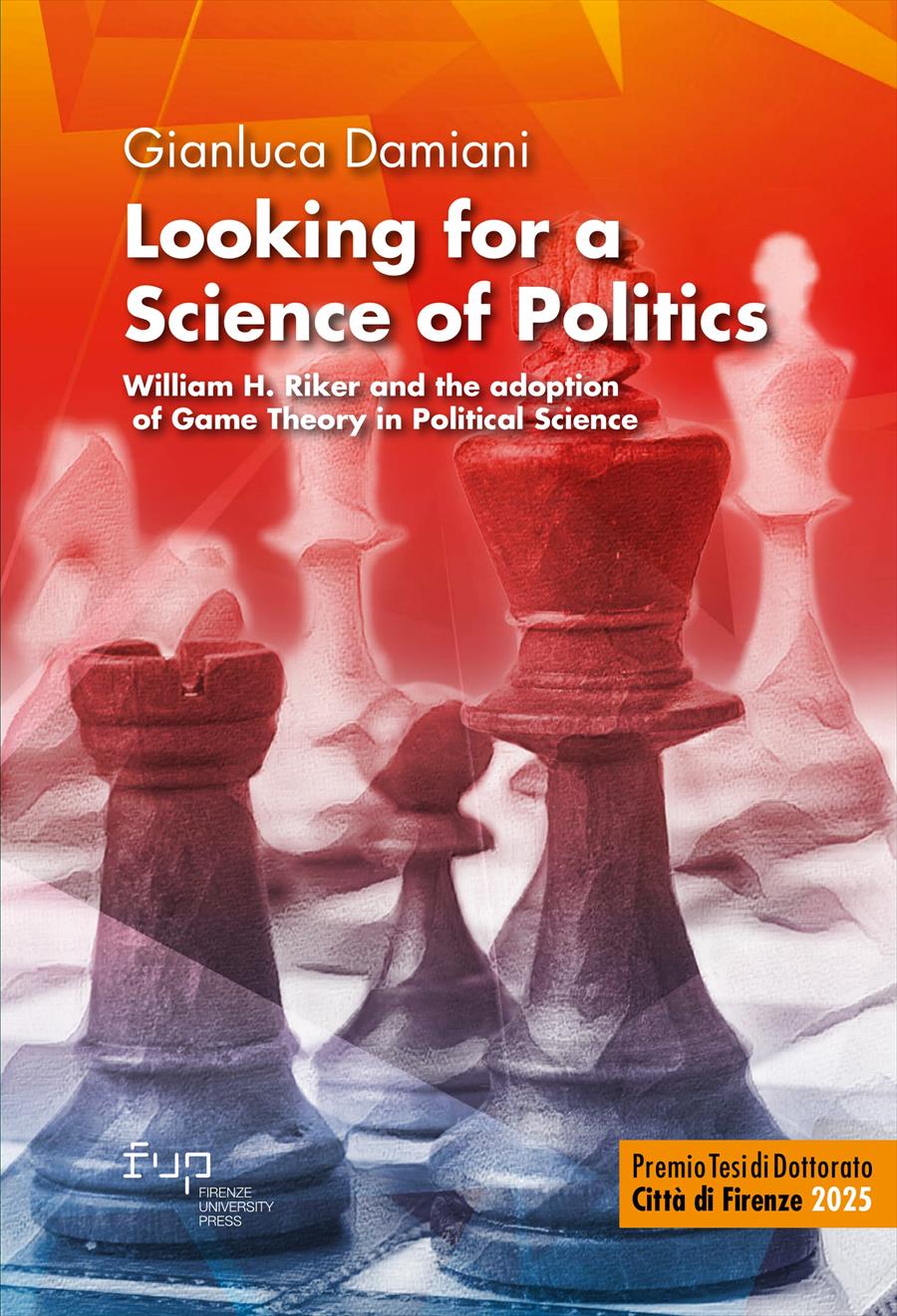
Looking for a Science of Politics
William H. Riker and the adoption of Game Theory in Political Science
- Gianluca Damiani,
This book contributes to the history of game theory by examining how the Theory of Games entered political science. This transition was largely driven by the work of the American political scientist William H. Riker, who, although trained in a traditional approach to the discipline, embraced game theory and formal political analysis in the late 1950s. His efforts were central to the emergence of Positive Political Theory. The book refines the conventional narrative on game theory’s role in political science, showing its adoption as an autonomous intellectual trajectory rather than a mere case of economic imperialism. Methodologically, it offers a historical reconstruction of Riker’s early works, especially The Theory of Political Coalitions (1962), combining critical analysis with extensive archival research and interviews to trace the intellectual and institutional forces shaping this transformation.
- Parole chiave:
- History of Game Theory,
- Positive Political Theory,
- Postwar Social Sciences,
- Rational Choice,
- William H. Riker,
- DOI: 10.36253/979-12-215-0978-6
- Collana: Premio Tesi di Dottorato Città di Firenze
- Comitato scientifico: Premio Tesi di Dottorato Città di Firenze 2025
- Lingua: Inglese
- Argomento: Scienza politica
Gianluca Damiani
The parallel paths of Economics and Political Science: from the early XXth century to the Postwar- CC BY 4.0 |
- © Author(s)
-

pp.9-47
pp.49-81
pp.83-109
Gianluca Damiani
Looking for a “Genuine Science of Politics”: Riker’s “The Theory of Political Coalitions”- CC BY 4.0 |
- © Author(s)
-
pp.111-139
pp.141-175
- Adcock, Robert. 2009. “Interpreting behavioralism”. In: Modern political science: Anglo-American exchanges since 1880. Ed. by Robert Adcock, Mark Bevir, and Shannon C Stimson. Princeton, NJ: Princeton University Press, pp. 180–208. DOI: 10.1515/9781400827763.180
- Adcock, Robert and Mark Bevir. 2006. “Political Science”. R. Backhouse, P. Fontaine, eds. The History of the Social Sciences since 1945, Cambridge: Cambridge University Press, 2010 DOI: 10.1017/cbo9780511845260.006
- Center for the Advanced Studies in the Behavioral Sciences. 1959. “Plans for continuation of the Center”. Box 10, William Harrison Riker Papers
- Alchian, Armen A. 1965. “Some Economics of Property Rights”. Il Politico 30.4, pp. 816–829.
- Alchian, Armen A. and William R. Allen. 2018. Universal Economics. Indianapolis: Liberty Fund.
- Almond, Gabriel A. 1966. “Political theory and political science”. American Political Science Review 60.4, pp. 869–879. DOI: 10.2307/1953762
- Almond, Gabriel A. 1988. “Separate Tables: Schools and Sects in Political Science”. Political Science and Politics 21.4, pp. 828–842. DOI: 10.2307/420022
- Amadae, Sonja M. 2003. Rationalizing capitalist democracy: The cold war origins of rational choice liberalism. Chicago: University of Chicago Press.
- Amadae, Sonja M. and Bruce Bueno de Mesquita. 1999. “The Rochester School: The origins of positive political theory”. Annual Review of Political Science 2.1, pp. 269–295. DOI: 10.1146/annurev.polisci.2.1.269
- Arrow, Kenneth J. 1962. Social choice and individual values. New York: John Wiley & Sons. DOI: 10.12987/9780300186987
- Arrow, Kenneth J. 1983. “Cowles in the history of economic thought”. Cowles Fiftieth An- niversary Volume. Ed. by Alvin K Klevorick. New Haven: Yale University Press.
- Arrow, Kenneth J. 1991. “Jacob Marschak (1890-1977). A Biographical Memoir”. National Academy of Sciences. Biographical Memoirs. DOI: 10.5040/9781350052505-0260
- Arrow, Kenneth J. 1951. “Mathematical Models in the Social Sciences”. The Policy Sciences. Recent Developments in Scope and Method. Ed. by Harold D. Lasswell and Daniel Lerner. Stanford: Stanford University Press, pp. 507–32.
- Kenneth Arrow. 2011. Interviews by Jane Hibbard, November 9, December 2, December 13 and December 19, 2011, Stanford University. Stanford Historical Society Oral History Program, https://purl.stanford.edu/bf254ys7197
- Arrow, Kenneth J. 2014. “The Origins of the Impossibility Theorem”. The Arrow Impossibility Theorem. Ed. by Eric Maskin and Amartya Sen. New York: Columbia University Press. DOI: 10.7312/mask15328-008
- Arrow, Kenneth J. and Gerard Debreu. 1954. “Existence of an equilibrium for a competitive economy”. Econometrica, 22.3, pp. 265–90. DOI: 10.2307/1907353
- Aumann, Robert J. and Michael Maschler. 1964. “The Bargaining Set for Cooperative Games”. Advances in Game Theory. Ed. by Michael Dresher, Lloyd S. Shapley, and Albert W. Tucker. Vol. 52. Princeton: Princeton University Press DOI: 10.1515/9781400829156-017
- Austen-Smith, David. 2006. “Economic Methods in Positive Political Theory”. The Oxford Handbook of Political Economy. Ed. by Barry R. Weingast and Donald A. Wittman. Oxford: Oxford University Press, pp. 899–914. DOI: 10.1093/oxfordhb/9780199548477.003.0050
- Austen-Smith, David and Jeffrey S. Banks. 1999. Positive political theory I. Ann Arbor: University of Michigan Press DOI: 10.3998/mpub.14228
- Backhouse, Roger E. 2017. Founder of Modern Economics: Paul A. Samuelson: Volume 1: Becoming Samuelson, 1915-1948. Oxford: Oxford University Press.
- Backhouse, Roger E. and Steven G. Medema. 2009. “Robbins’s Essay and the Axiomatization of Economics”. Journal of the History of Economic Thought 31.4, pp. 485–499. DOI: 10.1017/s1053837209990277
- Baer, Michael A, Malcolm E Jewell, and Lee Sigelman. 1991. Political science in America: Oral histories of a discipline. Lexington: The University Press of Kentucky.
- Baron, David P. and John A. Ferejohn. 1989. “Bargaining in Legislatures”. The American Political Science Review 83.4, pp. 1181–1206. DOI: 10.2307/1961664
- Barry, Brian. 1970. Sociologists, Economists and Democracy. Chicago: Chicago University Press.
- Bergson, Abram. 1938. “A Reformulation of Certain Aspects of Welfare Economics”. The Quarterly Journal of Economics 52.2, pp. 310–34. DOI: 10.2307/1881737
- Bernd, Joseph L., John M. Claunch, and James F. Herndon, eds. 1964-73. Mathematical Applications in Political Science. Vol. I-VII. Dallas-Chancellorsville: Southern Methodist University Press-The University of Virginia Press.
- Bernheim, B. Douglas. 1984. “Rationalizable Strategic Behavior”. Econometrica, 52.4, pp. 1007–28. DOI: 10.2307/1911196
- Binmore, Ken. 2015. “Rationality”. Handbook of Game Theory vol. 4. Ed. by H. Peyton Young and Zamir Shmuel. Amsterdam: Elsevier Science Publishers BV, pp. 2–26. DOI: 10.1016/b978-0-444-53766-9.00001-x
- Binmore, Ken and Partha Dasgupta, eds. 1987. The Economics of Bargaining. Oxford: Basil Blackwell
- Bjerkholt, Olav. 2015. “How it all began: the first Econometric Society meeting, Lausanne, September 1931”. The European Journal of the History of Economic Thought 22.6, pp. 1149–1178. DOI: 10.1080/09672567.2015.1091853
- Black, Duncan. 1948. “The decisions of a committee using a special majority”. Econometrica, 16.3, pp. 245–61. DOI: 10.2307/1907278
- Black, Duncan. 1948. “The elasticity of committee decisions with an altering size of majority”. Econometrica 16.3, pp. 262–70. DOI: 10.2307/1907279
- Black, Duncan. 1948. “Un approccio alla teoria delle decisioni di comitato”. Giornale degli Economisti 7, 5-6, pp. 262–284.
- Black, Duncan. 1950. “The unity of political and economic science”. The Economic Journal 60.239, pp. 506–514. DOI: 10.2307/2226793
- Black, Duncan. 1958. The theory of committees and elections. Cambridge: Cambridge University Press.
- Black, Duncan. 1969. “On Arrow’s Impossibility Theorem”. The Journal of Law & Economics 12.2, pp. 227–248. DOI: 10.1086/466667
- Blaug, Mark. 1997. Economic theory in retrospect. Cambridge: Cambridge University Press. DOI: 10.1017/cbo9780511805639
- Blaug, Mark. 2003. “The formalist revolution of the 1950s”. Journal of the History of Economic Thought 25.2, pp. 145–156. DOI: 10.1080/1042771032000083309
- Boettke, Peter J. 2019. “The Allure and Tragedy of Ideological Blinders Left, Right and Center: A Review Essay of Nancy MacLean’s Democracy in Chains”. Research in the History of Economic Thought and Methodology 37B, pp. 123–147. DOI: 10.1108/s0743-41542019000037b016
- Boulding, Kenneth E. 1958. “Theoretical Systems and Political Realities: a review of Morton A. Kaplan, System and Process in International Politics ”. The Journal of Conflict Resolution 2.4, pp. 329–334. DOI: 10.1177/002200275800200405
- Brady, Gordon L. and Gordon Tullock, eds. 1996. Formal Contributions to the Theory of Public Choice. The Unpublished Works of Duncan Black. Kluwer Academic Publishers. DOI: 10.1007/978-94-009-1794-1
- Brams, Steven J. 1975. Game Theory and Politics. Mineola: Dover Publications.
- Buchanan, James M and Gordon Tullock. 1962. The calculus of consent: Logical foundations of constitutional democracy. Ann Arbor: University of Michigan Press. DOI: 10.3998/mpub.7687
- Buchanan, James M. 1954. “Individual Choice in Voting and the Market”. Journal of Political Economy 62, pp. 334–343. DOI: 10.1086/257538
- Buchanan, James M. 1954b. “Social Choice, Democracy, and Free Markets”. Journal of Political Economy 62, pp. 114–23. DOI: 10.1086/257496
- Bueno de Mesquita, Bruce (2021). Interview with the author (May 22th 2021)
- Butterworth, Robert L. 1971. “A Research Note on the Size of Winning Coalitions”. The American Political Science Review, pp. 741–748. DOI: 10.2307/1955518
- Campbell, Angus et al. 1980. The american voter. Chicago: University of Chicago Press.
- Caplan, Bryan. 1999. “The Austrian Search for Realistic Foundations”. Southern Economic Journal 65.4, pp. 823–838. DOI: 10.1002/j.2325-8012.1999.tb00202.x
- Christ, Carl F. 1952. “History of the Cowles Commission 1932-1952”. Economic Theory and Measurement. Chicago: Cowles Commission for Research in Economics, pp. 3–65. DOI: 10.4337/9781035377336.00008
- Cogliano, Jonathan. 2019. “An Account of "The Core" in Economic Theory”. Center for the History of Political Economy at Duke University Working Paper Series 2019-17. DOI: 10.2139/ssrn.3454838
- Coleman, James. 1968. “The Marginal Utility of a Vote Commitment”. Public Choice 5, pp. 39–58. DOI: 10.1007/bf01718683
- Copeland, Arthur H. 1945. “Review to The Theory of Games and Economic Behavior”. Bulletin of the American Mathematical Society, 51.7, pp. 498–504. DOI: 10.1090/s0002-9904-1945-08391-8
- Corry, Leo. 2003. Modern algebra and the rise of mathematical structures. Basel: Birkhauser. DOI: 10.1007/978-3-0348-7917-0
- Cox, Gary W. 1997. Making Votes Count. Strategic Coordination in the World’s Electoral Systems. Cambridge: Cambridge University Press. DOI: 10.1017/cbo9781139174954
- Dahl, Robert A. 1961. “The behavioral approach in political science: epitaph for a monument to a successful protest”. American Political Science Review 55.4, pp. 763–772. DOI: 10.2307/1952525
- Dahl, Robert A. 2005. Who governs?: Democracy and power in an American city. New Haven: Yale University Press. DOI: 10.2307/2573188
- Dahl, Robert A. and Charles E. Lindblom. 1953. Politics, economics and welfare: planning and politico-economic systems, resolved into basic processes. New York: Harper & Brothers.
- Davis, Otto A, Melvin J Hinich, and Peter C Ordeshook. 1970. “An expository development of a mathematical model of the electoral process”. American political science review 64.2, pp. 426–448.
- Davis, Otto A. 1968. “Notes on Strategy and Methodology for a Scientific Politi- cal Science”. In: Mathematical Applications in Political Science. Ed. by Joseph L. Bernd. Vol. 4. Charlottesville: University Press of Virginia.
- Davis, Otto A., Morris H. DeGroot, and Melvin J. Hinich. 1972. “Social Preference Orderings and Majority Rule”. Econometrica, 40.1, pp. 147–57.
- Davis, Otto A. and Melvin Hinich. 1966. “A Mathematical Model of Policy Formation in a Democratic Society”. Mathematical Applications in Political Science II. Ed. by Joseph L. Bernd. Southern Methodist University Press, pp. 175– 208.
- Debreu, Gerard. 1959. Theory of value: An axiomatic analysis of economic equilibrium. New Haven: Yale University Press.
- Debreu, Gerard. 1983. “Mathematical economics at Cowles”. Cowles Fiftieth Anniversary Volume. Ed. by Alvin K Klevorick. New Haven: Yale University Press.
- Debreu, Gerard. 2008. “Mathematical Economics”. New Palgrave Dictionary of Economics. Ed. by Steven Durlauf and Lawrence E. Blume. Palgrave MacMillan, London. DOI: 10.1057/978-1-349-95121-5_1083-2
- Deutsch, Karl W. 1954. “Game Theory and Politics: Some Problems of Application”. The Canadian Journal of Economics and Political Science 20.1, pp. 76–83. DOI: 10.2307/138414
- Dimand, Robert W. 2019. “The Cowles Commission and Foundation for Research in Economics”. The New Palgrave Online (2019) DOI: 10.1057/978-1-349-95121-5
- Downs, Anthony. 1957. An economic theory of democracy. New York: Harper & Row.
- Dryzek, John S. 2006. “Revolutions without enemies: Key transformations in political science”. American Political Science Review 100.4, pp. 487–492. DOI: 10.1017/s0003055406062332
- Dummett, Michael. 2005. “The work and life of Robin Farquharson”. Social Choice and Welfare 25.2, pp. 475–483. DOI: 10.1007/s00355-005-0014-x
- Dummett, Michael and Robin Farquharson. 1961. “Stability in Voting”. In: Econometrica, 29, pp. 33–42 DOI: 10.2307/1907685
- Düppe, Till. 2010. “Debreu’s apologies for mathematical economics after 1983”. Erasmus Journal for Philosophy and Economics 3.1, pp. 1–32. DOI: 10.23941/ejpe.v3i1.37
- Düppe, Till. 2012. “Gerard Debreu‘s Secrecy: His Life in Order and Silence”. History of Political Economy 44.3, pp. 413–49. DOI: 10.1215/00182702-1717239
- Düppe, Till and E Roy Weintraub. 2014. Finding equilibrium. Princeton: Princeton University Press. DOI: 10.1515/9781400850129
- Düppe, Till and E Roy Weintraub. 2014. “Siting the new economic science: The Cowles Commission’s activity analysis conference of June 1949”. Science in context 27.3, pp. 453–483. DOI: 10.1017/s0269889714000143
- Easton, David. 1951. “The decline of modern political theory”. The Journal of Politics 13.1, pp. 36–58. DOI: 10.2307/2126121
- Easton, David. 1953. The Political System: An inquiry into the state of Political Science.New York: Alfred A. Knopf.
- Easton, David. 1965. A Systems Analysis of Political Life. New York: John Wiley & Sons.
- Easton, David. 1969. “The New Revolution in Political Science”. The American Political Science Review 63.4, pp. 1051–1061 DOI: 10.2307/1955071
- Easton, David, Luigi Graziano, and John Gunnell. 2002. The development of politi- cal science: A comparative survey. London: Routledge. DOI: 10.4324/9780203203767
- Edgeworth, Francis Y. 2008. “Mathematical methods in political economy [1909]”. New Palgrave Dictionary of Economics. Ed. by Steven Durlauf and Lawrence E Blume. Palgrave MacMillan, London. DOI: 10.1057/978-1-349-95121-5_1164-2
- “Empirical Research currently under way in the Department of Economics” 1960. Box 32, Lionel W. McKenzie Papers.
- Erickson, Paul. 2015. The world the game theorists made. Chicago: University of Chicago Press. DOI: 10.7208/chicago/9780226097206.001.0001
- Erickson, Paul, Klein, Judy L., Daston, Lorraine, Lemov, Rebecca, Sturm, Thomas and Gordin, Michael D. 2015. How Reason Almost Lost its mind: The strange career of Cold War Rationality. Chicago: University of Chicago Press. DOI: 10.7208/chicago/9780226046778.001.0001
- Fagen, Richard R. 1961. “Some Contributions of Mathematical Reasoning to the Study of Politics”. American Political Science Review 55.4, pp. 888–900. DOI: 10.2307/1952536
- Fagen, Richard R. 1963. “Review to The Theory of Political Coalitions”. American Political Science Review 57.2, pp. 446–7. DOI: 10.2307/1952835
- Farquharson, Robin (1970). Theory of Voting. Oxford: Blackwell.
- Farr, James. 2009. “The Historical Science (s) of Politics: The Principles, As- sociation, and Fate of an American Discipline”. In: Modern political science: Anglo-American exchanges since 1880. Princeton University Press, Princeton, NJ, pp. 66–96. DOI: 10.1515/9781400827763.66
- Filippov, Mikhail. 2005. “Riker and Federalism”. Constitutional Political Economy 16, pp. 93–111. DOI: 10.1007/s10602-005-2230-x
- Fisher, Franklin M. 1989. “Games Economists Play: A Noncooperative View”. The RAND Journal of Economics 20.1. Ed. by 20, pp. 113–24. DOI: 10.2307/2555655
- Fisher, Irving. 1892. Mathematical Investigations in the Theory of Value and Price. New Haven: Yale University Press.
- Fleury, Jean-Baptiste. 2012. “Wandering through the Borderlands of the Social Sciences: Gary Becker’s Economics of Discrimination”. History of Political Economy 44.1, pp. 1–40. DOI: 10.1215/00182702-1504041
- Fogel, Robert William, Fogel, Enid, Guglielmo, Mark and Grotte, Nathaniel. 2013. Political arithmetic: Simon Kuznets and the empirical tradition in economics. Chicago: University of Chicago Press. DOI: 10.7208/chicago/9780226020723.001.0001
- Forget, Evelyn L. and Craufurd D. Goodwin. 2011. “Intellectual communities in the history of economics”. History of Political Economy 43.1, pp. 1–23. DOI: 10.1215/00182702-2010-042
- Friedman, Jeffrey, ed. 1995. The Rational Choice Controversy. New Haven: Yale University Press.
- Friedman, Milton. 1954. Essays in Positive Economics. Chicago: Chicago University Press.
- Fudenberg, Drew and David K. Levine. 2016. “Whither Game Theory? Towards a theory of Learning in Games”. Journal of Economic Perspectives 30.4, pp. 151– 170. DOI: 10.1257/jep.30.4.151
- Fudenberg, Drew and Jean Tirole. 1991. Game Theory. Cambridge: The MIT press.
- Garceau, Oliver. 1951. “Research in the political process”. American Political Science Review 45.1, pp. 69–85. DOI: 10.2307/1950884
- Gibbard, Allan and Hal R. Varian. 1978. “Economic Models”. The Journal of Philosophy 75.11, pp. 664–77 DOI: 10.5840/jphil1978751111
- Gibbons, Robert A. 1992. A Primer in Game Theory. New York: Prentice-Hall.
- Gindis, David. 2020. Law and Economics Under the Palms: Henry Manne at the University of Miami, 1974-1980. https://papers.ssrn.com/sol3/papers.cfm?abstract_id=3567105
- Giocoli, Nicola. 2003. “Fixing the point: the contribution of early game theory to the tool-box of modern economics”. Journal of Economic Methodology 10.1, pp. 1–39. DOI: 10.1080/1350178032000042040
- Giocoli, Nicola. 2003. Modeling rational agents: From interwar economics to early modern game theory. Chelenham: Edward Elgar Publishing. DOI: 10.4337/9781781956472
- Giocoli, Nicola. 2009. “Mathematics as the role model for neoclassical economics”. MPRA Paper 33806, pp. 145–165. DOI: 10.2139/ssrn.930660
- Giocoli, Nicola. 2009. “Three alternative (?) stories on the late 20th century rise of game theory”. Studi e Note di Economia XIV.2, pp. 187–210. DOI: 10.2139/ssrn.1140111
- Goodman, Leo and Harry Markowitz. 1952. “Social Welfare Functions Based on Individual Rankings”. American Journal of Sociology 58, pp. 257–62. DOI: 10.1086/221147
- Green, Donald P. and Ian Shapiro. 1994. Pathologies of Rational Choice Theory. A Critique of Applications in Political Science. New Haven: Yale University Press.
- Griffith, Ernest S., ed. 1948. Research in Political Science. Chapel Hill: University of North Carolina Press.
- Gunnell, John G. 1995. “The Declination of the "State”and the Origins of American Pluralism”. In: Political Science in History: Research Programs and Political Traditions. Ed. by James Farr, John S Dryzek, and Stephen T. Leonard. Cam- bridge: Cambridge University Press, pp. 19–40.
- Hagemann, Harald. 2011. “European émigrés and the ‘Americanization’of eco- nomics”. The European Journal of the History of Economic Thought 18.5, pp. 643– 671.
- Hayek, Friedrich A. von. 1937. “Economics and knowledge”. Economica, 4.13, pp. 33–54. DOI: 10.2307/2548786
- Hayek, Friedrich A. von. 1952. The Counter-Revolution of Science: studies on the Abuse of Reason. Glencoe: The Free Press.
- Heaney, Michael T and John Mark Hansen. 2006. “Building the Chicago school”. American Political Science Review 100.4, pp. 589–596. DOI: 10.1017/s0003055406062460
- Heard, Alexander. 1949. “Research on Political Behavior: Report of a Conference”. Items 3, pp. 41–44.
- Herfeld, Catherine. 2018. “From theories of human behavior to rules of rational choice: tracing a normative turn at the Cowles Commission, 1943–54.” History of Political Economy 50.1, pp. 1–48. DOI: 10.1215/00182702-4334997
- Hinich, Melvin J. and Michael Munger. 2006. “In memorian: Otto "Toby" Davis, 1934-2006”. Public Choice 128, pp. 357–9. DOI: 10.1007/s11127-006-9041-0
- Horn, Robert van, Philip Mirowski, and Thomas A. Stapleford, eds. 2011. Building Chicago Economics. Cambridge: Cambridge University Press. DOI: 10.1017/cbo9781139004077
- Hotelling, Harold. 1929. “Stability in Competition”. The Economic Journal 39.153, pp. 41–57. DOI: 10.2307/2224214
- Hotz, Alfred J. 1963. “Review to The Theory of Political Coalitions.” Midwest Journal of Political Science 7.3, pp. 295–7. DOI: 10.2307/2109034
- Howson, Susan. 2011. Lionel Robbins. Cambridge: Cambridge University Press.
- Hurwicz, Leonid. 1945. “Review to The Theory of Games and Economic Behavior”. The American Economic Review 35.5, pp. 909–25. DOI: 10.1214/aoms/1177730216
- Hutchison, Terence W. 1938. Significance and basic postulates of economic theory. London: MacMillan and Co.
- Ingrao, Bruna and Giorgio Israel. 1987. La Mano Invisibile. L’equilibrio economico nella storia della scienza. Bari: Laterza.
- Israel, Giorgio and Ana Millan Gasca. 2009. The World as a Mathematical Game: John von Neumann and the Twentieth Century Science. Basel: Birkhauser. DOI: 10.1007/978-3-7643-9896-5
- Jaffe, Sonia, Minton, Robert, Mulligan, Casey B. and Murphy, Kevin M., 2019. Chicago Price Theory. Princeton: Princeton University Press
- Jones, Bryan, Lin, Tse-Min, Munger, Michael, and Ordeshook, Peter. 2011. “In memorian: Melvin J. Hinich, 1939-2010”. Public Choice 146, pp. 1–8. DOI: 10.1007/s11127-010-9743-1
- Kalisch, G., Milnor, J.W. Nash, J. and Nering E.D. 1952. Some Experimental n-Person Games. Tech. rep. 948. RAND-Memorandum. DOI: 10.4337/9781781956298.00012
- Kaplan, Morton A. 1957. Systems and Process in International Politics. New York: John Wiley & Sons.
- Kaplan, Morton A.1963. “The Theory of Political Coalitions”. The Annals of the American Academy of Political and Social Science 347, pp. 137–8 DOI: 10.1177/000271626334700116
- Kenny, Michael. 2009. “Birth of a discipline: interpreting British political studies in the 1950s and 1960s”. In: Modern political science: Anglo-American exchanges since 1880. Ed. by Robert Adcock, Mark Bevir, and Shannon C Stimson. Princeton: Princeton University Press, pp. 158–179. DOI: 10.1515/9781400827763.158
- Kramer, Gerald H. 1966. “A Decision-Theoretic Analysis of a Problem in Political Campaigning”. In: Mathematical Applications in Political Science II. Ed. by Joseph L. Bernd. Dallas: Southern Methodist University Press, pp. 137–60.
- Kreps, David. 1990. A Course in Microeconomic Theory. Princeton: Princeton University Press.
- Kreps, David. 1991. Game Theory and Economic Modelling. Oxford: Clarendon Press. DOI: 10.1093/0198283814.001.0001
- Kuhn, Harold W. and Sylvia Nasar, eds. 2002. The Essential John Nash. Princeton: Princeton University Press.
- Kuhn, Harold William and Albert William Tucker. 1953. Contributions to the Theory of Games. Princeton: Princeton University Press.
- Lasswell, Harold D. and Abraham Kaplan. 1950. Power and Society: A Framework for Political Inquiry. New Haven: Yale University Press.
- Lasswell, Harold D. and Daniel Lerner, eds. 1951. The Policy Sciences. Recent Developments in Scope and Method. Stanford: Stanford University Press.
- Lazear, Edward P. 2000. “Economic Imperialism”. The Quarterly Journal of Economics 115.1, pp. 99–146 DOI: 10.1162/003355300554683
- Leonard, Robert. 2010. Von Neumann, Morgenstern, and the creation of game theory: From chess to social science, 1900–1960. Cambridge: Cambridge University Press. DOI: 10.1017/cbo9780511778278
- Leonard, Thomas C. 2016. Illiberal reformers. Princeton: Princeton University Press.
- Levy, David M. 2017. “A Review of Nancy MacLean’s "Democracy in Chains: The History of Radical Right’s Stealth Plan for America"”. George Mason University Working Paper No. 19-19. DOI: 10.2139/ssrn.3390053
- Levy, David M. and Sandra J. Peart. 2020. Toward an Economics of Natural Equals. A Documentary History of the Early Virgina School. Cambridge: Cambridge University Press. DOI: 10.1017/9781108571661
- Lindblom, Charles E. 1997. “Political Science in the 1940s and 1950s”. Daedalus 126.1, American Academic Culture in Transformation: Fifty Years, Four Disciplines, pp. 225–52. DOI: 10.1515/9780691227832-013
- Lohmann, Susanne. 2008. “Rational Choice and Political Science”. The New Palgrave Dictionary of Economics. Ed. by Steven Durlauf and Lawrence E. Blume. London: Palgrave Macmillan. DOI: 10.1057/978-1-349-95121-5_2341-1
- Lowell, Lawrence A. 1910. “The Physiology of Politics: Presidential Address, Sixth Annual Meeting of the American Political Science Association”. American Political Science Review 4.1, pp. 1–15.
- Lowi, Theodor J. 1992. “The State in Political Science: how we become what we study”. The American Political Science Review 86.2, pp. 1–7. DOI: 10.2307/1964011
- Lucas, William F. 1994. “Von Neumann-Morgenstern Stable Sets”. Handbooks of Game Theory with Economic Applications. Ed. by Robert J. Aumann and Sergiu Hart. Vol. I. Amsterdam: Elsevier Science Publishers BV, pp. 544–587. DOI: 10.1016/s1574-0005(05)80020-7
- Luce, Duncan R. and Howard Raiffa. 1957. Games and decisions: Introduction and critical survey. New York: John Wiley and Sons.
- MacLean, Nancy. 2017. Democracy in Chains: The deep history of radical right’s stealth plan for America. New York: Viking.
- Mäki, Uskali. 2009. “Economic Imperialism. Concept and Constraints”. Philosophy of the Social Sciences 39.3, pp. 351–80 DOI: 10.1177/0048393108319023
- Manne, Henry and James Stocker. 2012. “Interview with Henry Manne”. Securities and Exchange Commission Historical Society.
- Marschak, Jacob. 1946. “Neumann’s and Morgenstern’s new approach to Static Economics”. Journal of Political Economy 54.2, pp. 97–115 DOI: 10.1086/256327
- SSRC Committee on Mathematical Training of Social Scientists. 1955. “Recom- mended policies for the Mathematical Training of Social Scientists: Statement by a Committee of the Council”. Items 9.2, pp. 13–16.
- Matthews, Donald R. 1963. “Review to The Theory of Political Coalitions.” The Journal of Politics 25.3, pp. 578–80.
- McKelvey, Richard D. 1975. “Intransitivities in Multidimensional Voting Models and Some Implications for Agenda Control”. Journal of Economic Theory 12.472-482 DOI: 10.1016/0022-0531(76)90040-5
- McKelvey, Richard D. and Peter C. Ordeshook. 1978. “Competitive Coalition Theory”. In: Game Theory and Political Science. Ed. by Peter C. Ordeshook. New York: New York University Press.
- McKelvey, Richard D., Peter C. Ordeshook, and Mark D. Winer. 1978. “The Competitive Solution for N-Person Games Without Transferable Utility, with an Application to Committee Games”. The American Political Science Review 72.2, pp. 599–615 DOI: 10.2307/1954112
- McKelvey, Richard D. and Thomas R. Palfrey. 1995. “Quantal Response Equi- libria for Normal Form Games”. Games and Economic Behavior 10, pp. 6– 38 DOI: 10.1006/game.1995.1023
- McKelvey, Richard D. and Richard D. Smith. 1975. “A Comment on The Debate Over Riker’s "Size Principle"”. Mimeographed, Carnegie Mellon University, Box 19, Willam Harrison Riker Papers
- McKenzie, Lionel W. 1954. “On the existence of general equilibrium for a com- petitive market”. Econometrica, 27.1, pp. 54–71 DOI: 10.2307/1907777
- McKenzie, Lionel W. 1999. “A Scholar’s progress”. Keio economic studies 36.1, pp. 1–12.
- n.d. “Lionel W. McKenzie Papers”. David M. Rubenstein Rare Book & Manuscript Library, Duke University.
- McKinsey, John C. C. 1952. Introduction to the theory of games. New York: McGraw-Hill.
- McLean, Iain. 2002. “William H. Riker and the Invention of Herestetics”. British Journal of Political Science, 32.3, pp. 535–558. DOI: 10.1017/s0007123402000224
- McLean, Iain. 2009. “In Riker’s Footsteps”. In: British Journal of Political Science 39.1, pp. 195– 210 DOI: 10.1017/s0007123408000379
- McLean, Iain. 2015. “The strange history of social choice, and the contribution of the Public Choice Society to its fifth revival”. Public Choice 163.1-2, pp. 153–165. DOI: 10.1007/s11127-014-0161-7
- McLean, Iain, Alistair McMillan, and Burt L. Monroe, eds. 1998. The theory of committees and elections by Duncan Black and Committee Decisions with Comple- mentary valuation by Duncan Black and R.A. Newing. New York: Springer Science & Business Media. DOI: 10.1007/978-94-011-4860-3
- Medema, Steven G. 2000. “"Related Disciplines": The Professionalization of Public Choice Analysis”. History of Political Economy 32.supplement, pp. 289–324. DOI: 10.1215/00182702-32-suppl_1-289
- Medema, Steven G. 2009. The Hesitant Hand. Taming Self-interest in the History of Economic Ideas. Princeton: Princeton University Press. DOI: 10.1515/9781400830770
- Medema, Steven G. 2011. “Public Choice and the notion of creative communities”. History of Political Economy 43.1, pp. 225–246. DOI: 10.1215/00182702-2010-049
- Merriam, Charles E. 1923. “Recent Advances in Political Methods”. American Political Science Review 17.2, pp. 275–295. DOI: 10.2307/1944115
- Mirowski, Philip. 1992. More heat than light. Cambridge: Cambridge University Press.
- Mirowski, Philip. 2002. Machine dreams: Economics becomes a cyborg science. Cambridge: Cambridge University Press.
- Morgan, Mary S. 1990. The history of econometric ideas. Cambridge: Cambridge University Press.
- Morgenstern, Oskar. 1976. “Perfect foresight and economic equilibrium”. In: Selected economic writings of Oskar Morgenstern. Ed. by Andrew Schotter. New York: New York University Press, pp. 169–83.
- Morgenstern, Oskar. 1976. “The Collaboration of Oskar Morgenstern and John von Neumann on the theory of games”. Journal of Economic Literature 14, pp. 805–16. DOI: 10.1515/9781400829460.712
- n.d. “Oskar Morgenstern Papers”. David M. Rubenstein Rare Book and Manuscript Library, Duke University.
- Morrell, Jack B. 1972. “The chemist breeders: the research schools of Liebig and Thomas Thomson”. Ambix 19.1, pp. 1–46. DOI: 10.1179/amb.1972.19.1.1
- Moscati, Ivan. 2018. Measuring utility: From the marginal revolution to behavioral economics. Oxford: Oxford University Press. DOI: 10.1093/oso/9780199372768.001.0001
- Mosteller, Frederick. 1974. “The role of the Social Science Research Council in the advance of mathematics in the social sciences”. Items 28, pp. 17–24.
- Nasar, Sylvia. 1998. A Beautiful Mind: A biography of John Forbes Nash Jr. New York: Simon & Schuster.
- Nash, John F. 2002. “Non-Cooperative Games [1950]”. In: The Essential John Nash. Ed. by Harold W. Kuhn and Sylvia Nasar. Princeton: Princeton University Press. DOI: 10.1515/9781400884087-009
- Nash, John F. 2002. “The Bargaining Problem (1950)”. In: The Essential John Nash. Ed. by Harold W. Kuhn and Sylvia Nasar. Princeton: Princeton University Press. DOI: 10.1515/9781400884087-006
- Nash, John F. 2002. “Two-Person Cooperative Games (1953)”. In: The Essential John Nash. Ed. by Harold W. Kuhn and Sylvia Nasar. Princeton: Princeton University Press. DOI: 10.1515/9781400884087-010
- Neumann, John von. 1928. “Zur Theorie der Gesellschaftsspiele”. Mathematische Annalen 100, pp. 295–300. DOI: 10.1007/bf01448847
- Neumann, John von. 1945. “A Model of General Economic Equilibrium”. The Review of Economics Studies 13.1, pp. 1–9. DOI: 10.2307/2296111
- Neumann, John von and Oskar Morgenstern. 2007. Theory of games and economic behavior [1944]. Princeton: Princeton University Press.
- Niemi, Richard. 2021. “Interview with the author” May 27th 2021
- Olson, Mancur. 1965. The Logic of Collective Action: Public Goods and the Theory of Groups. Cambridge: Harvard University Press.
- Ordeshook, Peter C. 1980. “Political Disequilibrium and Scientific Inquiry: A Comment on William Riker’s "Implications from the Disequilibrium of Majority Ruler for the Study of Institutions"”. American Political Science Review 74.2, pp. 447–50. DOI: 10.2307/1960639
- Ordeshook, Peter C. 1990. “The emerging discipline of political economy”. In: Perspective on Positive Political Economy. Ed. by James E. Alt and Kenneth A. Shepsle. Cambridge: Cambridge University Press, pp. 9–31. DOI: 10.1017/cbo9780511571657.003
- Ordeshook, Peter C. 1996. “Engineering or Science: what is the study of politics?” In: The Rational Choice Controversy. Ed. by Jeffrey Friedman. New Haven: Yale University Press, pp. 175–188. DOI: 10.12987/9780300146424-011
- Ordeshook, Peter C. 2007. “The Competitive Solution Revisited”. In: Positive Changes in Political Science: The Legacy of Richard D. McKelvey’s Most Influential Writings. Ed. by John H. Aldrich, James E. Alt, and Arthur Lupia. Ann Arbor: The University of Michigan Press, pp. 165–86.
- Ordeshook, Peter C. 2021. “I’ll begin where I began”. Manuscript sent to the author (29th April 2021)
- Orozco Espinel, Camila. 2020. “How mathematical economics became (simply) economics: The mathematical training of economists during the 1940s, 1950s, and 1960s in the United States”. Center for the History of Political Economy at Duke University Working Paper Series. DOI: 10.2139/ssrn.3731733
- Osborne, Martin J. and Ariel Rubinstein. 1994. A Course in Game Theory. Cambridge: The MIT Press.
- Palfrey, Thomas. 2005. “Richard Drummond McKelvey (1944-2002)”. National Academy of Sciences. Biographical Memoirs 87.
- Pearce, David G. 1984. “Rationalizable Strategic Behavior and the Problem of Perfection”. In: Econometrica, 52.4, pp. 1029–1050. DOI: 10.2307/1911197
- Pendleton Herring, Edward. 1947. “The social sciences in modern society”. Items 1.1, p. 5.
- Persson, Torsten and Guido Tabellini. 2002. Political economics: explaining economic policy. Cambridge: The MIT Press.
- Poole, Keith T. and Howard Rosenthal. 1985. “A Spatial Model for Legislative Roll Call Analysis”. American Journal of Political Science 29.2, pp. 357–384. DOI: 10.2307/2111172
- Punzo, Lionello F. 1991. “The school of mathematical formalism and the Vien- nese circle of mathematical economists”. Journal of the History of Economic Thought 13.1, pp. 1–18. DOI: 10.1017/s1053837200003369
- Qualter, Terence H. 1980. Graham Wallas and the great society. London: Palgrave MacMillan. DOI: 10.1007/978-1-349-04923-3
- Raiffa, Howard. 1992. “Game Theory at the University of Michigan, 1948-1952”. Toward a history of game theory. Ed. by E. Roy Weintraub. Durham: Duke University Press. DOI: 10.1215/00182702-24-supplement-165
- Ranney, Austin. 1974. “The Committee on Political Behavior, 1949–64, and the Committee on Governmental and Legal Processes, 1964–72”. Items: Newsletter of the Social Science Research Council 28, pp. 37–41.
- Reiss, Julian. 2013. Philosophy of Economics. A Contemporary Introduction. London: Rout- Ledge.
- Rellstab, Urs. 1992. “New Insights into the Collaboration between John von Neu- mann and Oskar Morgenstern on the Theory of Games and Economic Behavior”. In: Toward a history of game theory. Ed. by E. Roy Weintraub. Durham: Duke University Press. DOI: 10.1215/00182702-24-supplement-77
- Report on Political Science for Committee on Social Science” (1960). Box 32, Lionel W. McKenzie Papers
- Research in Theoretical Economics” (1960). Box 32, Lionel W. McKenzie Papers
- Riker, William H. 1953. Democracy in the United States. New York: Macmillan.
- Riker, William H. 1957. “Events and situations”. The Journal of Philosophy 54.3, pp. 57–70. DOI: 10.2307/2022192
- Riker, William H. 1958. “Causes of events”. The Journal of Philosophy 55.7, pp. 281–291. DOI: 10.2307/2022600
- Riker, William H. 1958b. “Contributions of Game Theory to Political Theory (mimeo)”. William H. Riker Papers, Box 18, Folder 2.
- Riker, William H. 1959. “A Test of the Adequacy of the Power Index”. In: Behavioral science 4.2, pp. 120–131 DOI: 10.1002/bs.3830040205
- Riker, William H. 1959. “Supplementary Statements, Riker to Tyler, December 4th, 1959”. Box 10, Folder 1, William H. Riker Papers.
- Riker, William H. 1960. “Inventory of Personal Interests”. Box 10, William H. Riker Papers.
- Riker, William H. 1961. “Voting and the summation of preferences: an interpretive bibliographical review of selected developments during the last decade”. American Political Science Review 55.4, pp. 900–911 DOI: 10.2307/1952537
- Riker, William H. 1962. “The calculus of consent by James M. Buchanan and Gordon Tullock”. Midwest Journal of Political Science 6.2, pp. 408–411. DOI: 10.2307/2108773
- Riker, William H. 1962. The theory of political coalitions. New Haven: Yale University Press.
- Riker, William H. 1968. “Report to MSSB on Summer Course in Mathematical Political Analy- sis”. Box 29, Lionel W. McKenzie Papers.
- Riker, William H. 1969. “Arrow’s Theorem and Some Examples of the Paradox of Voting”. Mathematical Applications in Political Science I. Ed. by John M. Claunch. Dallas: Southern Methodist University Press, pp. 41–60.
- Riker, William H. 1970. “Rational Behavior in Politics: Evidence from a Three Person Game”. American Political Science Review 64.1, pp. 48–60. DOI: 10.2307/1955612
- Riker, William H. 1971. “Comment on Butterworth, "A Research Note on the Size of Winning Coalitions"”. The American Political Science Review 65.3, pp. 745–47. DOI: 10.1017/s0003055400136470
- Riker, William H. 1977. “The Future of a Science of Politics”. American Behavioral Scientist 21.1, pp. 11–38. DOI: 10.1177/000276427702100102
- Riker, William H. 1980. “Implications from the Disequilibrium of Majority Ruler for the Study of Institutions”. The American Political Science Review 74.2, pp. 432–446. DOI: 10.2307/1960638
- Riker, William H. 1982. Liberalism against Populism: A confrontation between the theory of democracy and the theory of social choice. San Francisco: Freeman and Company.
- Riker, William H. 1984. “The Heresthetics of Constitution-Making: The Presidency in 1787, with Comments on Determinism and Rational Choice. Presidential Address, American Political Science Association 1983”. The American Political Science Review 78.1, pp. 1–16. DOI: 10.2307/1961245
- Riker, William H. 1986. The art of political manipulation. New Haven; Yale University Press.
- Riker, William H. 1992. “The entry of game theory into political science”. In: Toward a history of game theory. Ed. by E. Roy Weintraub. Vol. 24. Durham: Duke University Press. DOI: 10.1215/00182702-24-supplement-207
- Riker, William H. 1996. The strategy of rhetoric: Campaigning for the American Constitution. New Haven: Yale University Press
- Riker, William H. 1997. “The Ferment of the 1950s and the Development of Rational Choice Theory”. Contemporary empirical political theory. Ed. by Kristen R Monroe. Los Angeles: University of California Press, pp. 191–201. DOI: 10.1525/9780520313248-010
- n.d. “William Harrison Riker Papers”. D.262, Rare Books, Special Collections, and Preservation, River Campus Libraries, University of Rochester.
- Riker, William H. and Steven J. Brams. 1972. “Models of Coalition Formation in Voting Bodies”. Mathematical Applications in Political Science. Ed. by Joseph L. Bernd. Vol. VI. Charlottesville: University Press of Virginia.
- Riker, William H. and Peter C. Ordeshook. 1973. An introduction to positive political theory. Englewood Cliffs: Prentice-Hall.
- Riker, William H. and Kenneth Shepsle. 1979. “Interview to William Harrison Riker by Kenneth Shepsle”. Box 85, William H. Riker Papers.
- Rizvi, Abu Turab S. 1994. “Game theory to the rescue?” Contributions to Political Economy 13.1, pp. 1–28. DOI: 10.1093/oxfordjournals.cpe.a035624
- Robbins, Lionel 1932. The nature and significance of economic science. London: Routledge.
- Robinson, James A. 1963. “Decision-Making and Coalition Building”. In: The Journal of Conflict Resolution 7.4, pp. 763–8. DOI: 10.1177/002200276300700409
- Roos, Charles F. 1933. “Constitution of the econometric society”. Econometrica, pp. 106–108.
- Ross, Dorothy. 2009. “Anglo-American Political Science, 1880-1920”. In: Modern political science: Anglo-American exchanges since 1880. Princeton: Princeton University Press, pp. 18–36. DOI: 10.1515/9781400827763.18
- Roth, Alvin E. 1988. “Introduction to the Shapley Value. Essays in honor of Lloyd S. Shapley”. In: The Shapley Value. Ed. by Alvin Roth. Cambridge: Cambridge University Press, pp. 1–27. DOI: 10.1017/cbo9780511528446.002
- Roth, Alvin E. and Robert B. Wilson. 2019. “How Market Desigh Emerged from Game Theory: A Mutual Interview”. Journal of Economic Perspectives 33.3, pp. 118–143. DOI: 10.1257/jep.33.3.118
- Rubinstein, Ariel. 1982. “Perfect Equilibrium in a Bargaining Model”. Econometrica, 50.1, pp. 97–109. DOI: 10.2307/1912531
- Rubinstein, Ariel. 2007. “Afterword”. Theory of games and economic behavior. Princeton: Princeton University Press. DOI: 10.1515/9781400829460.633
- Scaff, Lawrence A. 2011. Max Weber in America. Princeton: Princeton University Press.
- Schelling, Thomas C. 1980. The Strategy of Conflict [1961]. Cambridge: Harvard University Press
- Schofield, Norman. 1996. “Rational Choice and Political Economy”. In: The Rational Choice Controversy. Ed. by Jeffrey Friedman. New Haven: Yale University Press. DOI: 10.12987/9780300146424-012
- Schotter, Andrew. 1992. “Oskar Morgenstern’s Contribution to the Development of the Theory of Games”. In: Toward a history of game theory. Ed. by E. Roy Weintraub. Durham: Duke University Press. DOI: 10.1215/00182702-24-supplement-95
- Schumpeter, Joseph A. 1942. Capitalism, Democracy and Socialism. New York: Harper & Brothers.
- Schumpeter, Joseph A. 1987. History of Economic Analysis [1954]. New York: Routledge.
- Selten, Reinhardt. 1965. “Spieltheoretische Behandlung eines Oligopolmodells mit Nachfrageträgheit”. In: Zeitschrift für die gesamte Staatswissenschaft 121, pp. 301–24.
- Selten, Reinhardt. 1975. “Re-examination of the Perfectness Concept for Equilibrium Points in Extensive Games”. International Journal of Game Theory 4, pp. 25–55. DOI: 10.1007/bf01766400
- Serrano, Roberto. 2005. “Fifty Years of the Nash Program, 1953-2003”. Investigaciones Económicas XXIX.2, pp. 219–258. DOI: 10.2139/ssrn.724233
- Shackle, George L. S. 1967. The years of high theory: invention and tradition in economic thought 1926-1939. Cambridge: Cambrdige University Press
- Shapley, Lloyd S. and Martin Shubik. 1954. “A method for evaluating the distri- bution of power in a committee system”. American political science review 48.3, pp. 787–792. DOI: 10.2307/1951053
- Shapley, Lloyd S. 1953. “A Value for n-Person Games”. Contributions to the Theory of Games. Ed. by Harold W. Kuhn and Albert Tucker. Vol. II. Princeton: Princeton University Press, pp. 307–317.
- Shepsle, Kenneth A. 1974. “On the Size of Winning Coalitions”. The American Political Science Review 68.2, pp. 505–18. DOI: 10.2307/1959499
- Shepsle, Kenneth A. 1979. “Institutional Arrangements and Equilibrium in Multidimensional Voting”. American Journal of Political Science 23.1, pp. 27–59. DOI: 10.2307/2110770
- Shepsle, Kenneth A. 2021. “Interview with the author” (May 17th 2021)
- Shubik, Martin. 1954. Readings in game theory and political behavior. Vol. 9. London: Double- day
- Shubik, Martin. 1961. “Referee’s report on ’The Theory of Political Coalitions" by William H. Riker”. Box 8, Martin Shubik Papers.
- Shubik, Martin. 1984. “Game Theory Models and Methods in Political Economy”. In: Handbook of Mathematical Economics. Ed. by Kenneth J. Arrow and Michael D. Intriligator. Vol. 1. Amsterdam: North Holland. DOI: 10.1016/s1573-4382(81)01011-4
- Shubik, Martin. 1992. “Game theory at Princeton, 1949–1955: a personal reminiscence”. In: Toward a history of game theory. Ed. by E Roy Weintraub. Durham: Duke University Press. DOI: 10.1215/00182702-24-supplement-151
- Shubik, Martin. 2002). “Game Theory and Operations Research: Some Musings 50 years later”. Operations Research 50, pp. 192–6. DOI: 10.1287/opre.50.1.192.17789
- n.d. “Martin Shubik Papers”. David M. Rubenstein Rare Book and Manuscript Library, Duke University.
- Simon, Herbert. 1945. “Review to The Theory of Games and Economic Behavior”. The American Journal of Sociology, 50.6, pp. 558–60. DOI: 10.1086/219699
- Simon, Herbert. 1947. Administrative Behavior. New York: Macmillan.
- Simon, Herbert. 1996. Models of My Life. Cambridge: The MIT Press.
- Smith, Mark. 2009. “A Tale of Two Charlies: Political Science, History, and Civic Reform, 1890–1940”. In: Modern Political Science: Anglo-American Exchanges Since 1880. Ed. by Robert Adcock, Mark Bevir, and Shannon C. Stimson. Princeton, Princeton University Press, pp. 118–36. DOI: 10.1515/9781400827763.118
- Smith, Vernon L. 1992. “Game Theory and Experimental Economics: Begin- ning and Early Influences”. In: Toward a history of game theory. Ed. by E. Roy Weintraub. Durham: Duke University Press. DOI: 10.1215/00182702-24-supplement-241
- Committee on the Social Sciences-University of Rochester (1961). “Minutes of the Meeting, October, 2, 1961”. Box 32, Lionel W. McKenzie Papers.
- “Minutes of the Meeting, November 6th, 1961”. Box 32, Lionel W. McKenzie Papers.
- Solovey, Mark. 2013. Shaky Foundations. New Brunswick: Rutgers University Press
- Somit, Albert and Joseph Tanenhaus. 1967. The development of political science: From Burgess to behavioralism. Boston: Allyn and Bacon.
- Spencer, Roger W. and David A. Macpherson, eds. 2014. Lives of the Laureates. Cambridge: The MIT Press. DOI: 10.7551/mitpress/9780262027960.001.0001
- Taylor, Michael. 1971. “Mathematical political theory”. British Journal of Political Science 1.3, pp. 339–382. DOI: 10.1017/s0007123400009157
- Truman, David B. 1951. The governmental process. New York: Alfred A. Knopf.
- Truman, David B. 1965. “Disillusion and regeneration: the quest for a discipline”. American Political Science Review 59.4, pp. 865–873. DOI: 10.2307/1953210
- Tullock, Gordon. 2004. “Economic Imperialism [1972]”. In: Virginia Political Economy. The Selected works of Gordon Tullock. Ed. by Charles K. Rowley.
- Tyler, Ralph W. 1956. “Study Center for Behavioral Scientists”. Science 123.3193, pp. 405–8.
- University of Rochester Undergraduate Bulletin (1961-2)
- University of Rochester Undergraduate Bulletin (1967-8)
- Wald, Abraham. 1947. “Theory of games and economic behavior by John v. Neumann and Oskar Morgenstern”. The Review of Economics and Statistics 29.1, pp. 47–52. DOI: 10.2307/1925651
- Wallas, Graham. 1920. Human nature in politics [1908]. London: Constable and Co.
- Ward, Benjamin. 1972. What’s wrong with economics? London: Palgrave MacMillan.
- Weber, Max. 1946. From Max Weber: Essays in Sociology: Essays in Sociology (eds: Hans Heinrich Gerth, and Charles Wright Mills) Oxford: Oxford University Press.
- Weintraub, E. Roy (1983). “On the existence of a competitive equilibrium: 1930- 1954”. Journal of Economic Literature 21.1, pp. 1–39.
- Weintraub, E. Roy. 1991. Stabilizing dynamics: Constructing economic knowledge. Cambridge: Cambridge University Press. DOI: 10.1017/cbo9780511571831
- Weintraub, E. Roy. ed. (1992). Toward a history of game theory. Durham: Duke University Press.
- Weintraub, E. Roy. 2002. How economics became a mathematical science. Durham: Duke University Press.
- Weintraub, E. Roy. 2008. “Mathematics and economics”. In: The New Palgrave Dictionary of Economics. Ed. by Steven Durlauf and Lawrence E Blume. London: Palgrave MacMillan. DOI: 10.1057/978-1-349-95121-5_2735-1
- Weintraub, E. Roy and Philip Mirowski. 1994. “The pure and the applied: Bour- bakism comes to mathematical economics”. Science in Context 7.2, pp. 245–272. DOI: 10.1017/s026988970000168x
- Wilson, Robert. 1971. “Stable Coalition Proposals in Majority-Rule Voting”. Journal of Economic Theory 3, pp. 254–71. DOI: 10.1016/0022-0531(71)90022-6
- Wilson, Robert. 1972. “The Game-Theoretic Structure of Arrow’s General Possibility Theorem”. Journal of Economic Theory 5.14-20. DOI: 10.1016/0022-0531(72)90115-9
- Anno di pubblicazione: 2026
- Pagine: 234
- eISBN: 979-12-215-0978-6
- Licenza d'uso: CC BY 4.0
- © 2026 Author(s)
- Anno di pubblicazione: 2026
- Pagine: 234
- ISBN: 979-12-215-0977-9
- Licenza d'uso: CC BY 4.0
- © 2026 Author(s)
Informazioni bibliografiche
Titolo del libro
Looking for a Science of Politics
Sottotitolo del libro
William H. Riker and the adoption of Game Theory in Political Science
Autori
Gianluca Damiani
Opera sottoposta a peer review
Numero di pagine
234
Anno di pubblicazione
2026
Copyright
© 2026 Author(s)
Licenza d'uso
Licenza dei metadati
Editore
Firenze University Press
DOI
10.36253/979-12-215-0978-6
ISBN Print
979-12-215-0977-9
eISBN (pdf)
979-12-215-0978-6
eISBN (xml)
979-12-215-0979-3
Collana
Premio Tesi di Dottorato Città di Firenze
ISSN della collana
3103-3881
e-ISSN della collana
3103-3989
News ed Eventi
Salva la citazione
Libri consigliati