
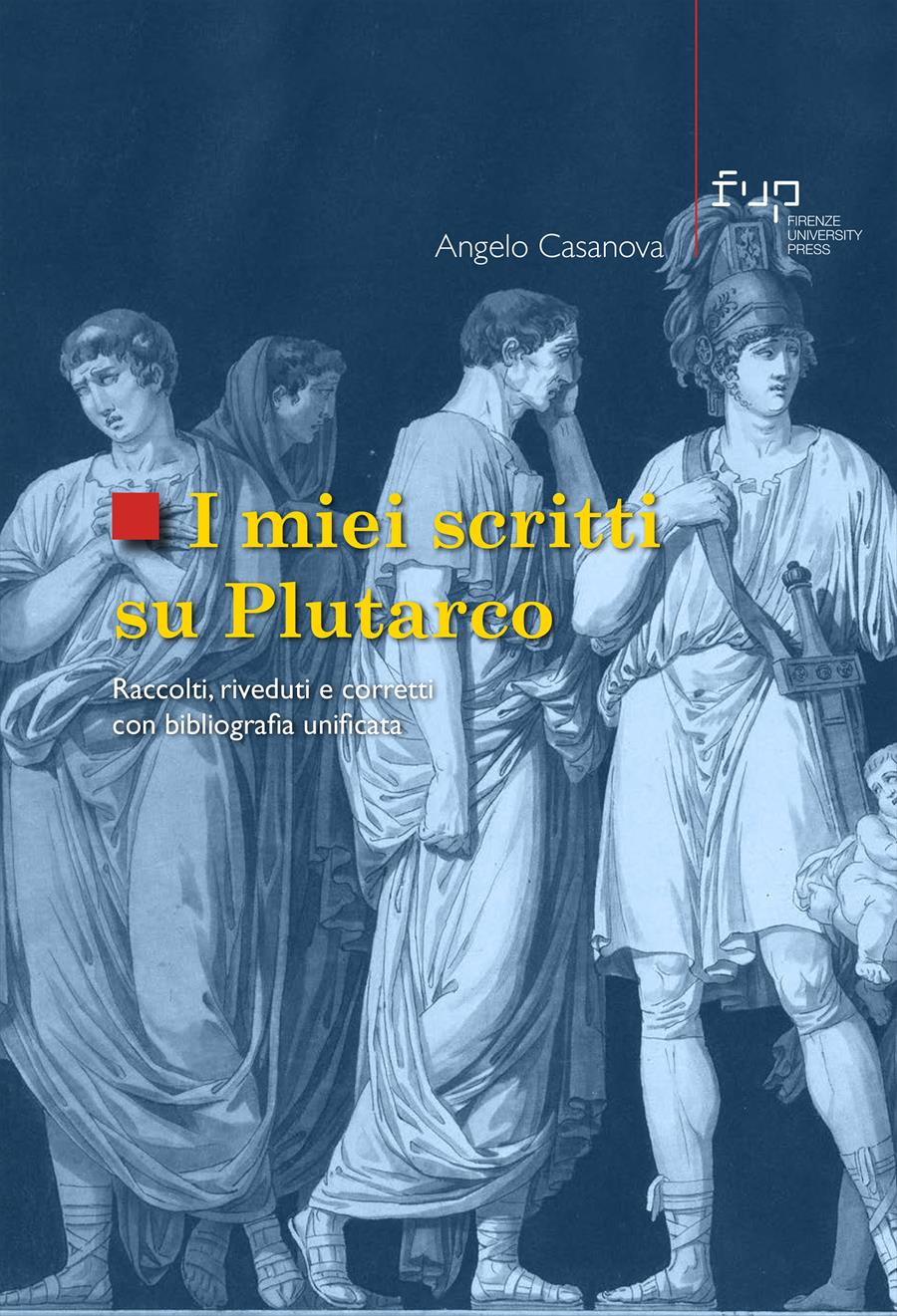
- I miei scritti su Plutarco
- Angelo Casanova
Menander in Plutarch: A Conjecture for Eros (fr. 791 K.-A.)
- Angelo Casanova

- © 2025 Author(s) |
- CC BY 4.0
- DOI: 10.36253/979-12-215-0824-6.11
Written in English because dedicated to Frederick E. Brenk, S.J., the paper once again addresses the textual problem of fr. 134 S. (from the lost work Perì Érotos, On Love), where Plutarch quotes a long fragment of Menander. The poet studies the ways of falling in love. The text is difficult and the last line is corrupt. The end of the fragment is also quoted in the dialogue Amatorius, but similarly corrupt. To solve the problem, a new textual conjecture is proposed.
- Keywords:
- Plutarch,
- Amatorius,
- fr. 134,
- love,
- Eros vs Aphrodite,
University of Florence, Italy
Chapter Information
Chapter Title
Menander in Plutarch: A Conjecture for Eros (fr. 791 K.-A.)
Authors
Angelo Casanova
Language
English
DOI
10.36253/979-12-215-0824-6.11
Peer Reviewed
Publication Year
2025
Copyright Information
© 2025 Author(s)
Content License
Metadata License
Bibliographic Information
Book Title
I miei scritti su Plutarco
Book Subtitle
Raccolti, riveduti e corretti con bibliografia unificata
Authors
Angelo Casanova
Peer Reviewed
Number of Pages
366
Publication Year
2025
Copyright Information
© 2025 Author(s)
Content License
Metadata License
Publisher Name
Firenze University Press
DOI
10.36253/979-12-215-0824-6
ISBN Print
979-12-215-0823-9
eISBN (pdf)
979-12-215-0824-6
eISBN (xml)
979-12-215-0825-3
Series Title
Studi e saggi
Series ISSN
2704-6478
Series E-ISSN
2704-5919