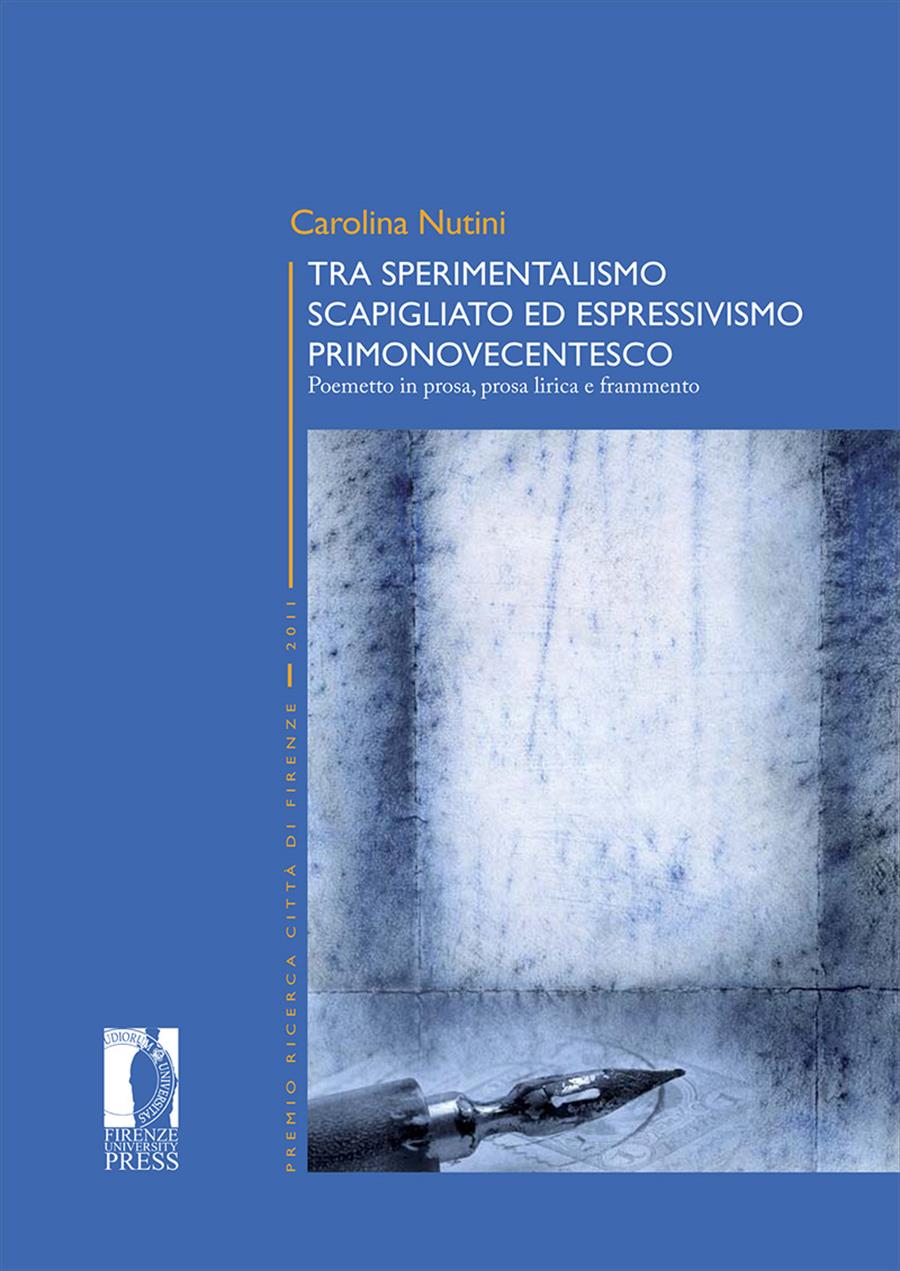
Tra sperimentalismo scapigliato ed espressivismo primonovecentesco poemetto in prosa, prosa lirica e frammento
- Carolina Nutini,
The book sets out to reconstruct why and how poetry and prose came to meet and mix in Italy between the second half of the nineteenth century and the beginning of the twentieth century; contrary to what has taken place in France for the petit poème en prose, there has been no overall mapping of the Italian sphere to give refreshed sense to single phenomena. The author begins to fill this gap by looking at three areas of research: the Scapigliatura movement, the experimentations of the last two decades of the nineteenth century (from Ragusa Moleti to Pica, Deledda to Capuana), and «La Voce» 1908-1913. Two works are constantly used as inevitable points of reference: Operette morali by Leopardi and Petits poèmes en prose by Baudelaire.
- DOI: 10.36253/978-88-6655-272-7
- Series: Premio Ricerca «Città di Firenze»
- Scientific Board
- Language: Italian
- Subjects: Linguistic
- Download PDF
-

- © 2012 Author(s)
- CC BY-NC-ND 3.0 IT
- Publication Year: 2012
- Pages: 562
- eISBN: 978-88-6655-272-7
- Content License: CC BY-NC-ND 3.0 IT
- © 2012 Author(s)
- Publication Year: 2012
- eISBN: 978-88-9273-578-1
- Content License: CC BY-NC-ND 3.0 IT
- © 2012 Author(s)
Bibliographic Information
Book Title
Tra sperimentalismo scapigliato ed espressivismo primonovecentesco poemetto in prosa, prosa lirica e frammento
Authors
Carolina Nutini
Peer Reviewed
Publication Year
2012
Copyright Information
© 2012 Author(s)
Content License
Metadata License
Publisher Name
Firenze University Press
DOI
10.36253/978-88-6655-272-7
eISBN (pdf)
978-88-6655-272-7
eISBN (xml)
978-88-9273-578-1
Series Title
Premio Ricerca «Città di Firenze»
Series ISSN
2705-0289
Series E-ISSN
2705-0297
News and Events
Fulltext
downloads
Views
Export Citation
Suggested Books