
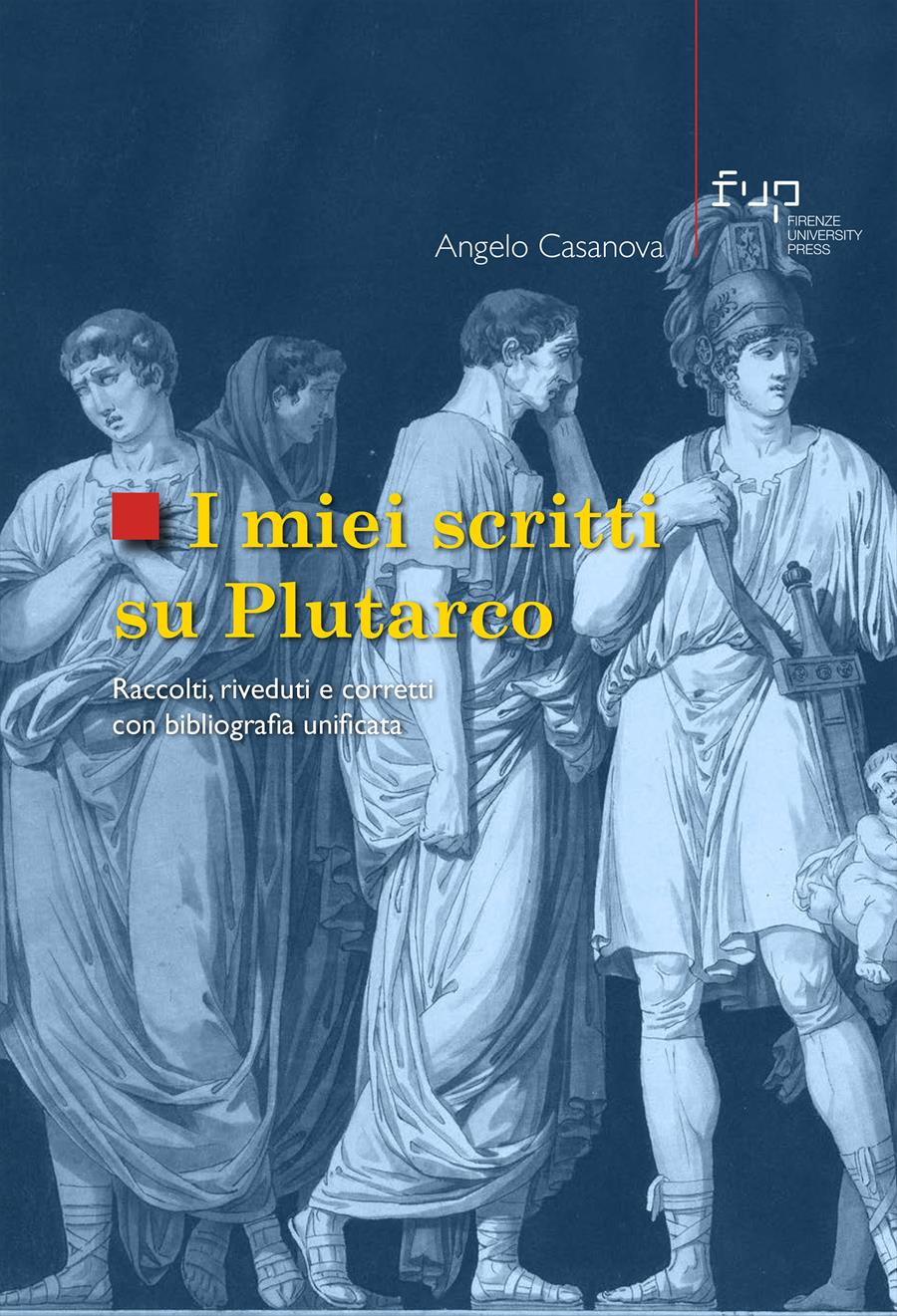
- I miei scritti su Plutarco
- Angelo Casanova
Menandro maestro d’amore nell’opera di Plutarco
- Angelo Casanova

- © 2025 Author(s) |
- CC BY 4.0
- DOI: 10.36253/979-12-215-0824-6.08
In QC 3.6, criticizing Epicurus’ opinion on love, Plutarch quotes Menander as a great expert on love affairs. In particular, he quotes the beginning lines of the Misoumenos (also mentioned in his Life of Sulla). Besides, in fr. 134 S., he describes him as a specialist and a scientist of Eros: to prove his assertion, he quotes a long passage of an unknown comedy, in which the poet explains the causes of falling in love. The text is difficult and a line is corrupt: this paper aims to determine its correct interpretation, with the support of Am. 763B (where the the last lines are quoted). Furher important quotations of Menander occur in the De audiendis poetis.
- Keywords:
- Love in Plutarch,
- Epicurus,
- Menander,
- Eros the god,
University of Florence, Italy
Chapter Information
Chapter Title
Menandro maestro d’amore nell’opera di Plutarco
Authors
Angelo Casanova
Language
Italian
DOI
10.36253/979-12-215-0824-6.08
Peer Reviewed
Publication Year
2025
Copyright Information
© 2025 Author(s)
Content License
Metadata License
Bibliographic Information
Book Title
I miei scritti su Plutarco
Book Subtitle
Raccolti, riveduti e corretti con bibliografia unificata
Authors
Angelo Casanova
Peer Reviewed
Number of Pages
366
Publication Year
2025
Copyright Information
© 2025 Author(s)
Content License
Metadata License
Publisher Name
Firenze University Press
DOI
10.36253/979-12-215-0824-6
ISBN Print
979-12-215-0823-9
eISBN (pdf)
979-12-215-0824-6
eISBN (xml)
979-12-215-0825-3
Series Title
Studi e saggi
Series ISSN
2704-6478
Series E-ISSN
2704-5919