
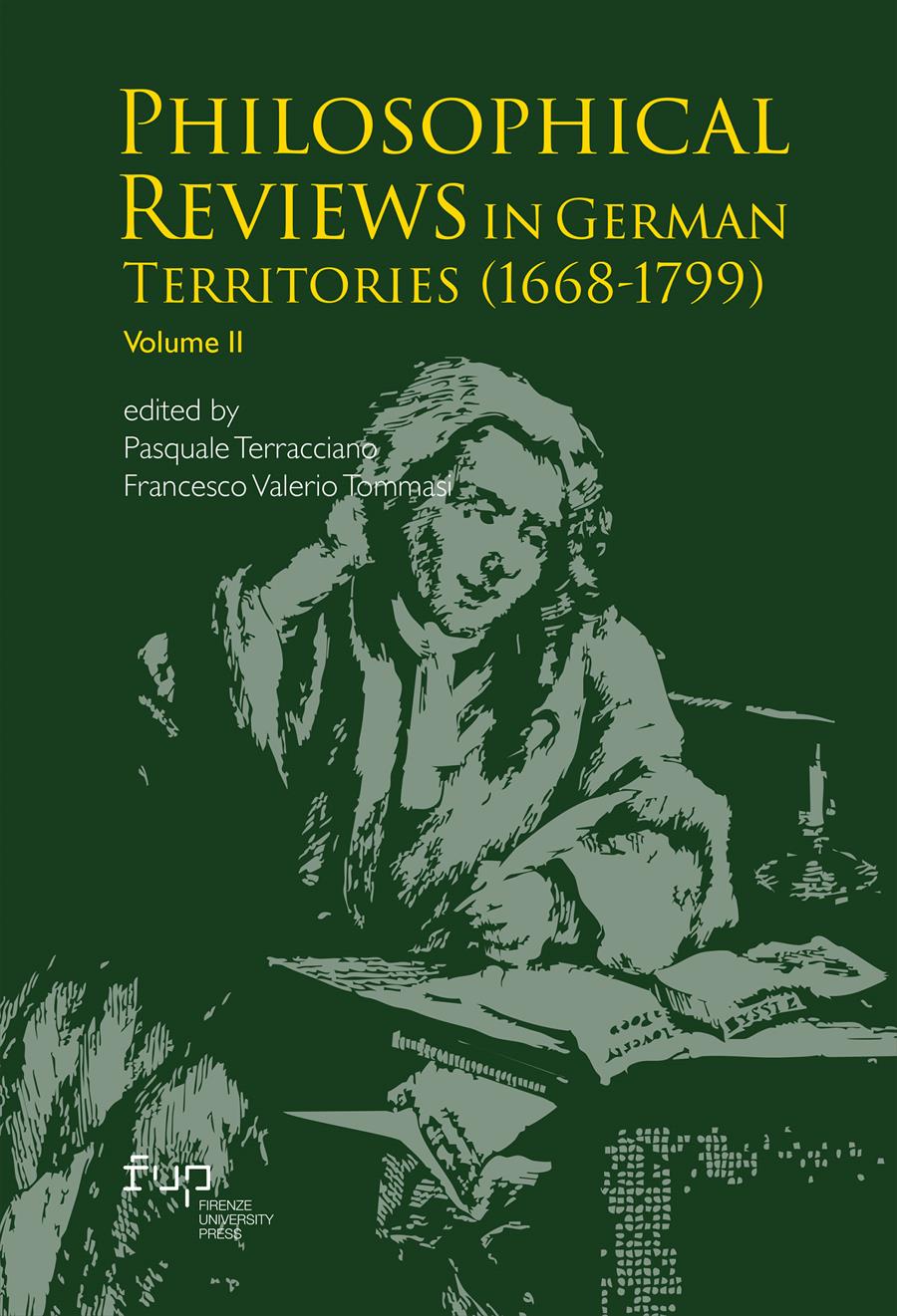
- Philosophical Reviews in German Territories (1668-1799)
- A cura di Pasquale Terracciano, Francesco Valerio Tommasi
Leibniz and the Function of Book Reviews
- Lucia Oliveri

- © 2026 Author(s) |
- CC BY 4.0
- DOI: 10.36253/979-12-215-0999-1.03
Leibniz viewed reviews as charitable acts by savants who dedicate part of their time to advancing science and returning it to society. This activity must be disinterested and scientifically honest insofar as it does not bring honor and recognition to the savant. Leibniz was an active reviewer of books for major journals of the time. Does his activity reflect what he says about savants? Through an analysis of a paradigmatic case – his review of John Locke’s An Essay Concerning Human Understanding – I argue that, in this case at least, Leibniz used reviews as a scientific tool to instill prejudices in his scientific peers. By «prejudices», I do not mean false judgments about a book but rather precognitions that one must have to critically assess a book's content, which may incline readers to reject the author's arguments.
- Keywords:
- Leibniz,
- Locke,
- Review,
- Innate Ideas,
- Substance,
- Matter,
University of Münster, Germany - ORCID: 0000-0001-8022-4538
- A = Leibniz, G. W. 1923–2021. Sämtliche Schriften und Briefe. Berlin: Akademie Verlag/DeGruyter.
- AT = Descartes, René. 1964–1978. Oeuvres de Descartes, édité par C. Adam, et P. Tannery. Paris: Vrin.
- Barth, Christian. 2011. “Apperception in the New Essays Concerning Human Understanding. A Critique of the Reflective Account.” In Natur und Subjekt. ix. Internationaler Leibniz-Kongress, hrsg. von Herbert Breger et al., 37–43. Berlin: Akademie Verlag.
- Beiderbeck, Friedrich, and Claire Gantet, edited by. 2021. Wissenskulturen in der Leibniz-Zeit: Konzepte – Praktiken – Vermittlung. Berlin-Boston: De Gruyter. DOI: 10.1515/9783110730593
- Boeker, Ruth. 2021. Locke on Persons and Personal Identity. Oxford: Oxford University Press. DOI: 10.1093/oso/9780198846758.003.0001
- Bolton, Martha B. 2015. “Locke on Thinking Matter.” In A Companion to Locke, edited by Mattew Stuart, 334–53. Chichester (UK): Wiley-Blackwell. DOI: 10.1002/9781118328705.ch17
- CSM = Descartes, René. 1984–1991. The Philosophical Writings of Descartes, transleted by J. Cottingham, R. Stoothoff, D. Murdoch, and A. Kenny, 3 vols. Cambridge: Cambridge University Press.
- Dascal, Marcelo. 2006. Gottfried Wilhelm Leibniz. The Art of Controversies. Berlin-Amsterdam: Springer Nature. DOI: 10.1007/1-4020-5228-6
- De Rosa, Raffaella. 2002. Innate Ideas and Intentionality Descartes Vs Locke. Dissertation. New Brunswick: Rutgers University.
- De Rosa, Raffaella. 2015. “Locke’s Critique of Innatism.” In A Companion to Locke, edited by Matthew Stuart, 157–74. Chichester (UK): Wiley-Blackwell. DOI: 10.1002/9781118328705.ch8
- Essay = Locke, John. 17004. An Essay Corning Human Understanding. London: s.n.
- Gantet, Claire. 2021a. “Leibniz und die gelehrten Journale.” In Wissenskulturen in der Leibniz-Zeit: Konzepte – Praktiken – Vermittlung, hrsg. von Friedrich Beiderbeck, und Claire Gantet, 253–88. Berlin-Boston: De Gruyter. DOI: 10.1515/9783110730593
- Gantet, Claire. 2021b. “Leibniz’ Journalartikel – eine Übersicht.” In Wissenskulturen in der Leibniz-Zeit: Konzepte – Praktiken – Vermittlung, hrsg. von Friedrich Beiderbeck, und Claire Gantet, 289–322. Berlin-Boston: De Gruyter. DOI: 10.1515/9783110730593
- Giampietri, Francesco, a cura di. 2012. Leibniz allo specchio. Dissimulazioni erudite. Milano: Mimesis.
- Jorgensen, Larry M. 2009. “The principle of continuity and Leibniz’s theory of consciousness.” Journal of the History of Philosophy 47, 2: 223–48. DOI: 10.1353/hph.0.0112
- Locke, John. 1688. “Extrait d’un livre anglais qui n’est pas encore publié, intitulé : Essay philosophique concernant l’entendement humain.” Bibliothèque universelle et historique 8: 49–142.
- Locke, John. 1975. An Essay Concerning Human Understanding, edited by Peter H. Nidditch, London: Clerendon.
- Lodge, Paul, and Tom Stoneham, edited by. 2015. Locke and Leibniz on Substance. New York: Routledge. DOI: 10.4324/9781315762418
- McRae, Robert. 1976. Leibniz: Perception, Apperception, and Thought. Toronto: University of Toronto Press. DOI: 10.3138/9781487579777
- Oliveri, Lucia. 2016. “Imagination and Harmony in Leibniz’s Philosophy of Language.” Diss. University of Münster. <https://nbn-resolving.de/urn:nbn:de:hbz:6-05169689910>.
- Oliveri, Lucia. 2019. “The Leibniz-Treuer Correspondence. With text and English translation of excerpts from Treuer’s De mente sensu non errante and Correspondence with Leibniz.” The Leibniz Review 29: 83–104. DOI: 10.5840/leibniz2019298
- Oliveri, Lucia. 2021. Imaginative Animals. Leibniz’s Logic of Imagination. Stuttgart: Steiner Verlag. DOI: 10.25162/9783515130516
- Oliveri, Lucia. 2021a. “Conceivability Errors and the Role of Imagination in Symbolization.” Jolma the Journal for the Philosophy of Language, Mind and the Arts 2, 2: 293–310. DOI: 10.30687/Jolma/2723-9640/2021/02/002
- Oliveri, Lucia. 2024. “Perception and Thought. Leibniz’s Criticism of Descartes’s Denial of Perception to Animals.” Giornale di Metafisica 2: 536–50.
- Pelletier, Arnaud. 2017. “Attention et aperception selon Leibniz : aspects cognitifs et éthiques.” Les Études philosophiques 120, 1: 103–18. DOI: 10.3917/leph.171.0103
- Pollok, Konstantin. 2004. Locke In Germany: Early German Translations of John Locke, 1709–61. Bristol: Thoemmes Continuum.
- Priarolo, Mariangela. 2016. “The Consequences of Error. Leibniz and Toleration.” Rivista di storia della filosofia 71, 4: 745–64. DOI: 10.3280/SF2016-004012
- Tabb, Kathryn. 2019. “Locke on Enthusiasm and the Association of Ideas.” In Oxford Studies in Early Modern Philosophy, vol. IX, edited by Ronald Rutherford, 75–104. Oxford: Oxford University Press. DOI: 10.1093/oso/9780198852452.003.0003
- Thiel, Udo. 2011. The early Modern Subject. Self Conscsiousness and personal identity from Descartes to Hume. Oxford-New York: Oxford University Press.
Informazioni sul capitolo
Titolo del capitolo
Leibniz and the Function of Book Reviews
Autori
Lucia Oliveri
Lingua
Inglese
DOI
10.36253/979-12-215-0999-1.03
Opera sottoposta a peer review
Anno di pubblicazione
2026
Copyright
© 2026 Author(s)
Licenza d'uso
Licenza dei metadati
Informazioni bibliografiche
Titolo del libro
Philosophical Reviews in German Territories (1668-1799)
Sottotitolo del libro
Volume 2
Curatori
Pasquale Terracciano, Francesco Valerio Tommasi
Opera sottoposta a peer review
Numero di pagine
282
Anno di pubblicazione
2026
Copyright
© 2026 Author(s)
Licenza d'uso
Licenza dei metadati
Editore
Firenze University Press
DOI
10.36253/979-12-215-0999-1
ISBN Print
979-12-215-0998-4
eISBN (pdf)
979-12-215-0999-1
eISBN (epub)
979-12-215-1060-7
Collana
Knowledge and its Histories
ISSN della collana
3035-5974
e-ISSN della collana
3035-5923