
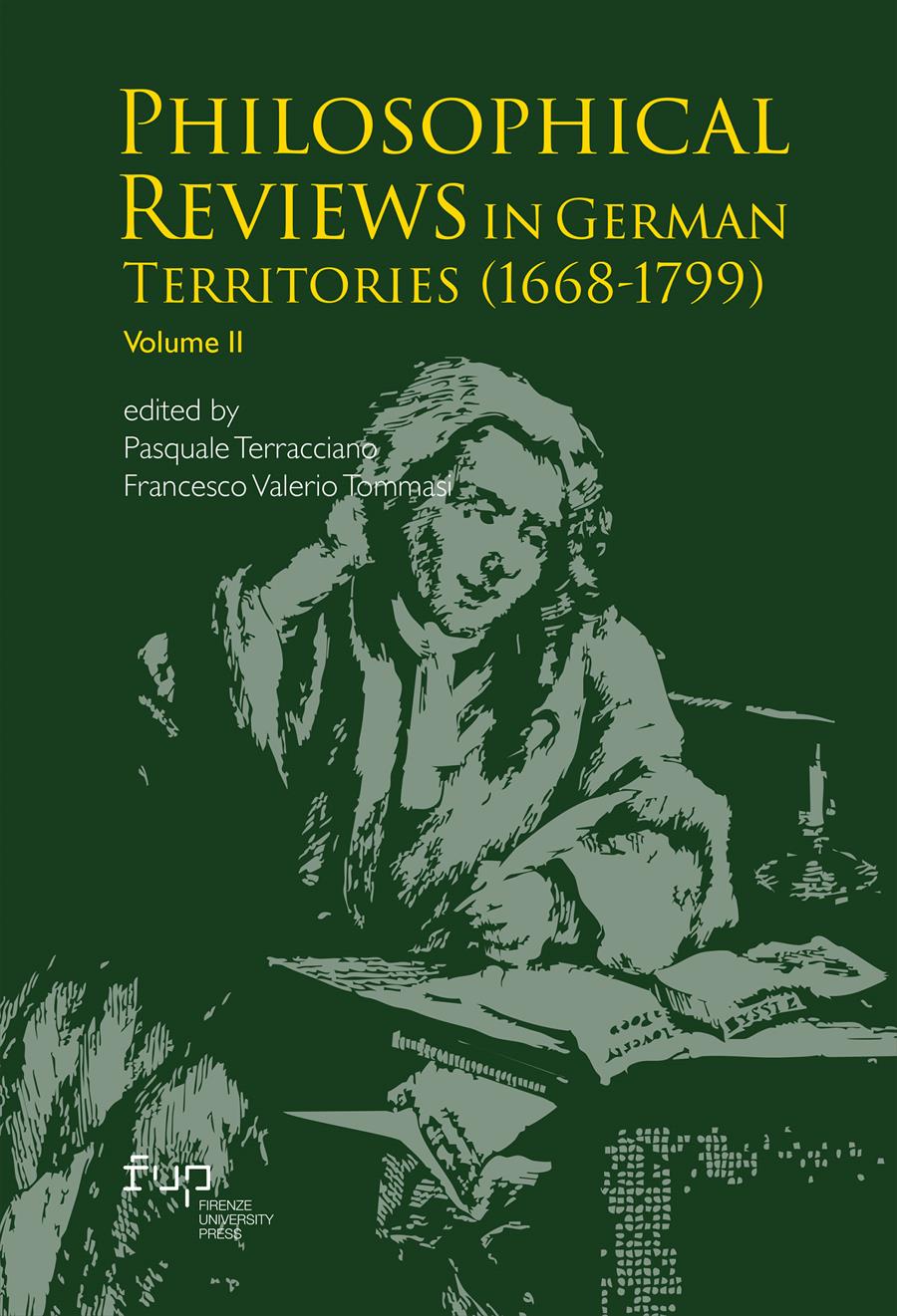
- Philosophical Reviews in German Territories (1668-1799)
- Edited by Pasquale Terracciano, Francesco Valerio Tommasi
Democratic Thresholds. Freedom, Trade and Politics in Fichte’s Closed Commercial State, through its critics
- Silvestre Gristina

- © 2026 Author(s) |
- CC BY 4.0
- DOI: 10.36253/979-12-215-0999-1.14
This article examines Johann Gottlieb Fichte’s Closed Commercial State (1800) through the lens of its critical reviews, showing how these functioned less as neutral scholarly judgments than as polemical interventions within a political battlefield. Indeed, the work – redefining property as a right to productive activity and proposing economic closure as the basis for distributive justice – sparked intense debate between 1800 and 1803. In conclusion, is it shown that these many divergent voices illustrate how the Closed Commercial State became a conceptual battlefield where competing visions of democracy and political economy at the dawn of modernity were negotiated and contested.
- Keywords:
- Johann Gottlieb Fichte,
- Closed Commercial State,
- Reviews,
- Trade,
- Politics,
University of Padua, Italy - ORCID: 0009-0005-5814-7034
- Anonymous. 1801a/1995. “Der geschlossene Handelsstaat.” In J. G. Fichte in zeitgenössischen Rezensionen. Band 3: Nr. 94–138, hrsg. von Erich Fuchs, Wilhelm G. Jacobs, und Walter Schieche, 181–84. Stuttgart-Bad Cannstatt: Frommann-Holzboog.
- Anonymous. 1801b/1995. “Neue Theorie des Eigenthums.” In Der geschlossenme Handelstaat.” In J. G. Fichte in zeitgenössischen Rezensionen. Band 3: Nr. 94–138, hrsg. von Erich Fuchs, Wilhelm G. Jacobs, und Walter Schieche, 211–14. StuttgartBad Cannstatt: FrommannHolzboog.
- Anonymous. 1801c/1995. “Der geschloßne Handelsstaat.” In J. G. Fichte in zeitgenössischen Rezensionen. Band 3: Nr. 94–138, hrsg. von Erich Fuchs, Wilhelm G. Jacobs, und Walter Schieche, 219–38. StuttgartBad Cannstatt: FrommannHolzboog.
- Anonymous. 1801d/1995. “Der geschlossene Handelsstaat.” In J. G. Fichte in zeitgenössischen Rezensionen. Band 3: Nr. 94–138, hrsg. von Erich Fuchs, Wilhelm G. Jacobs, und Walter Schieche, 238–41. StuttgartBad Cannstatt: FrommannHolzboog.
- Anonymous. 1801e/1995. “Der geschloßne Handelsstaat.” In J. G. Fichte in zeitgenössischen Rezensionen. Band 3: Nr. 94–138, hrsg. von Erich Fuchs, Wilhelm G. Jacobs, und Walter Schieche, 241–48. StuttgartBad Cannstatt: FrommannHolzboog.
- Anonymous. 1802/1995. “Der geschlossene Handelsstaat.” In J. G. Fichte in zeitgenössischen Rezensionen. Band 3: Nr. 94–138, hrsg. von Erich Fuchs, Wilhelm G. Jacobs, und Walter Schieche, 261–79. StuttgartBad Cannstatt: FrommannHolzboog.
- Anonymous. 1803/1995. “Der geschlossene Handelsstaat.” In J. G. Fichte in zeitgenössischen Rezensionen. Band 3: Nr. 94–138, hrsg. von Erich Fuchs, Wilhelm G. Jacobs, und Walter Schieche, 279–90. StuttgartBad Cannstatt: FrommannHolzboog
- Fichte, Johann Gottlieb. 2012. The Closed Commercial State, edited by Anthony Curtis Adler. Albany: SUNY.
- Hagens, Caspar von. 1804. Philosophische und politische Untersuchung über die Rechtmäßigkeitder Zünfte und Polizeitaxen und ihre Wirkungen auf die bürgerliche Gesellschaft mitbesonderer Hinsicht auf Fichte’s geschlossenen Handelsstaat. München: Scheresche Buchhandlung.
- Hestermann, Ludwig. 1802. Der offene Handelsstaat. Ein Philosophischer Entwurf. Leipzig-Pforzheim: Müller.
- Kant, Immanuel. 1796. Den Evige Fred. Et philosophiskt udkast af Immanuel Kant, hrsg. von Malthe Christian Møller. Kiöbenhavn: J.H. Schubothes Forlag.
- Møller, Malthe Christian. 1800/1995. “Ueber den ewigen Frieden.” In J. G. Fichte in zeitgenössischen Rezensionen. Band 3: Nr. 94–138, hrsg. von Erich Fuchs, Wilhelm G. Jacobs, und Walter Schieche, 175–81. StuttgartBad Cannstatt: FrommannHolzboog.
- Müller, Adam Heinrich. 1801/1995. “Ueber einen philosophischen Entwurf von Hrn. Fichteœ; betitelt: ‘Der geschloßne Handelsstaat’.” In J. G. Fichte in zeitgenössischen Rezensionen. Band 3: Nr. 94–138, hrsg. von Erich Fuchs, Wilhelm G. Jacobs, und Walter Schieche, 248–60. StuttgartBad Cannstatt: FrommannHolzboog.
- Nicolai, Christoph Friedrich. 1801/1995. Der geschlossene Handelsstaat.” In J. G. Fichte in zeitgenössischen Rezensionen. Band 3: Nr. 94–138, hrsg. von Erich Fuchs, Wilhelm G. Jacobs, und Walter Schieche, 185–211. StuttgartBad Cannstatt: FrommannHolzboog.
- Rehberg, August Wilhelm. 1801/1995. “Der geschlossene Handels-Staat.” In J. G. Fichte in zeitgenössischen Rezensionen. Band 3: Nr. 94–138, hrsg. von Erich Fuchs, Wilhelm G. Jacobs, und Walter Schieche, 214–18. StuttgartBad Cannstatt: FrommannHolzboog.
- Acosta, Emiliano. 2019. “Nature and Perpetual Peace in Kant and Fichte’s Cosmopolitanism.” Anuario Filosófico 52, 1: 87–111.
- Adler, Anthony Curtis. 2012. “Interpretive Essay: Fichte’s Monetary History.” In Johann Gottlieb Fichte, The Closed Commercial State, edited by Anthony Curtis Adler, 1–71. Albany: SUNY.
- Adler, Anthony Curtis. 2012. “Translator’s Introduction.” In Johann Gottlieb Fichte, The Closed Commercial State, edited by Anthony Curtis Adler, XIII–XX. Albany: SUNY.
- Arrese Igor, Hector Oscar. 2018. “Sense and Limits of the Fichtean Project of a Closed Commercial State.” Tópicos 54, 7: 215–36.
- Blumenfeld, Jacob. 2023. The Concept of Property in Kant, Fichte, and Hegel: Freedom, Right, and Recognition. New York: Routledge.
- Cesa, Claudio. 1968. “Noterelle sul pensiero politico di Fichte.” Rivista Critica di Storia della Filosofia 23, 1: 61–80.
- Duichin, Marco. 2017. “Alla pace del cimitero: la recezione settecentesca di ‘Zum ewigen Frieden’ e le fonti nascoste di un topos kantiano.” Diciottesimo Secolo 2, 1: 45–75.
- Duso, Giuseppe. 1999. “Rivoluzione e costituzione del potere.” In Il Potere. Per la storia della filosofia politica moderna, a cura di Giuseppe Duso, 203–11. Roma: Carocci.
- Duso, Giuseppe. 2008. “Fichte e la filosofia politica in una prospettiva storico-concettuale.” In Fichte et la politique, édité par JeanChristophe Goddard, et Jacinto Rivera de Rosales, 27–48. Monza: Polimetrica.
- Esdaile, Charles. 2001. The French Wars 1792–1815. London-New York: Routledge.
- Fleischacker, Samuel. 2004. A Short History of Distributive Justice. Cambridge, MA: Harvard University Press.
- Forsyth, Murray. 1980. “The Old European StatesSystem: Gentz vs. Hauterive.” Historical Journal 23, 3: 521–38.
- Fremont-Barnes, Gregory. 2001. The French Revolutionary Wars. New York: Routledge.
- Fuchs, Erich, Wilhelm G. Jacobs, und Walter Schieche, hrsg. von. 1995. J. G. Fichte in zeitgenössischen Rezensionen. Band 3: Nr. 94–138. StuttgartBad Cannstatt: FrommannHolzboog.
- Gambaro, Giacomo. 2020. Filosofia trascendentale e orizzonte pratico nell’ultimo Fichte. Padova: Cleup.
- Gambaro, Giacomo. 2022. “Una politica del trascendentale. Le lezioni di filosofia applicata del 1813 di J. G. Fichte Fichte.” In Congetture politiche. Scritti in onore di Maurizio Merlo, a cura di Giulia Angelini et al., 191–214. Padua: Padova University Press.
- Gentz, Friedrich von. 1984. “Über den ewigen Frieden.” In Immanuel Kant, Zum ewigen Frieden: Ein philosophischer Entwurf: Texte zur Rezeption, 1796–1800, hrsg. von Manfred Buhr, und Steffen Dietzsch, 250–91. Leipzig: Reclam.
- Gristina, Silvestre. 2024. Trascendentale e praxis. L’eredità di Fichte nei giovani hegeliani. Milano: Mimesis.
- Gristina, Silvestre. 2025a. “Staat.” In Johann Gottlieb Fichte. Leben–Werk–Wirkung, hrsg. von Matteo Vincenzo d’Alfonso, und Christian Klotz, 827–31. BadenBaden: Nomos Verlag.
- Gristina, Silvestre. 2025b. “‘Alle Philosophie ist verdächtig. Es lebe die Philosophie!’ On K. F. Köppen’s Revolutionary Fichte.” Fichte-Studien 54, 2: 423–56.
- Gristina, Silvestre. Forthcoming. “On Revolution. Friedrich von Gentz’s Review of Fichte’s Beitrag.” In Philosophical Reviews in German Territories (1668-1799), vol. III, edited by Laura Anna Macor. Florence: Firenze University Press.
- Hahn, Karl. 1994. “Fichtes und Proudhons Begriff des Eigentums als Recht auf Arbeit.” In Das geistige Erbe Europas, hrsg. von Manfred Buhr, 548–57. Napoli: Vivarium.
- Heisenberg, Thimo. 2025. “The Use of History in Fichte’s Closed Commercial State.” Fichte-Studien 54, 2: 457–73.
- Hoffmann, Thomas Sören, hrsg. von. 2018. Fichtes “Geschlossener Handelsstaat”: Beiträge zur Erschließung eines Anti-Klassikers. Berlin: Duncker & Humblot.
- Hoffmann, Thomas Sören. 2025. “Der geschloßene Handelsstaat. Ein philosophischer Entwurf als Anhang zur Rechtslehre und Probe einer künftigzu liefernden Politik (1800).” In Johann Gottlieb Fichte. Leben–Werk–Wirkung, hrsg. von Matteo Vincenzo d’Alfonso, und Christian Klotz, 259–71. BadenBaden: Nomos Verlag.
- James, David. 2010. “Fichte’s Theory of Property.” European Journal of Political Theory 9, 2: 202–17.
- James, David. 2011. Fichte’s Social and Political Philosophy: Property and Virtue. Cambridge: Cambridge University Press.
- James, David. 2012. “Conceptual Innovation in Fichte’s Theory of Property: The Genesis of Leisure as an Object of Distributive Justice.” European Journal of Philosophy 23, 3: 509–28.
- James, David. 2023. “Fichte on Property and Labour.” In David James, Property and Its Forms in Classical German Philosophy, 48–88. Cambridge: Cambridge University Press.
- Lauth, Reinhard, Gliwitzky, Hans. 1988. “Vorwort.” In J. G. Fichte — Gesamtausgabe der bayerischen Akademie der Wissenschaften. Band I, 7, hrsg. von Reinhard Lauth, und Hans Gliwitzky, 3–44. Stuttgart-Bad Cannstatt: Frommann-Holzboog.
- Léon, Xavier. 1914. “Le socialisme de Fichte d’après l’État Commercial Fermé.” Revue de Métaphysique et de Morale 22, 1: 27–71.
- Marquardt, Jochen. 1991. “Der geschloßne Handelsstaat Zur konservativen Kritik einer aufklärerischen Utopie. Adam Müllers Replik auf Fichte.” Deutsche Zeitschrift für Philosophie 39, 3: 294–303.
- Nakhimovsky, Isaac. 2011. The Closed Commercial State: Perpetual Peace and Commercial Society from Rousseau to Fichte. Princeton (NJ): Princeton University Press.
- Nance, Michael. 2019. “Property and Economic Planning in Fichte’s Contractualism.” European Journal of Philosophy 27, 3: 643–60.
- Nance, Michael. 2024. “Money in Fichte’s The Closed Commercial State.” In The Palgrave Handbook of Philosophy and Money. vol. II: Modern Thought, edited by Joseph J. Tinguely, 253–73. Cham: Springer Verlag.
- Neuhann, Esther. 2024. “Fichte’s global material constitution.” European Journal of Political Theory 0. DOI: 10.1177/14748851241297093
- Nomer, Nedim. 2005. “Fichte and the Idea of Liberal Socialism.” Journal of Political Philosophy 13, 1: 53–75.
- Nomer, Nedim. 2019. “Fichte on Property Rights and Coercion.” In The Palgrave Fichte Handbook, edited by Steven Hoeltzel, 309–28. Cham: Palgrave Macmillan.
- Perrinjaquet, Alain. 1997. “Fichte, Proudhon et la propriété.” In Fichte et la France, édité par Ives Radrizzani, 141–81. Paris: Beauchesne.
- Picardi, Roberta. 2022. “The Right to the ‘Possibility of Acquiring Rights’: Cosmopolitan Right and Migration in Fichte’s Doctrine of Right.” European Journal of Philosophy 30, 1: 113–28.
- Rametta, Gaetano. 1999. “Diritto e potere in Fichte.” In Il Potere. Per la storia della filosofia politica moderna, a cura di Giuseppe Duso, 253–74. Roma: Carrocci.
- Rametta, Gaetano. 2004. “Politica e democrazia nell’idealismo tedesco.” In Oltre la democrazia. Un itinerario attraverso classici, a cura di Giuseppe Duso, 175–208. Roma: Carocci.
- Rametta, Gaetano. 2006. “Das Problem der Souveranität in Fichtes Staatslehre.” FichteStudien 29, 1: 89–99.
- Rametta, Gaetano. 2012. Fichte. Roma: Carocci.
- Rametta, Gaetano. 2017. “Doctrine de la science et Doctrine de l’État. La dissolution de la théologie politique chez le dernier Fichte.” In Fichte: la philosophie de la maturité, tome II, édité par JeanChristophe Goddard, et Marc Maesschalck, 31–50. Toulouse: EuroPhilosophie.
- Rampazzo Bazzan, Marco. 2006. “Das Ephorat bei J.G. Fichte.” Fichte-Studien 27, 1: 117–33.
- Rampazzo Bazzan, Marco. 2017. Il prisma “Rousseau”. Lo sguardo di Fichte sulla politica tra Staatsrecht e Rivoluzione Francese. Milano: Guerini e Associati.
- Rapport, Mike. 2013. “The French Revolutionary Wars, 1792–802.” In Mike Rapport, The Napoleonic Wars: A Very Short Introduction, 22–38. Oxford: Oxford University Press.
- Sabbatini, Carlo. 2018. “Appunti sulla proprietà nello Handelsstaat fichtiano: tra testo e contesto.” In La Storicità del diritto. Esistenza materiale, filosofia, ermeneutica, a cura di Adriano Ballarini, 203–51. Torino: Giappichelli.
- Sabbatini, Carlo. 2020. “Saggio introduttivo.” In Johann Gottlieb Fichte, Lo stato commerciale chiuso. Un progetto filosofico come appendice alla Dottrina del diritto e come saggio di una politica di prossima pubblicazione, a cura di Carlo Sabbatini, 9–72. Montella: Accaxemia Vivarium Novum.
- Sabbatini, Carlo, Spalletti, Stefano. 2020. “Early anti-global thought: economics and philosophy of law in J. G. Fichte’s Der geschloßne Handelsstaat”. History of Economic Ideas 28, 1: 11–33.
- Schneid, Frederick C., edited by. 2007. Warfare in Europe 1792–1815. London-New York: Routledge.
- Schroeder, Paul W. 1994. “The Second Coalition, 1798–1802.” In Paul W. Schroeder, The Transformation of European Politics 1763–1848, 177–230. Oxford: Clarendon Press.
- Spalletti, Stefano. 2017. Elementi di pensiero economico nello Stato commerciale chiuso di J. G. Fichte. University of Macerata, Department of Studies on Economic Development (DiSSE). Macerata: EUM.
- Stahl, Jürgen. 2016. “Fichtes ‘Handelsstaat’ im Kontext der Rezeption zeitgenössischen sozialökonomischen Denkens, und der Begründung bürgerlichdemokratischer Ideale.” FichteStudien 43, 1: 356–73.
- Verweyen, Hans J. 1981. “The Autonomous Subject and the State of Reason: A Systematic-Historical Investigation on Fichte’s “Closed Commercial State” of 1800.” Philosophy and History 14, 1: 58–60.
- Wood, Allen. 2004. “Kant and Fichte on Right, Welfare and Economic Redistribution.” Internationales Jahrbuch des Deutschen Idealismus – International Yearbook of German Idealism 2, 1: 77–101.
- Wood, Allen. 2016. “Right: Freedom, Property, and the State.” In Allen Wood, Fichte’s Ethical Thought, 251–90. Oxford: Oxford University Press.
Chapter Information
Chapter Title
Democratic Thresholds. Freedom, Trade and Politics in Fichte’s Closed Commercial State, through its critics
Authors
Silvestre Gristina
Language
English
DOI
10.36253/979-12-215-0999-1.14
Peer Reviewed
Publication Year
2026
Copyright Information
© 2026 Author(s)
Content License
Metadata License
Bibliographic Information
Book Title
Philosophical Reviews in German Territories (1668-1799)
Book Subtitle
Volume 2
Editors
Pasquale Terracciano, Francesco Valerio Tommasi
Peer Reviewed
Number of Pages
282
Publication Year
2026
Copyright Information
© 2026 Author(s)
Content License
Metadata License
Publisher Name
Firenze University Press
DOI
10.36253/979-12-215-0999-1
ISBN Print
979-12-215-0998-4
eISBN (pdf)
979-12-215-0999-1
eISBN (epub)
979-12-215-1060-7
Series Title
Knowledge and its Histories
Series ISSN
3035-5974
Series E-ISSN
3035-5923